


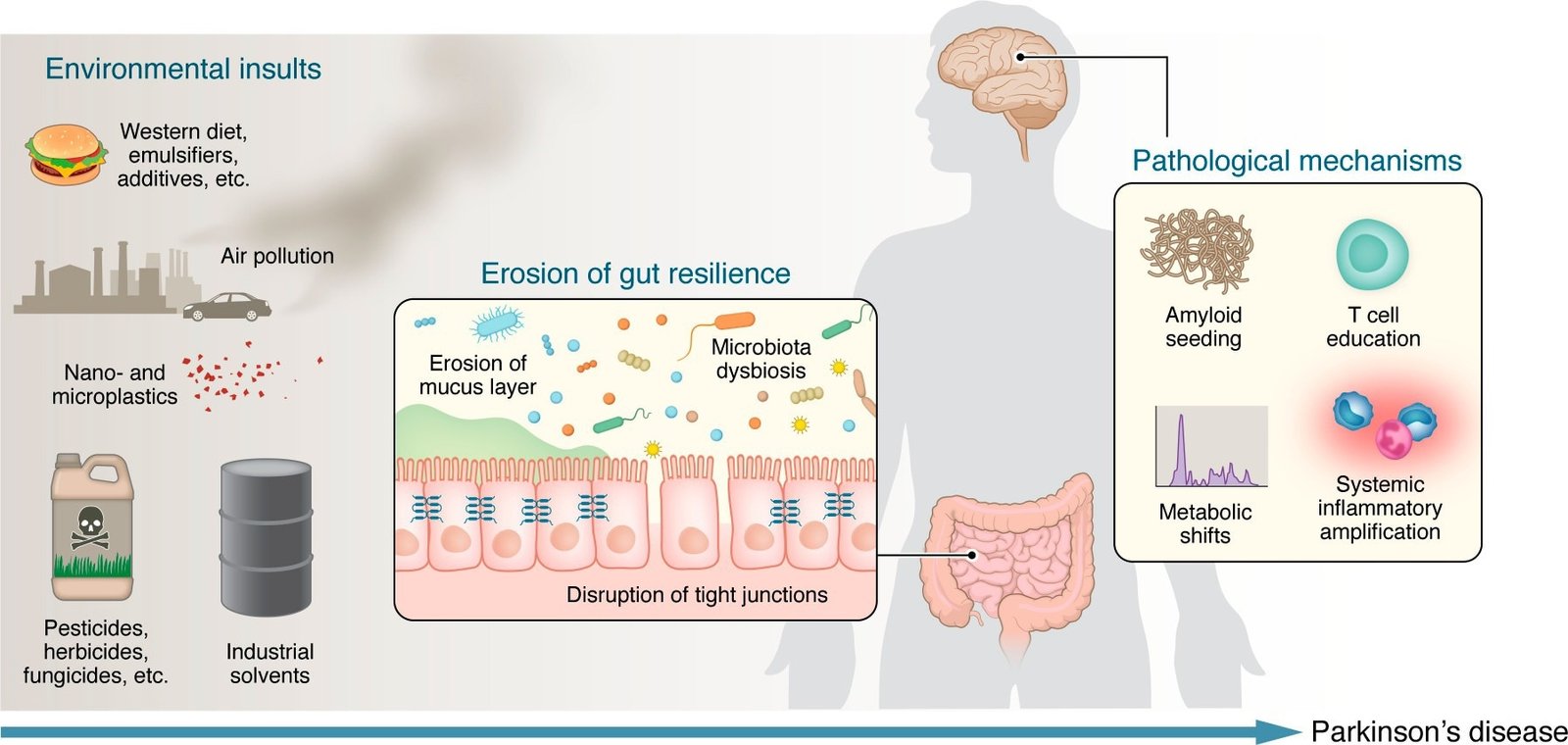
Scientists have proposed that Parkinson’s disease may begin far from the brain, where environmental toxins, microbiome disruption, and damage to the intestinal barrier interact to trigger a biological cascade that leads to neurodegeneration.
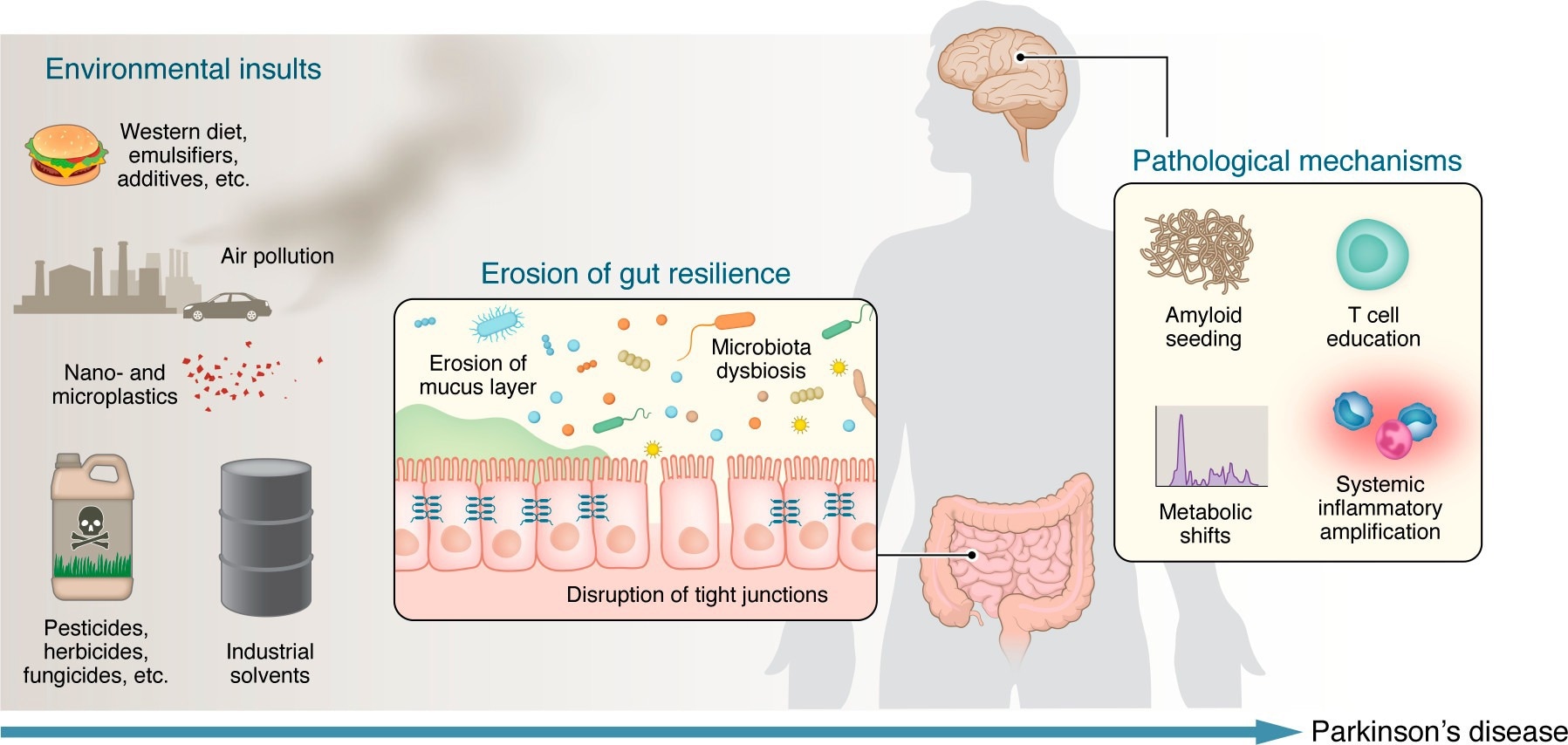
Environmental insults reduce intestinal resilience and initiate convergence mechanisms that cause Parkinson’s disease. A lifetime of environmental insults (including Western diets and food additives, nano- and microplastics, pesticides and herbicides, industrial solvents, and air pollution) affect the gut microbiome and intestinal barrier. These exposures promote microbiome imbalance, disrupt tight junctions, erode the mucus layer, and overall reduce gut resilience. When this peripheral defense is compromised, several mechanistic pathways propagate pathology to the brain: (a) amyloid dissemination by bacterial functional amyloid, (b) maladaptive T cell education and autoimmune responses, (c) metabolic changes by the microbiome that produce neurotoxic metabolites and reduce short-chain fatty acids, and (d) amplification of systemic inflammation. Together, these processes lower the threshold for α-syn misfolding, neuroinflammation, and neurodegeneration.
The recent outlook is clinical research journal suggest that PD may begin in the gut in some people due to environmental exposures or changes in the microbiome.
Increased incidence of Parkinson’s disease and early non-motor symptoms
The incidence of PD has more than doubled compared to past generations and is predicted to increase by more than 50% by 2040. This increase is beyond what can be explained by population aging, improved detection, or genetics alone. PD typically presents with progressive motor symptoms such as rigidity, rest tremor, gait disturbance, and bradykinesia. However, these symptoms appear only after the dopaminergic neurons in the substantia nigra have substantially degenerated, often after approximately half of these neurons have been lost.
Prodromal symptoms, such as anosmia, rapid eye movement sleep behavior disorder, and constipation, precede motor symptoms by 10 to 20 years. Understanding the growing burden of disease requires looking beyond the central nervous system, as pathological changes appear in the periphery long before they occur in the brain. The authors therefore propose that the brain is not the only site of early onset of PD, but that the gut may serve as an early interface where environmental exposures interact with host biology.
Environmental exposure and reduced host resilience
Exposure to the environment, including solvents (e.g., trichlorethylene), air pollution, and pesticides (e.g., rotenone, paraquat), has been implicated in the development of PD. However, individual exposure alone cannot fully explain the increased incidence of PD, suggesting that the disease may arise due to cumulative environmental pressures that reduce host resilience. The authors propose that the intestine regulates resilience through epithelial barrier integrity and microbial function and composition.
Toxins exert selective pressure, favoring taxa with traits that have deleterious effects. For example, paraquat produces reactive oxygen species (ROS), which reduce microbial diversity and increase the Enterobacteriaceae family, which produces a functional amyloid called Kali. Similarly, trichlorethylene inhibits mitochondrial complex I, reshaping the microbiota to favor sulfate-reducing bacteria (e.g., Desulfovibrio) over neuroprotective taxa that produce short-chain fatty acids.
Several environmental factors can also disrupt the intestinal barrier. Dietary emulsifiers such as polysorbate 80 and carboxymethylcellulose erode the mucin layer and weaken the barrier. Additionally, ingested microplastics and particulate matter (PM2.5) impair barrier function and cause inflammation. These particles also concentrate pesticides and heavy metals on their surfaces and facilitate the transport of environmental toxins across the intestinal barrier.
Changes in gut microbiota and mechanisms of neurodegeneration
Enterobacteriaceae contribute to α-synuclein pathology by producing curli subunits (CsgB and CsgA). These amyloids are structurally similar to α-synuclein. Curli can promote the accumulation of α-synuclein, which is also a pathogen-associated molecular pattern that stimulates inflammation. This dual role makes Kali an important link between environmental exposures and neurodegeneration. Furthermore, dysbiosis directs the metabolism of various neurotoxic pathways.
The kynurenine switch upregulates indoleamine 2,3-dioxygenase, diverting tryptophan metabolism from serotonin synthesis to kynurenine-derived neurotoxins. On the other hand, sulfate-reducing bacteria produce excess hydrogen sulfide, which inhibits mitochondrial cytochrome c oxidase (complex IV), impairs mitochondrial function, and exacerbates α-synuclein accumulation. Loss of short-chain fatty acids such as butyrate further exacerbates these changes.
Immune activation links intestinal dysfunction and brain degeneration
As a result, barrier dysfunction translocates bacterial components into the systemic circulation, and innate immune sensing through Toll-like receptors (TLR2 and TLR4) activates the NLRP3 inflammasome, leading to the release of interleukin (IL)-18 and IL-1β. These cytokines cross the blood-brain barrier and induce microglia into a hyperreactive state. Once primed, microglia exhibit an exaggerated response to subsequent damage from endogenous α-synuclein aggregates, viral infection, or low levels of exogenous toxins.
The authors also highlight the potential role of gut-driven immune education, where α-synuclein-reactive CD4+ T cells may be primed in the intestine before migrating to the brain, where proinflammatory T helper responses, including Th1 and Th17 activity and cytokines such as interferon-γ, may contribute to dopaminergic neuron damage.
Conclusions and implications for Parkinson’s disease prevention
If PD is the result of lifelong environmental pressures, effective interventions must focus on strengthening biological resilience and reducing environmental burden. For decades, research has focused on the central mechanisms of PD, such as mitochondrial dysfunction, α-synuclein aggregation, dopaminergic neuron vulnerability, and neuroinflammation. While these remain important targets, they represent downstream disease processes.
By the time they are detected in the brain, the disease may have already passed a critical inflection point. In contrast, the intestine is where environmental exposures intersect with the host. This is where epithelial barrier integrity and microbial ecology determine whether immune tolerance erodes, misfolded alpha-synuclein seeds form, and systemic inflammation sets the stage for brain degeneration.
Overall, the gut represents a potentially clinically modifiable, mechanistically upstream and therapeutically accessible target in PD, even after disease onset, with early studies suggesting improvement in some symptoms and biological markers but not definitive disease reversal. Therefore, an upstream transition may be essential to reverse global PD trends. Strengthening the resilience of the surrounding environment is one of the most promising, scientific and scalable strategies. Preventing onset in the gut may ultimately help correct the trajectory of PD.
Reference magazines:
- Parushaji B, Vogt RM. (2026). The Parkinson’s disease pandemic: Prioritizing environmental policy and gut-mediated biological resilience. Journal of Clinical Investigation, 136(5), e205275. DOI: 10.1172/JCI205275, https://www.jci.org/articles/view/205275
