


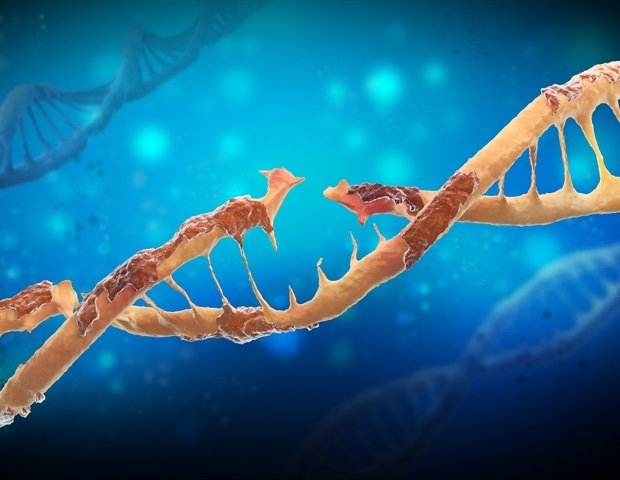
It turns out that an anti-cancer drug target already being studied in clinical trials has a more profound effect than researchers realized. Scientists at Scripps Research have discovered that the enzyme pol theta (Polθ) drives DNA repair machinery directly at broken replication forks, one of the most frequent forms of DNA damage in cancer cells. The survey results are molecular cell The March 16, 2026 announcement helps explain how tumors endure relentless replication stress and reveals why Pol theta inhibitors may be an effective strategy to selectively target cancer.
We uncovered an entirely new dimension of how cancer cells cope with DNA damage at replication forks. ”
Xiaohua Wu, Professor, Scripps Research Institute, lead study author
Each time a cell divides, it must make an exact copy of its entire genome. This process is carried out by molecular machinery that unzips the DNA double helix, reads each strand, and builds a new strand. The point at which this unpacking and copying takes place is called a replication fork. However, when this replication machinery is damaged, the fork can stall or collapse, leaving dangerous single-ended DNA breaks that are particularly difficult to repair and, if left unrepaired, can kill the cell. This is especially true for cancer cells, where replication stress is constant.
Scientists previously thought that a repair pathway called breakage-induced replication (BIR) was the main early responder to this type of damage. BIR uses an intact DNA template to restart replication and is relatively accurate but slow. In contrast, microhomology-mediated end joining (MMEJ) is a faster and more error-prone process that repairs breaks by aligning short matching DNA sequences. The prevailing view was that BIR is an active front-line mechanism and that MMEJ is primarily used to repair replication-independent double-end breaks. But the Scripps study’s findings challenge that view.
“Understanding that MMEJ operates there directly and through a clear set of rules provides a clearer understanding of why tumors are so resilient and how this can be exploited in therapy.”
Because microhomology sequences are frequently found in cancer genomes, Wu and her lab wanted to investigate whether MMEJ also has the ability to repair broken replication forks. The research team combined key new technologies to study this process in unprecedented detail. CRISPR nickase technology mimics the damage that causes replication fork collapse in real cells. Specialized reporter systems, molecular tools that signal when specific repair events occur within living cells. and genome sequencing to trace the deletion patterns left behind by each pathway.
What they found surprised them.
“As we looked more closely at what was happening in these broken forks, we continued to see signs of mutations that didn’t fit the BIR model,” explains Shibo Li, lead author of the study and a former postdoctoral researcher in Wu’s lab. “That signaled to us that something else was going on, and when we started pulling that string, we found that MMEJ was there, taking direct action early on at the crossroads.”
This finding pointed to pol theta as the engine driving MMEJ activity at the moment of fork collapse, prior to BIR, which is considered the primary mechanism for repairing broken forks.
The researchers also found that fork-MMEJ behaves differently from the standard form observed during replication-independent interruptions. Although both rely on Pol theta, fork MMEJ is initiated by the protein RPA, which generates a heterogeneous deletion pattern on both sides of the break, a unique fingerprint that sets it apart from the canonical format. These error-prone repair signatures are frequently observed in cancer genomes, suggesting that the MMEJ machinery may enable tumor cells to survive lethal DNA damage.
“We expected fork-MMEJ to follow the same rules as previously studied versions,” Wu says. “Knowing we weren’t following the same rules meant we were looking at something completely new.”
Several Pol theta inhibitors are already in clinical development and have shown promise for early efficacy in cancers harboring BRCA1 or BRCA2 mutations. These mutations associated with inherited breast and ovarian cancers disable key DNA repair pathways and make tumor cells aberrantly dependent on MMEJ for survival. This study shows that MMEJ is not a backup but an active front-line responder at broken junctions and suggests that blockade of Porcita may be more destructive to cancer cell survival than previously understood.
This study also identifies promising combination strategies. The research team found that ATR, a cellular protein that senses DNA damage, acts as a key switch at the broken fork region, suppressing fork MMEJ while guiding cells toward BIR. When the researchers blocked both ATR and Pol theta together, the replication-stressed cancer cells died at a much higher rate, while normal cells were largely unaffected. As ATR inhibitors are already in clinical development, this synergistic effect indicates the potential for combination therapy approaches.
“This has changed the way we think about when and why we use porcita inhibitors,” Wu says. “If this pathway is acting not only during replication-independent breaks, but also at the very moment the fork is broken, disruption of this pathway could have a much more profound impact on cancer cells than we realize, since cancer cells are constantly exposed to replication stress that causes replication fork breakage.”
The lab’s next steps include identifying additional proteins within the fork-MMEJ pathway, each representing potential new drug targets, and further characterizing how ATR regulates the balance between fork-MMEJ and BIR.
“The better we understand the factors involved in this pathway, the more potential targets there will be,” Wu added. “That ultimately drives better care for patients.”
sauce:
Scripps Research Institute
Reference magazines:
Lee, S. others. (2026). Microhomology-mediated end joining acts directly on the replication fork to repair single-ended double-strand breaks. molecular cell. DOI: 10.1016/j.molcel.2026.02.016. https://www.cell.com/molecular-cell/fulltext/S1097-2765(26)00130-9
