


Standing in a 1960s industrial building on Germany’s Baltic coast, Florian Gross moves toward a corner of the room, dosimeter in hand. A beeping sound begins to sound furiously.
“That’s about 10 microsieverts,” he says, wearing a hazmat suit. Typical dose rates are less than 0.2 microsieverts. “This is an area where you should probably stay one meter apart. You shouldn’t be standing or lying down here for an hour,” warns Gross, the radiation protection worker, in an eerily cheerful tone.
Inside this special building, one of the former nuclear power plants, some of the walls are uneven and pockmarked. This is the result of workers using hammers to peel away layers of concrete in search of radioactive contamination. The building is “one of the most difficult buildings to decontaminate and demolish,” said Kurt Radloff, the plant’s communications director.
Florian Gross holds a dosimeter beeping loudly on the radioactive wall of the old nuclear power plant in Lubumin as reporter Kiyo Deller looks on.Image: Henning Goll/DW
His parents worked at a Soviet-era nuclear facility in Lubmin, former East Germany, until it was shut down 35 years ago. Demolition of the facility was expected to take about 20 years. It is still far from completion, making it one of the most expensive private decommissioning projects in the world.
Nuclear power has existed for over 70 years. Still, of the more than 600 nuclear reactors built so far, only a third have been shut down and 20 have been completely decommissioned. Today’s nuclear reactors have a lifespan of 30 to 40 years, and hundreds are headed toward retirement.
Decommissioning is expensive and complex, but in the face of the recent energy crisis caused by the war in the Persian Gulf, countries in Europe and around the world are trying to revive declining industries to achieve energy independence.
The hidden costs of nuclear power
To view this video, please enable JavaScript and consider upgrading to a web browser that supports HTML5 video.
At a recent nuclear summit, European Commission President Ursula von der Leyen said Europe wanted to join the nuclear renaissance, citing the energy vulnerability of the Iran war and nuclear power’s ability to complement intermittent renewables.
Decommissioning a single nuclear reactor could cost up to $2 billion (1.75 billion euros), according to the International Atomic Energy Agency (IAEA). While some have achieved this on budget and on schedule, it is by no means a given.
Globally, even without taking into account significant cost overruns and the construction of new reactors, the disposal of shuttered nuclear power plants could become a multi-trillion dollar problem, burdening taxpayers and future generations.
Lubumin’s fall from nuclear grace
Rubmin was once the crown jewel of Soviet technology in the socialist German Democratic Republic (East Germany). It was planned to supply about a quarter of East Germany’s electricity needs, in part due to its location in the northeastern corner of the country, with easy access to the Baltic Sea needed to cool the reactors.
But troubles at the factory started early. After about a year of operation, a fire broke out in one of the machine rooms, shutting down the cooling system essential to avoid a meltdown. Further problems later occurred, but were not reported to the public.
Then, in 1989, the Berlin Wall fell and Germany began its path to unification. For the first time, West German inspectors were allowed to see inside a nuclear reactor. And they didn’t like what they found.
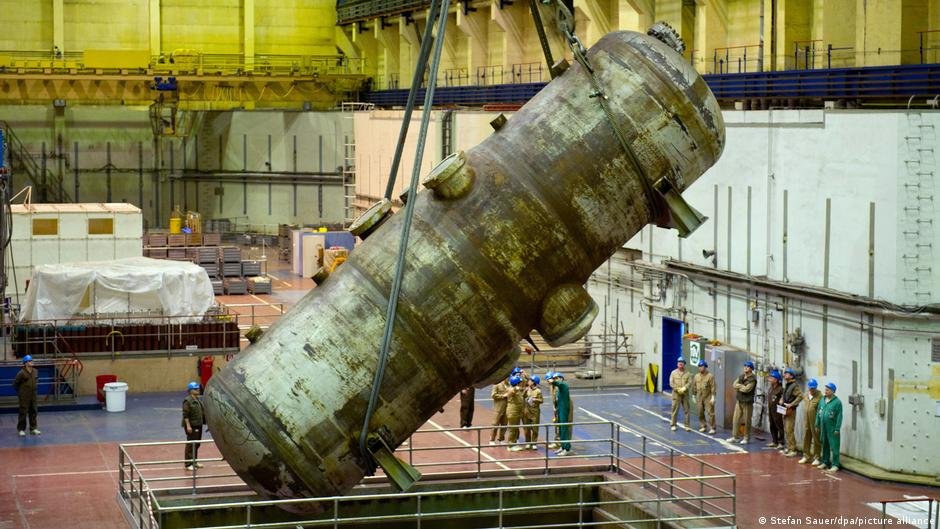
Experts deemed the reactor unsafe because the pressure vessel built to house the reactor core was fragile and lacked emergency cooling. They ordered the immediate closure of all five. But the story didn’t end there.
How to decommission a nuclear power plant
Decommissioning a nuclear power plant is not like demolishing an office block. This is a slow, painstaking, highly regulated process, more akin to surgery than construction.
Workers decontaminate materials at the old nuclear power plant in Lubumin. Water and sand used to blow away radioactivity must be stored safely Image: Thomas Trutschel/photothek/IMAGO
The first step is to remove the most radioactive parts: the fuel rods and everything around them. These go to the pool to cool off. This high-level waste remains radioactive for hundreds of thousands of years, so it is then moved to a storage site. For Lubumin, this process alone took seven years.
Then the real work begins. Everything else, all pipes, cables, doors, and structural parts must be tested for radioactivity and dismantled piece by piece. In the case of rubumin, that means 330,000 tons of substance.
Some contaminated parts, especially those closest to the nuclear fuel, also need to be safely stored for long periods of time.
“It will be placed in temporary storage and then ready for final permanent storage,” Kurt Radloff said.
Other components can be decontaminated and, after a series of tests, some can even be recycled.
Kurt Radloff is currently in charge of public relations for the factory where his parents worked during East Germany. Image: Henning Goll/DW
When nuclear power plant decommissioning does not proceed as planned
Even if things go smoothly, this is a very complex and time-consuming process. Especially if it isn’t. Rubumin, etc., whose dosimeter at Growth is ringing.
Radioactive water used during the work had seeped into cracks in the plaster and spread contamination through the walls, which came as a surprise to the cleanup workers.
“If there was a crack somewhere in the plaster, which probably wasn’t uncommon in 1990, it would seep in and spread,” Gross explained. All affected surfaces must be identified and removed.
Workers must conduct radiological tests on each layer of concrete. Image: Henning Goll/DW
Leaking contamination is also a problem at other older reactors. Changing safety standards, limited waste storage space, technological complexity, lack of funding, and public opposition often further increase costs and delays. In Lubumin, the original plan was to complete it 10 years ago at a cost of around 1 billion euros. The current estimate is €10 billion, with completion expected in the mid-2040s.
Most countries require nuclear operators to set aside funds for decommissioning in advance, but when that money runs out, governments and taxpayers step in.
What happens to the remaining nuclear waste?
Even after decommissioning, waste must be discharged. High-level and intermediate-level nuclear waste must be stored permanently. However, of the 31 countries currently producing nuclear power, only two have built permanent underground storage facilities. Not yet in Germany.
Everything at Lubumin is stored in a temporary storage building, awaiting a permanent home. However, finding a safe place to store nuclear waste long-term is not easy. Radloff joked that he wouldn’t live long enough to see high-level waste permanently disposed of “unless medical science makes significant advances.”
New nuclear reactors, including small modular reactors (SMRs), are designed and built with decommissioning in mind. This includes more standardized components and a modular structure that is theoretically easier to disassemble.
However, it remains to be seen whether this will lead to faster schedules or lower costs. None of these new reactors have been decommissioned, and only two SMRs have been built at commercial scale.
The cost of not considering all this is clear. “Dismantling the nuclear power plants was not part of the original plan. They didn’t think about it at all during the planning stages of these plants,” Radloff said.
small nuclear reactor
To view this video, please enable JavaScript and consider upgrading to a web browser that supports HTML5 video.
Editor: Tamsin Walker
This article was adapted from the DW Planet A video by Jennifer Collins.
