


Mars looks very different today than it did billions of years ago. Scientists believe the planet once had flowing water, a thicker atmosphere, and a much warmer climate. Currently, the Red Planet is frigid and dry, surrounded by only a thin layer of air.
Researchers believe that the biggest reason for this change is the solar wind. This steady stream of charged particles flowing outward from the Sun has gradually eroded Mars’ atmosphere over billions of years. As the atmosphere thinned, the planet cooled and much of its surface water disappeared.
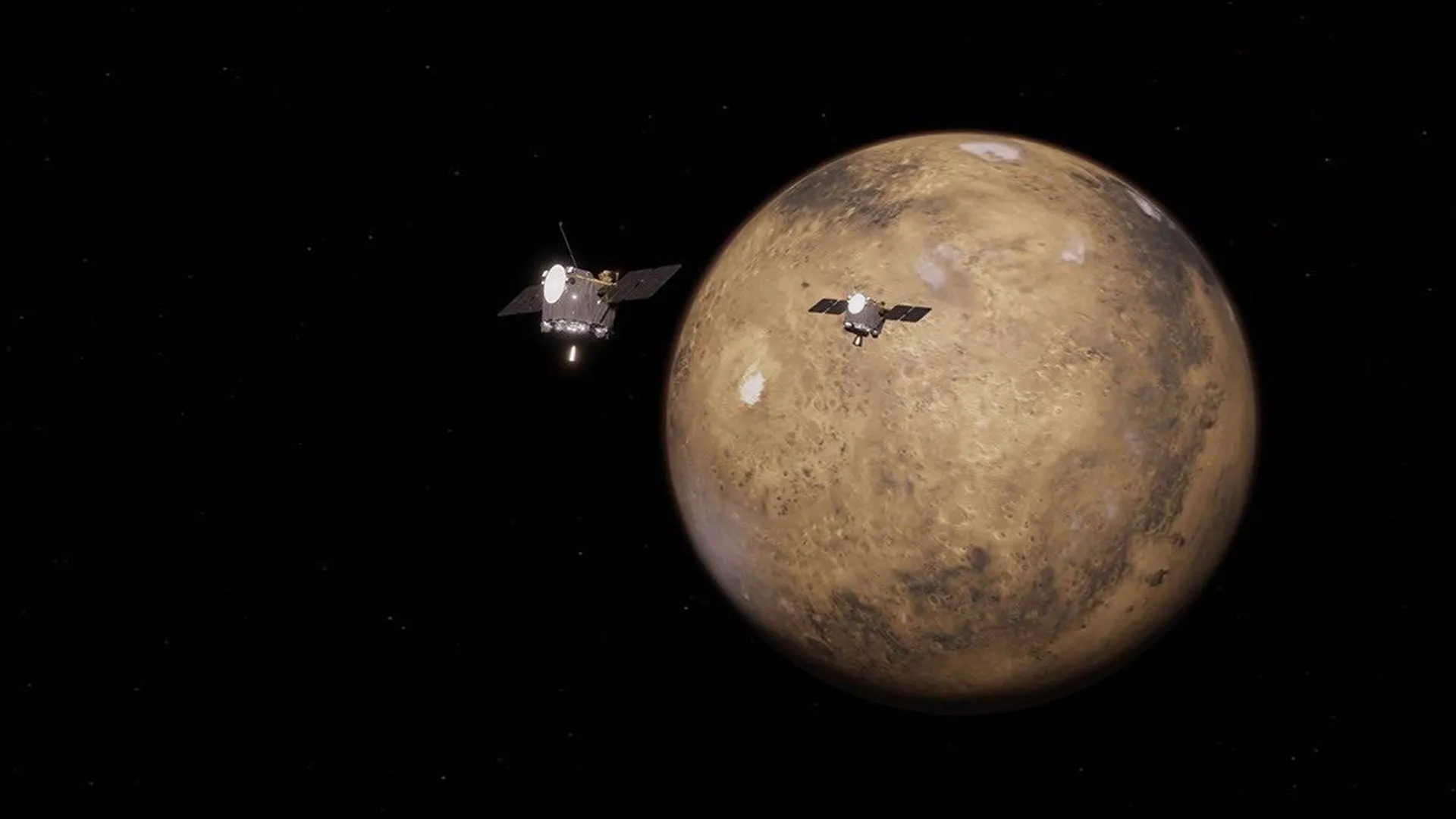
NASA is currently investigating this process with the ESCAPADE (Escape, Plasma Acceleration, and Dynamics Explorer) mission, which launched on November 13, 2025. The mission’s scientific instruments were activated and fully operational as of February 25th. These instruments will help scientists study how Mars lost much of its atmosphere and how the sun continues to shape Mars today. The spacecraft will also collect new information about space weather as it travels near Earth and on its journey to Mars.
Data collected after the mission reaches Mars could also help NASA better protect astronauts who may someday explore Mars.
“The pioneering ESCAPADE duo will not only investigate the role of the sun in turning Mars into an uninhabitable planet, but will also help develop space weather protocols for solar events directed toward Mars during future human missions to Mars,” said Joe Westlake, director of the Heliophysics Division at NASA Headquarters in Washington. “By joining the fleet of heliophysics missions across the solar system, ESCAPADE will become another weather observatory that will make humanity and technology safer and more successful in space.”
First ever Mars mission
ESCAPADE stands out because it uses two spacecraft working together in orbit around Mars. This coordinated approach allows scientists to observe the planet’s magnetic environment from two locations simultaneously, providing insights that cannot be achieved with a single spacecraft.
The pair of probes will track rapid changes in Mars’ magnetosphere, the area around Mars that is affected by its magnetic force. With this, researchers hope to determine the process by which Mars’ atmosphere slowly leaks into space.
“Having two spacecraft will help us understand cause and effect, or in the case of Mars, how the solar wind interacts with the magnetic field,” said Michelle Cash, ESCAPADE program scientist at NASA Headquarters.
Previous missions have used a single rover to study Mars’ atmosphere. ESCAPADE builds on that work by providing scientists with simultaneous views from two different positions.
“The ESCAPADE mission is a game changer,” said Rob Lillis, the mission’s principal investigator at the University of California, Berkeley. “It gives you what’s called a stereo perspective, two different points of view at the same time.”
When the spacecraft arrives at Mars, it will initially travel along the same orbit and pass over the same area at slightly different times. This strategy helps scientists pinpoint when and where changes occur in Earth’s magnetic environment.
“If two spacecraft pass through these regions in quick succession, we can watch how those regions change on timescales as short as two minutes,” Lillis said. “This allows us to make measurements that were not possible before.”
After about six months, the spacecraft will move into separate orbits. One will stay close to Mars, and the other will move further away. This five-month phase will allow researchers to observe the solar wind as it approaches Mars while simultaneously studying Mars’ reactions within its magnetosphere.
“Previous spacecraft could be riding upstream in the solar wind or close to a planet and measuring the magnetosphere. But with ESCAPADE, we can be in two places at the same time and measure cause and effect at the same time,” Lillis said.
Preparing for future human missions to Mars
Astronauts traveling to Mars will be exposed to much more solar radiation than people on Earth.
The Earth is protected by the Earth’s strong magnetic field, which protects it from the sun’s energetic particles. Mars also once had a stronger magnetic field, but over time the field has weakened. Today, Mars’ crust is dotted with magnetic regions, where there is a constantly changing magnetic field created by the interaction of the solar wind with charged particles in Mars’ upper atmosphere.
This unusual combination forms what scientists call a “hybrid” magnetosphere. Unfortunately, protection from the solar wind is limited, allowing energetic particles from the sun to reach the surface more easily. The thinness of Mars’ atmosphere further increases this vulnerability, creating a difficult environment for future explorers.
“Before we send humans to Mars, we need to understand what kind of environment astronauts will encounter,” Cash said.
ESCAPADE will also improve scientists’ understanding of Mars’ ionosphere. This region of the upper atmosphere is important because future astronauts will use it to send radio and navigation signals back to Earth, similar to communication systems on Earth.
“If we need GPS or long-range communications on Mars, we need to understand the ionosphere,” Lillis said.
An unusual route to Mars
Most Mars missions are launched during narrow periods when Earth and Mars align in orbit, an event that occurs approximately every 26 months. ESCAPADE is testing another strategy that could make future missions to Mars more flexible.
Instead of heading directly to Mars, the spacecraft is currently orbiting a point in space about 1 million miles from Earth, known as Lagrange Point 2. When Earth and Mars realign in November 2026, the spacecraft will orbit past Earth and use the planet’s gravity to propel itself toward Mars. The mission is scheduled to arrive in September 2027.
During this stage, the spacecraft will follow a large “loitering” orbit spanning about 2 million miles from Earth. This path carries them through an unexplored region of Earth’s far magnetic tail, a part of Earth’s magnetic environment that extends away from the Sun.
“We’re going to do discovery science,” Lillis said. “No one has ever measured the tail of the Earth this far away.”
Then, during its 10-month journey to Mars, the spacecraft will continue studying the solar wind and magnetic conditions in interplanetary space. These are the same environments that astronauts will eventually pass through on their way to Mars.
The ESCAPADE mission is funded by NASA’s Heliophysics Division and is part of NASA’s Small Innovative Missions Program for Planetary Exploration. The Space Science Institute at the University of California, Berkeley, is leading the mission with lead partner Rocket Lab. NASA’s Goddard Space Flight Center in Greenbelt, Maryland. Embry-Riddle Aeronautical University. Advanced space. And Blue Origin.
