


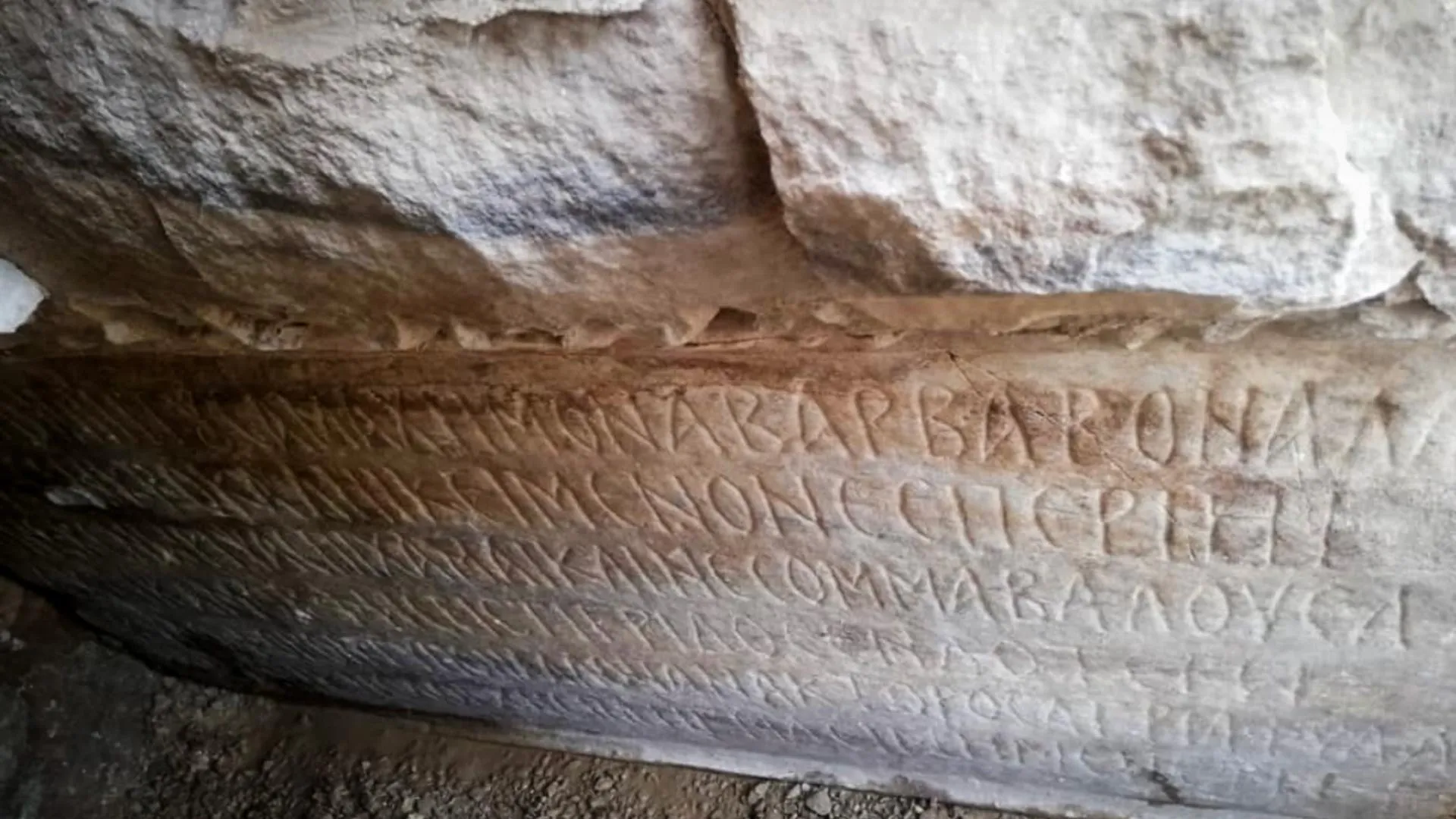
A newly discovered Greek inscription inside Syria’s Homs Great Mosque has reignited a long-standing debate over the location of the ancient Sun Temple. The temple was once associated with Elagabalus, the high priest who rose to become Roman emperor in the 3rd century AD.
Homs, known in ancient times as Emesa, has long been recognized for its historical importance. In the city center stands the Great Mosque, a landmark famous for its unusual oval design and deep religious significance.
This inscription was discovered at the base of one of the columns of the mosque during restoration work. The site itself has a checkered past. The church is associated with the 12th century ruler Nur al-Din and is thought to have been built over a church dedicated to St. John the Baptist. The church may have replaced an even older structure, perhaps a pagan temple.
A recent study published in the archaeological journal Shedet revisits the question of whether the mosque was built on the ruins of the Elagabals temple. For decades, historians have debated this possibility, but there was no clear evidence.
Dr Mahmun Saleh Abdulkarim, professor of archeology and history at the University of Sharjah and author of the study, believes this inscription could be the missing piece. He suggests this could help trace the origins of the site, which has served as a place of worship for multiple religions over the years.
“This inscription, discovered during restoration work, provides new evidence for a long-standing debate: was the temple of Elagabals located beneath the current Great Mosque in the city center, or in an archaeological layer above the tell (mound) where the ruins of the Islamic citadel of Homs now stand?” Professor Abdulkarim explains.
Layers of religion in ancient Emesa
For years, researchers have examined documents, coins, and archaeological remains to determine whether the Great Mosque once functioned as a temple and then as a church. Newly studied inscriptions provide new insights into this persistent question.
Professor Abdulkarim is analyzing the inscriptions to better understand how the modern mosque is connected to earlier religious buildings on the same site.
“A confirmed association with sun-worshipping symbols could indicate spatial continuity between pagan sanctuaries and later religious structures built on the same site,” he said, adding, “Such evidence suggests that the religious transformation of Emesa was a complete break with the religious transformation of Emesa.” “This would significantly strengthen the argument that this occurred through architectural stratification and reinterpretation rather than through architectural stratification and reinterpretation. It also underlines the importance of interdisciplinary collaboration between archaeology, epigraphy, architectural history and heritage conservation.”
This study presents Emesa as a city shaped by three main religious phases: paganism, Christianity, and Islam. We highlight how these transitions have unfolded over time and provide detailed examples of cultural continuity and adaptation in the Middle East.
The study “examines the evolution of religious life in Emesa during Roman and early Byzantine times. The study shows how the religious landscape of the city changed from the worship of local gods such as Elagabalus to the general acceptance of Christianity in the fourth century AD,” Professor Abdulkarim points out.
“Examining the political and social factors that brought about this transformation reveals a complex history of religious tolerance and struggle that ultimately enabled Christianity to flourish.”
Greek inscription details and translations
This inscription is carved on a granite block that forms part of the pedestal inside the mosque. Greek writing is carved directly into the stone.
The inscription, buried beneath the floor of the mosque, was first discovered during excavations in 2016, said archaeologist Teriz Rion, head of Homs’s excavations department.
The base of the column measures 1 × 1 m. The inscribed part covers approximately 75 cm of the front surface, and the remaining 25 cm forms the decorative frame. “The text in the image of the inscription is symmetrical and formal, spaced horizontally, a style often seen in formal dedications and memorials. The design features a multi-line inscription arranged in a horizontal straight line, and the plaque is surrounded by a decorative top border,” Lyon explained.
Due to the years of unrest in Syria, this inscription was not immediately fully studied. In May 2016, historian Abdulhadi al-Najjar shared an early translation on Facebook. “The inscription passages are characterized by a heroic and militaristic tone, depicting a warrior ruler who is likened to wind, storms and leopards, defeating his enemies and imposing tribute with ferocious kingship,” he wrote.
The text uses vivid descriptions of powerful rulers, likening them to forces of nature and predatory animals. Abdulkarim points out that Greek contains grammatical irregularities that were common in Roman Syria, where Aramaic was the main spoken language.
His analysis suggests that this inscription strengthens the proposed link between the mosque and an earlier pagan sanctuary.
“This Greek inscription, although grand in nature and not very detailed, provides clues about the relationship of this mosque with a pagan building, perhaps the Temple of the Sun, especially since researchers have long proposed this connection. Therefore, any Roman inscriptions discovered at this mosque will add further knowledge to our understanding of this subject,” Professor Abdulkarim said.
From pagan temples to churches and mosques
Professor Abdulkarim emphasizes the importance of Emesa as a religious and commercial center. Located on a major trade route connecting Antioch, Damascus, and the greater Levant, the city played an important role in the region’s history.
“The identity of Emesa in Rome was fundamentally based on paganism,” writes Professor Abdulkarim. The city’s religious life centered around the sun god Elagabalus, whose temple was the center of ritual and festivals.
Although this inscription has long attracted attention, it has not been thoroughly analyzed in academic research until now. A new study claims it provides strong evidence for both the existence and location of the Roman Sun Temple.
For nearly a century, scholars have debated where the temple was located. Professor Abdulkarim says the new discovery may finally reveal its location.
“My research helps clarify many long-standing questions and provides new insights into the religious evolution of this site in successive historical periods. It shows that the site later became a church and then a mosque after the Islamic conquest, an evolution that is also recorded in the works of Arab historians,” he said.
The study also explores how Emesa transitioned from a center of sun worship to an important center of Christianity during Roman and early Byzantine times. The temple of Elagabalus played a central role in shaping the city’s identity, influencing its politics, economy, and culture.
Priest who became Emperor of Rome
Religious elites associated with the Temple of the Sun held great power. One of those high priests eventually became Roman Emperor.
Until his accession to the throne in 218 AD, Elagabalus was the chief priest of the Syrian sun god. After becoming emperor, he sought to exalt this god above other gods throughout the Roman Empire.
Despite these efforts, the transition from paganism to Christianity in Emesa was gradual rather than sudden.
“Christianity did not suddenly replace paganism; rather, both communities had coexisted for generations,” Professor Abdulkarim explains. He points out that religious change often unfolds over a long period of time, with overlapping traditions rather than clear breaks.
A city that preserves its past
Beyond the inscriptions themselves, this research highlights broader patterns in Emesa’s history. Rather than erasing previous traditions, the city adapted and reinterpreted them.
“Emesa’s transformation was not a rupture; it was a negotiation between old and new faiths, and religious change reshaped not only sacred buildings but also power relations, identities, and urban spaces.”
The Temple of the Sun, dedicated to Elagabalus, remained central to the city’s identity, even though its function changed. Over time, the same place served as a temple, then a church, and finally a mosque.
Despite these changes, it remains central to the city’s religious and political life, reflecting a remarkable continuity spanning almost 2,000 years.
