


As the demand for healthcare increases, artificial intelligence is becoming the gateway to healthcare, with AI assistants becoming instantly available and able to translate medical terminology into understandable language.
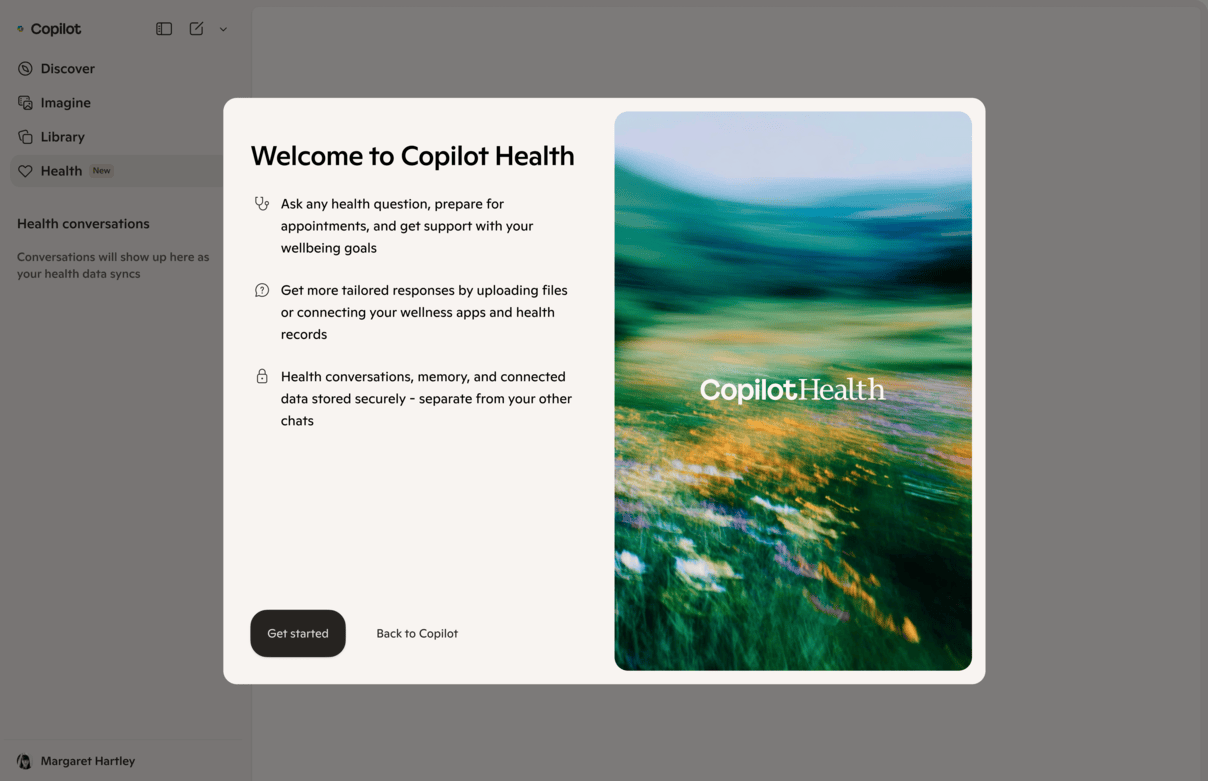
Microsoft on Thursday debuted Copilot Health, a consumer-facing AI assistant that can review medical records, help prepare for doctor appointments, and provide personalized insights based on health data.
The new Health feature is a separate, safe space within Copilot, Microsoft’s AI assistant. Bring your health records, wearable data, and health history together. Microsoft is testing Copilot Health with a select group of users and plans to make new features available through a gradual rollout. There is a waiting list for consumers to gain access before it is released more widely.
The mismatch between the demand for healthcare and its constrained supply is increasing. In many areas of the United States, there is a shortage of clinicians, long wait times for appointments, and barriers to accessing care.
Consumers are turning to AI as their first choice for healthcare, as evidenced by how many people ask health-related questions using chatbots published online.
Microsoft processes more than 50 million health questions a day across its AI consumer products, including Bing and Copilot, said Dominic King, M.D., vice president of health for Microsoft AI.
Last fall, the tech giant announced a new “Copilot for health” feature that can answer users’ health-related questions. Building on this, Microsoft is ramping up its consumer AI efforts with a new Copilot Health tool designed to give individuals the knowledge and information to make better health decisions, Microsoft executives said in a blog post.
Copilot Health’s medical intelligence is built on information from trusted health organizations in 50 countries and validated by Microsoft clinical teams using principles originally established by the National Academy of Medicine, Microsoft executives said. Answers include clear citations with easy links to source material and expert-written answer cards from Harvard Health.
In addition to answering common health-related questions, Copilot Health is designed to help consumers understand the health information they already have.
“We recognize that a true health partner that is highly useful to consumers and patients requires more than just general answers,” King said.
Through Copilot Health, users can create comprehensive health profiles that incorporate medical records such as medication lists, visit summaries, and test results from more than 50,000 U.S. hospitals and health care providers, as well as health data from more than 50 wearable devices, including Apple HealthKit, Oura, and Fitbit. Microsoft is working with health tech company HealthEx to capture patient medical records. Copilot Health users can also incorporate comprehensive laboratory test results from Function.
“I truly believe that we are on the path to a medical superintelligence that brings together both the breadth of knowledge of family physicians and general physicians and the deep expertise of specialists. AI can now provide breadth of expertise, but it can also do very deep work if needed,” said King, who previously worked in medicine as a general surgeon before moving into technology leadership positions at Google DeepMind, Google Health, and UnitedHealth Group.
Copilot Health users can integrate their medical records through their individual health portal. Copilot Health also supports more modern data sharing approaches, such as those facilitated by HealthEx, that leverage digital identity verification to capture medical records.
Microsoft executives insist that Copilot Health is not designed to replace doctors, but it does allow access to medical care when needed.
“What we are providing here is not a substitute for medical advice. We are not providing a definitive diagnosis or a definitive treatment plan. We provide tremendous support in that area,” King said.
Copilot Health uses AI to understand patterns in your health data and uncover more proactive and actionable insights. As an example, during a demo of Copilot Health using synthetic data, a user named Margaret, who has a history of diabetes and hypertension, asked the AI assistant to analyze her sleep patterns based on wearable data. The co-pilot’s medical examination provided insight that Margaret was not getting enough sleep, especially not getting enough deep sleep, which could increase her cardiovascular risk.
Copilot Health then used conversational AI to ask follow-up questions, prompting users to provide more information about when their sleep issues started.
“It just presents information and doesn’t allow people to take care of themselves,” King said.
Microsoft designed Copilot Health to demonstrate inference that extracts insights from previous conversations, medical records, vital signs from digital health tools, test results, and wearable data. This allows Copilot Health to answer more comprehensive questions, such as, “What do you think my main health challenge is? What questions should I ask my doctor?”
Based on the same user, Margaret, Copilot Health flagged major health issues such as a recent heart attack based on her test results, uncontrolled diabetes, high blood pressure based on wearable data, high cholesterol based on test results, and sleep problems.
“We’re very excited about the opportunity to provide this kind of intelligence and insight to our users. We think we’re on the cusp of technology that can really change the way care is delivered today,” said King.
Copilot Health also helps users find doctors who accept their insurance by connecting to a real-time U.S. provider directory and searching for doctors based on specialty, location, language spoken, and insurance coverage.
Microsoft designed Copilot Health with access, privacy and security controls in mind to protect users’ sensitive health information, Microsoft executives said.
Copilot Health data is protected with industry-leading security measures, including encryption at rest and in transit, strict access controls, and the ability for users to manage and delete their information when they choose, Microsoft executives said in a blog post.
Copilot Health information is not used to train the model.
Microsoft has also built a model that ensures not only safety but also a high level of accuracy in clinical reasoning. Copilot Health was developed in collaboration with in-house clinical teams and informed by an external panel of more than 230 physicians from more than 24 countries who contribute their medical expertise, safety feedback, and real-world perspectives.
The new Copilot Health AI assistant comes as AI companies increasingly focus on healthcare. Two months ago, OpenAI rolled out ChatGPT Health, a feature that connects artificial intelligence chatbots with users’ medical records and wellness apps to provide more personalized answers to medical questions. Amazon has expanded access to its Health AI assistant on its website and apps.
“2026 feels like an important year for consumer health, and there are many more solutions available,” King said.
But he argues that Microsoft’s approach to consumer health AI is unique based on several factors.
“Safety and security of what we do is extremely important and essential, and we think Microsoft is incredibly well-positioned. We have a lot of trust. We work with a lot of health systems. For example, we’ve made proactive decisions about separating this data and health conversation from the rest of what’s happening within Copilot,” he said.
“We’re launching what we believe to be the most extensive set of connectors to enable more access to wearable devices. We’ve spent a lot of time making access to medical records as smooth and easy as possible. There are other systems that offer that functionality, but generally they can be quite clunky and difficult to access,” he added.
King said Microsoft’s Copilot Health efforts have been informed by a team of doctors, and the AI team has taken time to get feedback from a diverse range of users. The company collaborated with organizations such as AARP, which serves the interests of 38 million older Americans, and the National Council on Health, which represents more than 180 patient advocacy groups.
“We’re very focused on building a comprehensive, patient- and consumer-centric product, rather than a generic service that does health care and everything else,” he said.
According to a recent analysis by Microsoft of health-related conversations on Copilot, consumers are increasingly relying on AI for information about health symptoms, conditions, and treatments.
Microsoft looked at more than 500,000 anonymized health-related conversations on Copilot in January alone and found that in nearly 1 in 5 conversations, people described their symptoms and got help interpreting their test results or managing their condition. The study found an increase in questions related to understanding medical symptoms at night, suggesting that people turn to AI when they cannot easily reach a medical professional.
“We had the opportunity to show (Copilot Health) to many of the top physicians and leading health systems in the United States, and the feedback from those sessions was that people really recognized that this is the future, giving consumers more control over their health care, giving them more insight, giving them the ability to manage their own conditions and spot patterns early,” King said. “There is a general recognition that we need to do this properly and safely and have quality and safety standards in place, but that this represents a new part of how care is delivered, not only in the future but actually in the short term.”
