


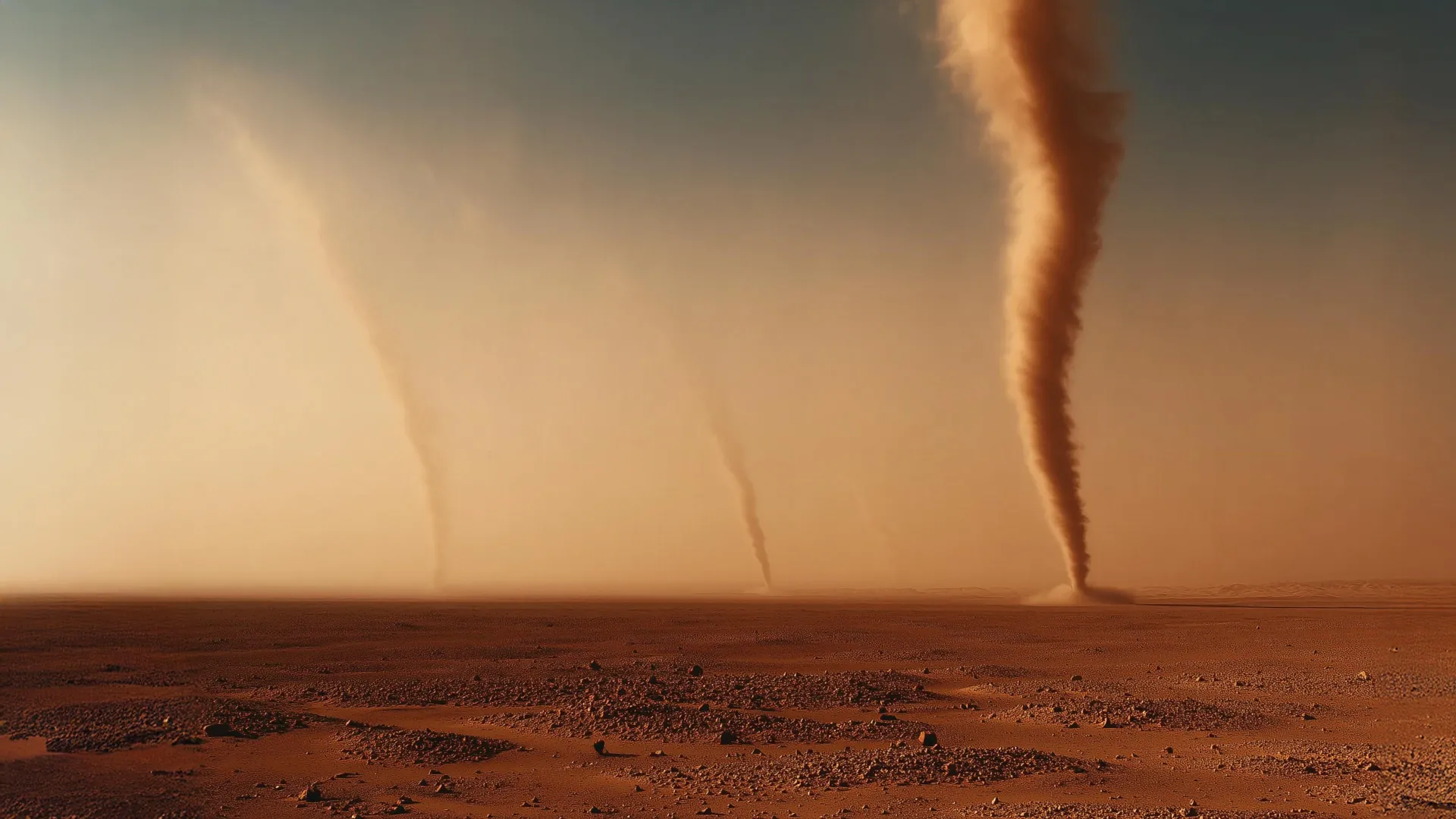
Mars is often depicted as an arid, lifeless desert, but it’s much more active than it appears. Its thin atmosphere and dusty terrain create an environment where constant movement generates electrical energy. Sandstorms and rotating dust devils sweep across the Earth’s surface, continually reshaping the landscape and driving processes that scientists are only beginning to fully understand.
Planetary scientist Ariane Wang has been studying this phenomenon in detail. In a series of studies, including a recent study published in Earth and Planetary Science Lettersshe investigated how the activity of these charged dusts affects the chemistry of Mars, particularly through its effects on isotopes.
Static electricity and hidden sparks on Mars
When dust particles collide and rub together in a Martian storm, they create static electricity. This can create strong electric fields that can cause electrostatic discharge (ESD). Such electrical discharges are more likely to occur on Mars than on Earth because the atmospheric pressure is so low.
These phenomena can appear as a faint glowing effect similar to the aurora borealis and trigger a series of electrochemical reactions. These processes are subtle but play important roles in the formation of planetary surfaces and atmospheres.
Revealing chemical reactions with lab simulations
Dr. Wang, a research professor at Washington University in St. Louis and a researcher at the McDonnell Space Science Center, recreated conditions on Mars in the lab to study these effects. With support from NASA’s Solar System Working Program, her team developed two specialized simulation chambers: PEACh (Planetary Environmental Analysis Chamber) and SCHILGAR (Simulation Chamber with Inline Gas Analysis).
Using these systems, researchers observed a wide range of chemical products formed during electrical discharges. These include volatile chlorine species, active oxides, airborne carbonates, and (per)chlorates. These compounds are important components of Mars’ modern chemical environment.
Dust chemistry and the chlorine cycle
Previous research by Wang’s team showed that dust-related electrical activity plays a major role in Mars’ chlorine cycle. The surface contains extensive chloride deposits left behind by ancient saline waters. By simulating conditions on Mars and carefully measuring reaction outputs, the researchers demonstrated that hot, dry Amazonian dust activity could produce carbonates, (per)chlorates, and volatile chlorine compounds consistent with those detected by the rover.
Isotopic evidence points to key processes
To better understand these reactions, Wang’s team, which includes researchers from six universities in the United States, China, and the United Kingdom, studied the isotopic composition of chlorine, oxygen, and carbon produced by these discharges. They found a consistent decrease in heavier isotopes across all three elements.
“Because isotopes are trace components in materials, isotope ratios can only be influenced by major processes in the system. Therefore, the substantial heavy isotope depletion of the three mobile elements is the ‘smoking gun’ for the importance of dust-induced electrochemistry in shaping the modern Martian surface-atmosphere system,” Wang says.
These isotope patterns act like fingerprints, showing that dust electrochemistry was the dominant force shaping Mars today.
A new model for Mars’ chemical cycles
Combining these findings, the researchers developed a model of Mars’ modern chlorine cycle and atmospheric carbonate production. The model shows how electrical reactions in dust storms release chemicals into the atmosphere, which then redeposit them on the Earth’s surface. Some of these materials migrate underground and over time contribute to the formation of new minerals.
This ongoing process helps explain the gradual decrease in 37Cl that led to the unusually low δ37Cl values (-51 percent) measured by NASA’s Curiosity rover.
“The Alien study is extremely important. This is the first experimental study to examine how electrostatic discharges affect isotopes in the Martian environment. This study is particularly valuable because isotopic signatures are like fingerprints and can be used to trace processes that influenced the Martian chlorine cycle,” points out Kun Wang, associate professor of Earth, environmental and planetary sciences at the University of Washington. “While this experiment did not produce the very light Cl isotope signature measured by the Mars rover, it clearly shows that electrostatic discharge can drive Cl isotope fractionation in the right direction. “This is an important step toward understanding the origin of these unusually light Cl features and the formation of perchlorate minerals on the surface of Mars. It also highlights how different Mars is from Earth, with the atmospheric and surface processes that control chemical reactions being very different.”
Electrical activity detected on space mission
Recent observations by NASA’s Perseverance rover provide further support. The rover recorded 55 electrical discharges during the leading edge of the dust devil and sandstorm. These findings show that natureconsistent with Wang’s previous work that predicted the chemical effects of such emissions.
Her research on (per)chlorates, amorphous salts, atmospheric carbonates, and volatile chlorine species is consistent with what the spacecraft observed and strengthens the case that dust electrochemistry is an active and ongoing process on Mars.
Impact beyond Mars
The importance of this research extends beyond Mars. Similar electrochemical processes may occur on other worlds such as Venus, the Moon, and exoplanets. This suggests that electrical activity caused by dust, lightning, or high-energy particles may play a broader role in shaping planetary environments.
“This study sheds light on an important aspect of modern Mars: atmosphere-surface interactions. But it also tells us about how surface chemistry was partially created. This has valuable lessons for other worlds where triboelectric charging can occur, such as Venus and Titan,” said Paul Byrne, associate professor of Earth, Environmental and Planetary Sciences at the University of Washington.
A more dynamic view of Mars
Taken together, these discoveries paint a picture of Mars as an active and evolving world. Dust storms are not just meteorological phenomena; they are powerful agents of chemical change. By revealing how electrical activity shapes the planet, Wang’s research is helping scientists better understand Mars’ past, present, and potential for future exploration.
As research progresses, Mars turns out to be much more complex than once thought, and many of its secrets remain to be discovered.
