




Facts about the Kentucky General Assembly
Learn important facts about the Kentucky General Assembly, including its history, structure, and functions of state government.
- A Kentucky bill is headed to the governor that could make it harder to sue pesticide manufacturers.
- Under the bill, EPA-approved labels would automatically meet state warning requirements.
- Supporters say the bill would protect businesses from frivolous lawsuits, while opponents worry it would prevent consumers from proving damages.
This article has been updated to reflect that Senate Bill 199 must return to the Senate for a vote after amendments in the House.
A controversial bill that could make it harder for Kentuckians to sue pesticide manufacturers over negative health effects is one step closer to passage.
Senate Bill 199, sponsored by Sen. Jason Howell (R-Murray), would automatically make pesticides registered with the Kentucky Department of Agriculture or the Environmental Protection Agency and labeled with EPA approval to comply with Kentucky’s warning label requirements.
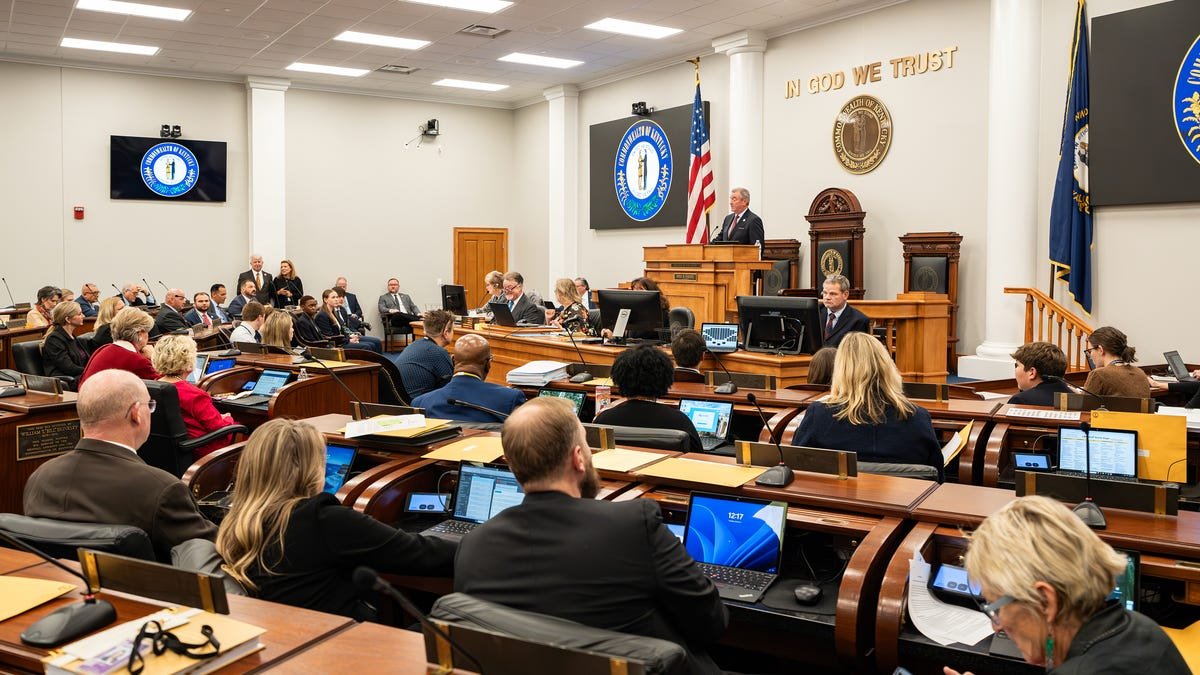
The bill passed 53-37 in the House on March 17, even as Democrats and Republicans voiced concerns about the EPA’s effectiveness and timeliness in reporting and warning people about pesticides and pesticide hazards.
Several Republican lawmakers argued that the bill does not give companies broad immunity, but instead allows them to sue if there is “smoking gun” or absolute proof that a product causes problems such as cancer or chronic disease.
The bill has divided opinion among prominent supporters of the state’s Make America Healthy Again movement and reflects growing divisions across the country over pesticide production. In February, President Donald Trump angered MAHA hardliners by ordering increased production of glyphosate, a commonly used herbicide.
Rep. Matt Lockett (R-Nicholasville), co-chair of the state’s MAHA task force, said he could not support the bill because Kentucky is a notoriously unlucky state that ranks No. 1 in the nation for cancer diagnoses and deaths.
“We should be fighting for our people, but we should also be fighting for our farmers, and we should be fighting for the health of our commonwealth, which has always lagged behind the rest of the country,” Lockett said.
But many Republican lawmakers said existing warning labels are sufficient to inform farmers and consumers, and that the agriculture industry relies heavily on pesticides. Rep. Suzanne Miles (R-Owensboro) said many products, such as toothpaste and clothing dye, come with health warnings, but it’s the consumer’s responsibility to understand the health risks and read the instructions.
“We’re putting a huge burden on these people for testing,” Miles said. “I don’t believe there is anyone working for a chemical company or a pharmaceutical company or anyone else who intentionally wants to harm anyone.”
Rep. Ryan Bivens (R-Hodgenville), who introduced the bill in the full House, proposed an amendment that would limit the bill to only products for agricultural use, but could also include products purchased by consumers for purposes such as gardening, lawn care and other household chores.
Bivens said the lawsuits facing pesticide makers, like the $7.25 billion settlement proposed by Roundup maker Bayer, will hurt companies and drive up the cost of products farmers rely on.
“We want to attract businesses and have them invest in our district,” Bivens said. “We want to bring jobs. But we never stand up and say, ‘We’ll help you get a frivolous lawsuit filed against you, which could end up costing you financially.'”
But Democratic lawmakers, including Rep. Adam Moore (D-Lexington), said the bill would limit plaintiffs’ ability to get the evidence they need from manufacturers.
“By deeming the EPA label sufficient as a matter of law, this bill would force judges to dismiss cases in the first place,” Moore said. “You can’t prove they’re hiding the truth. This law slams the door shut before you’re even allowed to look behind the scenes. It’s a Catch-22 invented by corporate lobbyists, where you can sue if you have proof, but it makes it impossible to find that evidence.”
To sway Republicans, Democrats have reminded Republicans of high-profile incidents and past public health failures, likening pesticide manufacturers to Big Tobacco and Big Pharma, which spent years hiding carcinogenic and dangerous side effects while lobbying and promoting their products. Moore also cited Health and Human Services Secretary Robert F. Kennedy’s landmark 2018 lawsuit against Monsanto for failing to warn consumers about cancer risks.
“But history has shown us that federal approval of a label does not necessarily mean that the label is as safe as we are led to believe,” said Rep. Ann Donworth, D-Lexington. “Take OxyContin. When Purdue Pharma introduced OxyContin, the government allowed a labeling that suggested it was less addictive than other opioids, and that claim remained on the label for years.”
“The drug was widely prescribed and patients believed it to be completely safe,” Donworth continued. “But by the time it became clear that stronger warnings were needed, Kentucky was already in crisis.”
The bill will be returned to the Senate after changes are made through House amendments. If passed, Gov. Andy Beshear would have the option of vetoing SB199 and signing it into law, or letting it become law without his signature. If he vetoes the bill, lawmakers have until mid-April, when the session ends, to override his veto.
Contact reporter Keely Doll at kdoll@courierjournal.com or follow her at X @keely_doll.
