


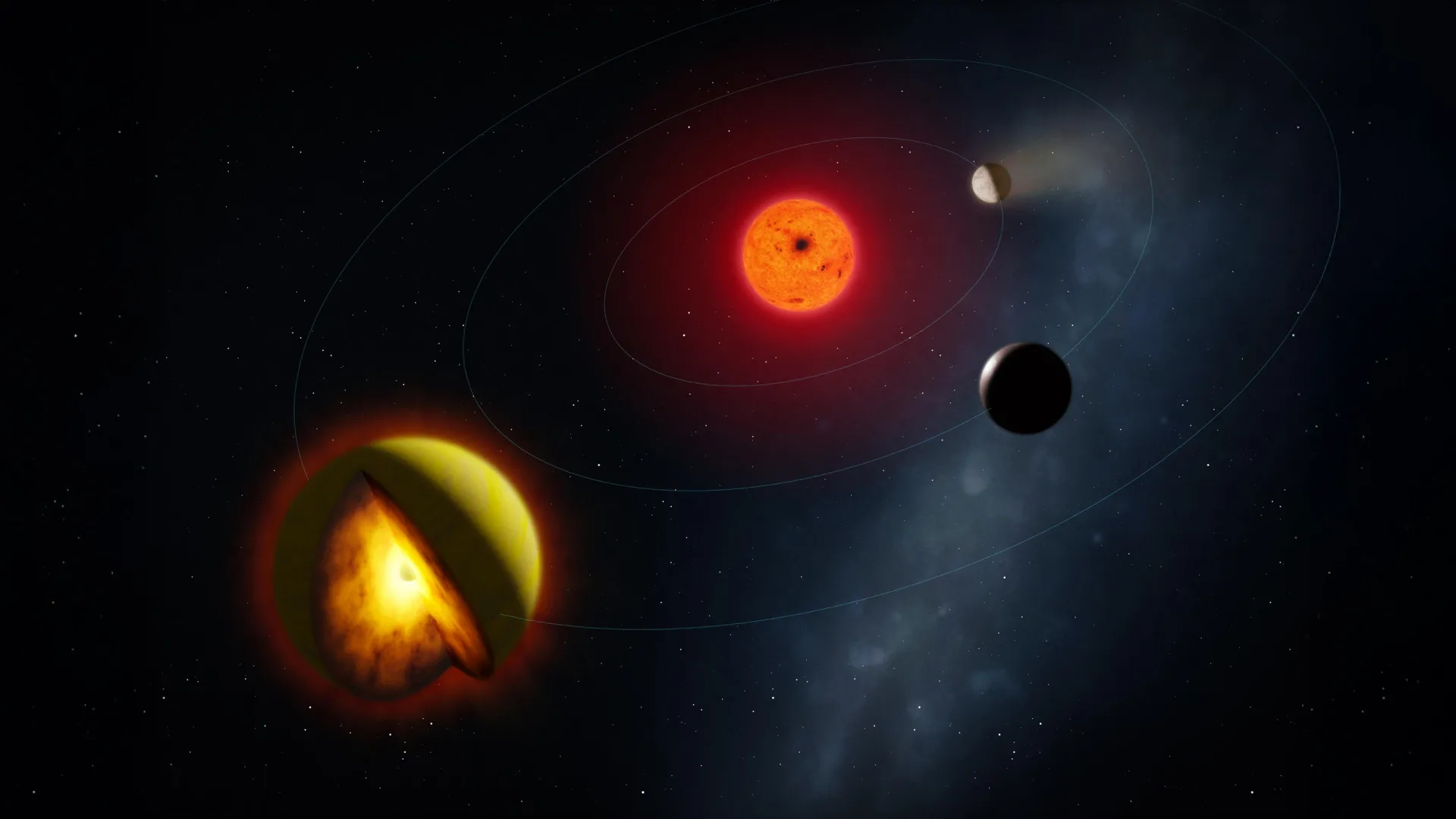
A team of researchers led by the University of Oxford has discovered evidence of a previously unknown type of planet outside our solar system: one that traps large amounts of sulfur deep within long-lasting lava oceans. The results were announced on March 16th. natural astronomy.
The world, called L 98-59 d (for exoplanet orbiting a star outside our solar system), orbits a small red star about 35 light-years from Earth. Data from the James Webb Space Telescope (JWST) and ground-based observatories reveal something unusual. For a planet about 1.6 times the size of Earth, it has a surprisingly low density and an atmosphere rich in hydrogen sulfide.
A planet that defies classification
Previously, scientists had classified planets like L 98-59 d into one of two categories. It could be a rocky “gas dwarf” with a hydrogen-dominated atmosphere, or a water-rich world with a deep ocean and ice.
New evidence shows that it doesn’t fit into either category. Instead, L 98-59 d appears to belong to an entirely different class of planets dominated by heavy sulfur compounds.
Global magma ocean beneath the earth’s surface
To understand this unusual world, researchers from the University of Oxford, the University of Groningen, the University of Leeds, and ETH Zurich used advanced computer simulations to track its evolution over almost five billion years, from shortly after its formation until today. By combining telescope observations with detailed models of the planet’s interior and atmosphere, they were able to infer what was happening deep within the planet.
Their findings suggest that L 98-59 d has a mantle made of molten silicates, similar to Earth’s lava. Beneath its surface is a vast ocean of magma thousands of kilometers deep. This huge reservoir allows the planet to trap large amounts of sulfur inside for long periods of time.
Magma oceans also help maintain a dense atmosphere rich in hydrogen, including sulfur-containing gases such as hydrogen sulfide (H2S). Typically, radiation from the host star gradually strips these gases into space through an X-ray-driven process.
Sulfur cycle between the interior and the atmosphere
Over billions of years, ongoing chemical exchanges between the molten interior and atmosphere have shaped the planet’s current appearance. These interactions explain the anomalous signals detected by the telescope.
The researchers suggest that L 98-59 d may be the first confirmed example of an extensive population of gas-rich, sulfur-dominated planets that maintain long-lived magma oceans. If so, this would indicate that there is a much greater variety of planet types across the galaxy than previously realized.
Lead author Dr Harrison Nicholls, from the University of Oxford’s Department of Physics, said: “This discovery suggests that the categories currently used by astronomers to describe small planets may be too simplistic. While this molten planet is unlikely to harbor life, it reflects the wide diversity of worlds that exist outside our solar system. And we may ask what other types of planets are waiting to be discovered.”
How sulfur forms the atmosphere
JWST observations in 2024 detected sulfur dioxide along with other sulfur gases in the upper atmosphere at L 98-59 d. According to the researchers’ model, these gases form when ultraviolet light from the host star, red dwarf L 98-59, triggers chemical reactions.
At the same time, the magma ocean beneath it acts as a massive storage system for volatile materials, absorbing and releasing gas over the billions of years since the planet formed. This combination of deep internal storage and UV-induced chemical reactions explains the planet’s unique properties.
Simulations suggest that L 98-59 d was likely formed by large amounts of volatile material and may have once resembled a larger Neptunian planet. Over time, it cooled, lost some of its atmosphere, and became smaller.
Scientists point out that magma oceans are thought to be the initial state of all rocky planets (including Earth and Mars). Studying these environments on distant worlds could provide insight into the early stages of our own planet’s history.
Rebuild an alien world using models
Co-author Professor Raymond Pierrehumbert, from the University of Oxford’s Department of Physics, said: “What’s interesting is that computer models can be used to reveal the hidden interiors of planets that will never be visited. Astronomers can only measure the size, mass and atmospheric composition of planets from a distance, but this study shows that it is possible to reconstruct the deep past of these otherworlds and discover types of planets that have no equivalents in our solar system.”
JWST is already providing a growing flow of data, and future missions such as Ariel and PLATO are expected to further expand that dataset. The research team plans to apply models using machine learning to these observations to map the diversity of planets outside our solar system and link them to their early development.
By doing so, scientists hope to better understand how planets form and evolve, and identify what kinds of worlds can support life.
Dr Richard Chatterjee (University of Leeds/University of Oxford) said: “Our computer model simulates a variety of planetary processes and allows us to turn back the clock and discover this rare rocky exoplanet, L 98-59. “It effectively allows us to understand how the planet evolved. Hydrogen sulfide gas, which is responsible for the rotten egg smell, seems to play a major role there. But as always, more observations are needed to understand this planet and others like it. Further investigation may reveal more.” Rather, exciting planets are surprisingly common. ”
