


Astronomers searching for extraterrestrial life have identified the most promising location. Researchers have narrowed down the number of rocky worlds that could support life to just under 50 out of more than 6,000 known exoplanets.
The survey results are Royal Astronomical Society Monthly Noticesreflects the kind of missions imagined in Hollywood movies project hail mary. The story follows Ryan Gosling’s character as he travels to distant star systems in search of a way to save Earth, encountering extraterrestrial life forms along the way, including a being named Rocky and fictional microorganisms such as Astrophage and Taumoeba.
Possibility of habitable zone planets and liquid water
Professor Lisa Kaltenegger, director of the Carl Sagan Institute at Cornell University, led the study with a team of undergraduate students. They analyzed new data from the European Space Agency’s Gaia mission and NASA’s Exoplanet Archive to identify planets located in the “habitable zone.”
This region around the star is neither too hot nor too cold, making it more likely that liquid water exists on the planet’s surface. Water is essential for life as we know it, so planets in this zone are thought to be the best candidates.
The study, titled “Exploring the Limits of Habitability: A Catalog of Rocky Exoplanets in the Habitable Zone,” also focuses on planets that receive similar levels of stellar energy to Earth.
“As Project Hail Mary shows so beautifully, life can be much more diverse than we currently imagine, so figuring out which of the 6,000 known exoplanets are most likely to host extraterrestrial life forms such as Astrophages, Thaumoeba, or Rocky could be important, not just for Ryan Gosling,” Professor Kaltenegger said.
“Our paper reveals where we should travel to find life if we built a ‘Hail Mary’ spacecraft.”
45 Rocky Worlds identified as top targets
The research team identified 45 rocky planets that could potentially support life within their habitable zones. They also highlighted an additional 24 planets within the more restrictive 3D habitable zone, based on stricter assumptions about how much heat a planet can withstand before becoming uninhabitable.
These include well-known exoplanets such as Proxima Centauri b, Trappist 1f, and Kepler 186f, as well as lesser-known candidates such as TOI-715 b.
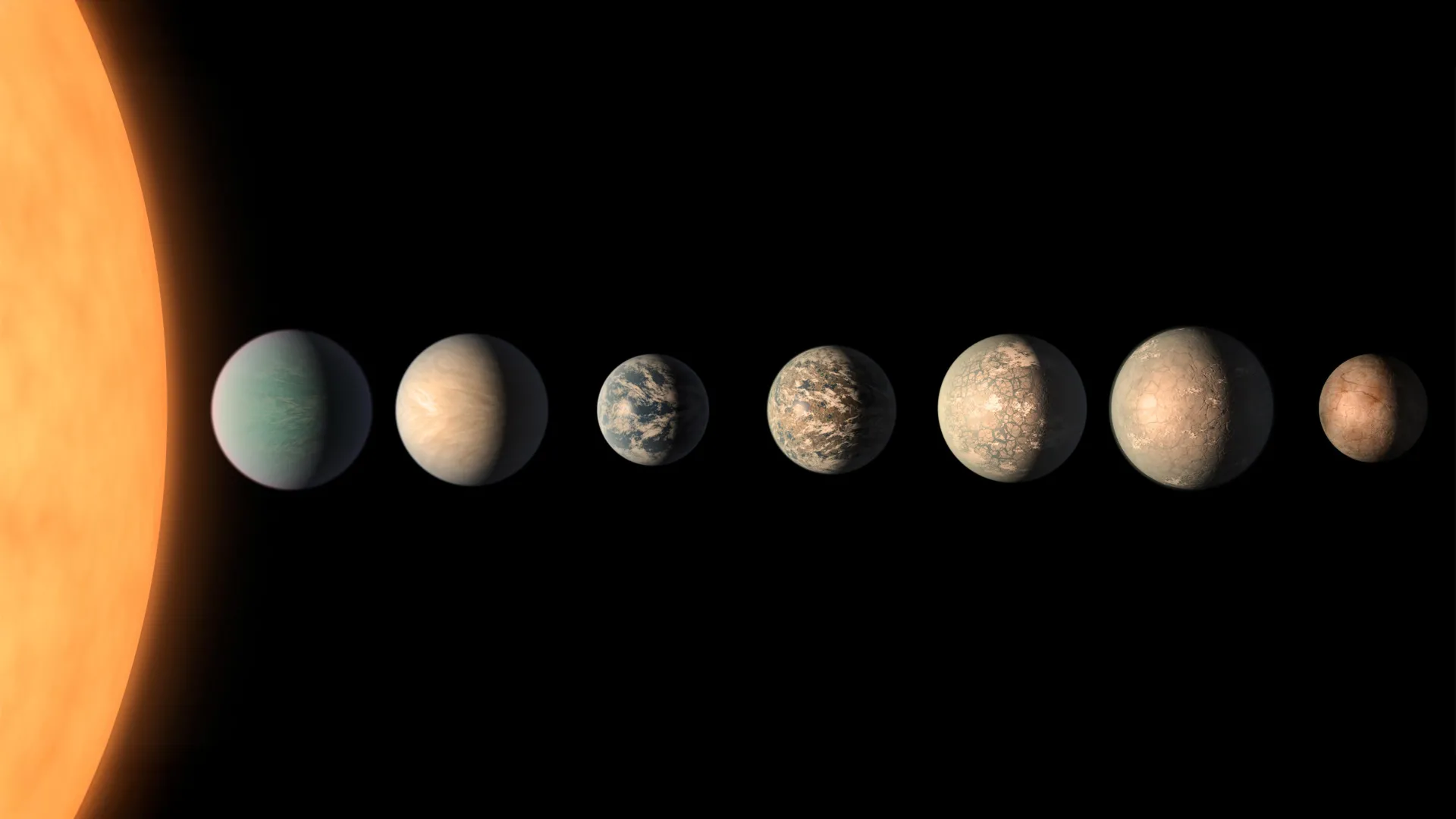
Some of the most interesting targets include planets d, e, f, and g in the TRAPPIST-1 system, about 40 light-years from Earth, and LHS 1140 b, 48 light-years away. The ability of these worlds to sustain liquid water depends in part on their ability to maintain an atmosphere.
Earth-like energy and promising nearby worlds
Some planets receive the same level of starlight that Earth receives from the Sun. These include the transiting planets Trappist 1 e, TOI-715 b, Kepler 1652 b, Kepler 442 b, and Kepler 1544 b, as well as planets such as Proxima Centauri b, GJ 1061 d, GJ 1002 b, and Wolf 1069 b, which are detected through their host star-induced motion.
The researchers also selected planets located near the inner and outer edges of the habitable zone to better understand where the limits of habitability lie. Although the concept of the habitable zone has been studied since the 1970s, new observations could refine and even reshape the current theory, Kaltenegger explained.
Test the limits of planetary habitability
Some exoplanets follow highly elliptical orbits. This means that the amount of heat an exoplanet receives from its star changes significantly over time. Studying these worlds could reveal whether planets must remain in the habitable zone continuously, or whether they can move in and out while maintaining conditions suitable for life.
Planets such as K2-239 d, TOI-700e, and K2-3d, along with Wolf 1061c and GJ 1061c, help scientists study the internal boundaries of habitability. Meanwhile, TRAPPIST-1g, Kepler-441b, and GJ 102 provide insight into the colder outer edge of the habitable zone.
“It’s hard to say what makes something more likely to have life, but identifying where to look is an important first step. So the goal of our project was to say, ‘This is the best target to look at,'” said Gillis Rowley, now a graduate student at San Francisco State University.
“We wanted to create something that would allow other scientists to search effectively, and we continued to discover new things about these worlds that we wanted to investigate further,” said fellow researcher Lucas Lawrence, now a graduate student at the University of Padua in Italy.
Searching for alien atmospheres using a telescope
Co-author Abigail Ball of Cornell University emphasized that Earth, Venus, and Mars provide useful benchmarks for understanding habitability.
“We know that Earth is habitable, but Venus and Mars are not. Using our solar system as a reference, we can look for exoplanets between Venus and Mars that receive stellar energy.
“Observing these planets will help us understand when they become uninhabitable, how much energy is too much, and which planets are still habitable or never were.
“The same idea applies to eccentric planets: How much orbital eccentricity can a planet maintain while retaining surface water and habitable conditions?
“We identified planets at the inner and outer edges of the habitable zone and the most eccentric planets to test our understanding of what it takes for planets to remain habitable. We also identified targets that are easiest to observe with the James Webb Space Telescope (JWST) and other telescopes.”
The research team also adapted different planets and observation methods to increase the chances of detecting signs of life.
Future telescopes and the search for life
This curated list will guide astronomers using current and future observatories, including JWST, the Nancy Grace Roman Space Telescope (scheduled to launch in 2027), the Very Large Telescope (scheduled for first light in 2029), the Habitable World Observatory (scheduled to launch in the 2040s), and the proposed Large Exoplanet Interferometer (LIFE) project.
Observing these small planets is essential to determining whether they have atmospheres and improving models of habitability, Lowry said.
He noted that initial analysis of 10 planets receiving Earth-like radiation has already identified two strong short-term research candidates: TRAPPIST-1 e and TOI-715 b.
The TRAPPIST-1 system is the primary focus of JWST observations led by Cornell University astronomer Nicole Lewis. TRAPPIST-1 and TOI-715 b both orbit small red stars, making it easier to detect and study Earth-sized planets.
Complete list of 45 potentially habitable exoplanets identified in paper
- GJ1002b
- GJ1002c
- GJ1061c
- GJ1061d
- GJ251c
- GJ273b
- GJ 3323b
- GJ 667 C c
- GJ 667 C e
- GJ667CP
- GJ682b
- K2-239d
- K2-288 B b
- K2-3d
- K2-72e
- Kepler-1229b
- Kepler-1410b
- Kepler-1544b
- Kepler-1606b
- Kepler-1649c
- Kepler-1652b
- Kepler-186f
- Kepler-296e
- Kepler-296f
- Kepler-441b
- Kepler-442b
- Kepler-452b
- Kepler-62 e
- Kepler-62f
- L 98-59f
- LHS 1140b
- LP890-9c
- proxima centauri b
- Ross 508b
- TOI-1266d
- TOI-700d
- TOI-700e
- TOI-715b
- trappist-1 d
- trappist-1 e
- Trappist-1f
- Trappist-1g
- tea gardens star c
- wolf 1061c
- Wolf 1069b
