


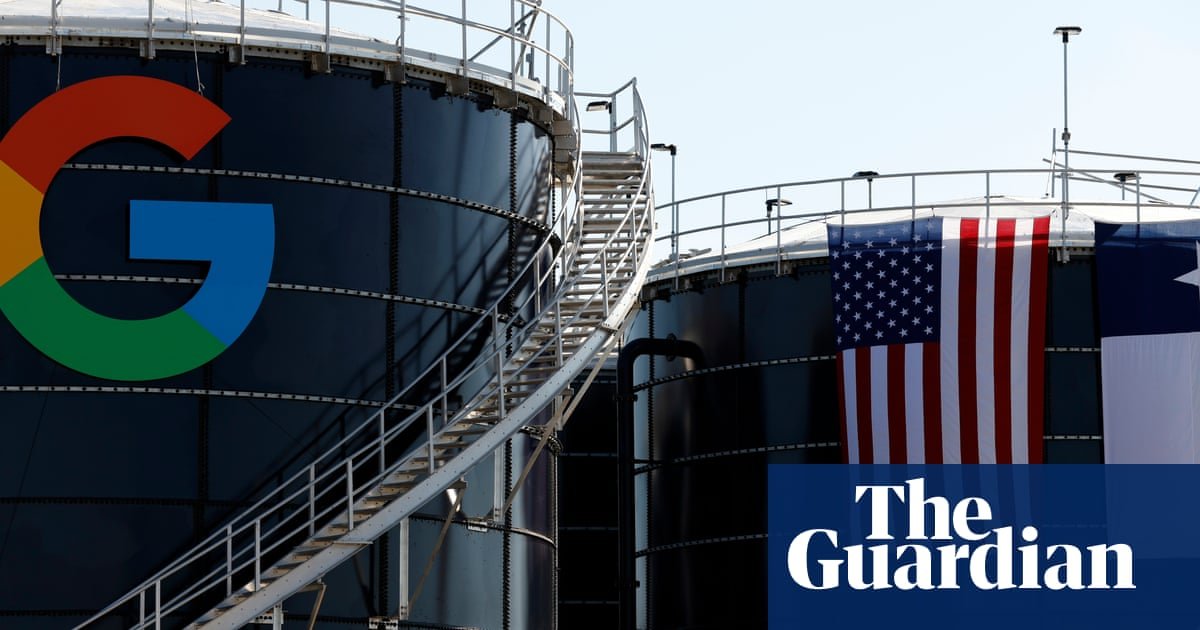
Google’s plans to partner with a natural gas power plant that could provide energy to one of its data centers in Texas have been revealed in a new investigation and confirmed by the company. The move is part of an ongoing pivot at the tech giant, which once pledged to become carbon neutral by 2030 and has long been considered a pioneer in clean energy.
The gas power plant will be built in Armstrong County, a sparsely populated area of the Texas Panhandle. According to a report by research group Cleanview, the project is being led by Crusoe Energy, which is partnering with Google to develop a data center campus known as “Goodnight,” after the name of a nearby town.
In January, Crusoe applied for a permit to build a 933-megawatt power plant on Goodnight Campus property, which indicated the facility would operate off-grid and provide energy to at least two buildings on campus, according to Cleanview. Satellite imagery commissioned by Cleanview confirms that construction is progressing well.
According to Crusoe’s 465-page permit application, the power plant will emit 4.5 million tons of carbon dioxide a year, a major contributor to the climate crisis. For comparison, the entire city of San Francisco emits about 4 million tons of carbon dioxide per year.
Cleanview founder and report author Michael Thomas said the power plant would be one of the first direct investments in fossil fuel infrastructure that Google has seen.
“Google has spent decades building an image as a leader in clean energy,” Thomas said. “I’ve always thought they were the most committed to climate goals. But these projects suggest a major strategic shift for the company may be underway.”
When the Guardian asked Google about its partnership with Crusoe on gas power plants, company spokeswoman Chrissy Moy did not deny the project, but said: “We do not have a contract for a power plant in Texas.” It’s unclear how much power Google will buy from the plant, and negotiations appear to be ongoing. She pointed to another partnership the company has with power company Serena Energy for wind power projects in the region. Mr. Crusoe did not respond to requests for comment.
The Texas power plant is the third known gas facility that Google has been involved with in the past few months. In October, the company announced a deal to buy power from a gas plant in Illinois, and last month Flatwater Free Press obtained documents showing Google is considering another huge gas project in Nebraska.
Google said its focus remains on carbon-free energy and does not consider the use of natural gas to be a deviation from its climate change goals. The company said it is moving from a strategy of buying carbon credits to building a power grid.
Asked by Axios at an energy conference in Houston last week about how natural gas fits in with the company’s clean energy goals and overall strategy, Michael Terrell, Google’s head of advanced energy, said, “I have nothing to say about that.”
From tackling climate change to “climate moonshots”
Google has long been a leader in climate action in technology. In 2020, the company set an ambitious net zero emissions goal of using carbon-free energy in all its operations by 2030. The company has invested in wind, solar, geothermal and nuclear energy projects. But as Google focuses more on AI and its high-energy needs, its emissions reduction obligations have eased.
In 2023, Google stated in its sustainability report that it was no longer “operatingly carbon neutral,” but that it was aiming for net zero by 2030. In 2024, the company reported that greenhouse gas emissions due to data center energy consumption had increased by 48% since 2019.
By 2025, Google had stopped talking about specific goals for 2030, instead framing its emissions targets as a “climate moonshot.” “Moonshot” is a term Google uses to refer to speculative projects that may or may not come to fruition, such as widespread self-driving cars or the yet-to-be-ubiquitous Wi-Fi balloon.
“While we remain committed to our climate moonshot, achieving it is proving more complex and difficult at every level,” Google wrote in its 2025 environmental report, calling its climate goals “ambition-based” and noting that the rapid growth of AI poses “significant uncertainties” about emissions.
Meta, Amazon and Microsoft, which have also long pledged net-zero carbon targets, are also turning to natural gas to power their AI data centers. Meta is building a huge facility in Louisiana that will run on natural gas, and has several multi-gigawatt data centers in the Amazon that will be powered by gas. Microsoft just announced a new gas project for a data center in West Virginia and this week signed a deal with Chevron to build a 2.5 gigawatt gas power plant in West Texas.
“For years, these hyperscalers have been grappling with climate goals and resisting the siren call of natural gas,” said Cleanview’s Thomas. “But what has happened in recent months has made the story even more complicated… There is a sense of tension in the race to develop AI.”
