


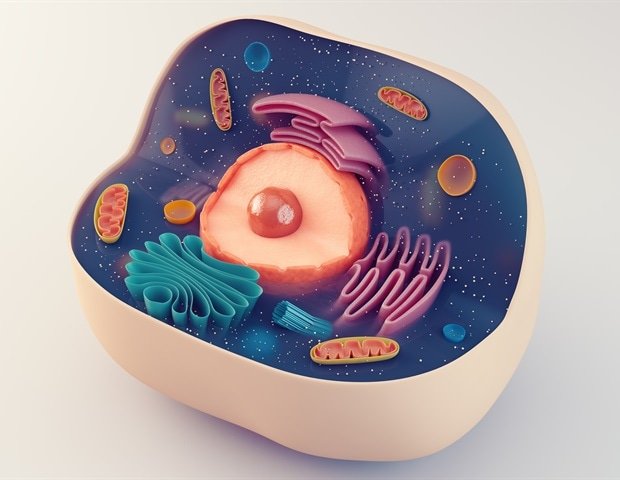
A team at the Center for Research in Biochemistry and Molecular Materials (CiQUS) at the University of Santiago de Compostela has developed a more flexible chemical strategy for creating biomimetic structures – artificial systems that mimic cellular function. This breakthrough could improve our understanding of life’s fundamental processes and pave the way for innovative biotechnological applications.
Mimicking life: the potential of synthetic cells
Synthetic biology aims to design artificial systems that mimic the behavior of living cells. These synthetic or biomimetic cells serve as simplified models to study fundamental biological processes and develop new technologies. In a recent study, CiQUS researchers introduced a new chemical approach to design such systems more flexibly. What is their purpose? Creating structures that act as microscopic chemical reactors, mimicking important cellular functions such as enzyme encapsulation and delivery.
“We’re essentially trying to replicate cellular function at the level of enzyme encapsulation and signal transduction.” Researcher Lucas Garcia explains: In natural cells, compartmentalization allows different reactions to occur simultaneously within the same space. The research team sought to mimic this functionality in artificial systems as well.
Overcoming experimental complexity
Traditionally, modifying the properties of biomimetic materials has required a lengthy, multi-step process of polymer design, laboratory synthesis, purification, and characterization. To streamline this, the CiQUS team employed a different strategy: reversible chemical bonding. These bonds allow researchers to tune the properties of a system directly in solution, eliminating the need to create multiple different compounds. Instead, scientists can start with a single base material and tune its behavior by adding small molecules. This is a much more efficient method for quick experiments.
Microfactories: coacervates as cell mimics
The researchers’ approach leverages dynamic covalent chemistry with boronates, a type of bond that can be reversibly formed and broken in aqueous solution. By adding specific molecules, researchers can fine-tune the properties of the system. The researchers began with a water-soluble polymer that, when combined with an oppositely charged molecule called catechol, separates from solution to form tiny droplets known as coacervates. These droplets act as chemical compartments similar to the cytoplasm of a cell.
“The system itself mimics the cytoplasm because the cytoplasm is rich in macromolecules.” says researcher Bruno Delgado. To further mimic cellular structure, the researchers surrounded the coacervates with an artificial membrane made of amphiphilic copolymers (polymers with both water-attracting and water-repelling regions). This membrane stabilizes droplets and controls the movement of molecules, similar to natural cell membranes.
Inside these compartments, the researchers introduced enzymes and proteins that facilitate chemical reactions. Each droplet thus becomes a microscopic chemical factory that can host multiple reactions. “These reactors accelerate reaction rates and enable communication between different populations of the system.” García highlights the possibility of generating molecules that interact with other similar structures.
Surprising discovery: dopants and membrane behavior
One unexpected finding was the influence of dopant molecules on enzyme activity within the coacervate. “We thought the enzyme activity would decrease, but when we added the dopant, the enzyme activity increased.” Delgado reveals. This discovery demonstrated that in addition to modulating physical properties such as stability and shape, the system can directly influence internal chemical behavior. This is an important insight for developing more sophisticated and controllable systems.
Another surprise was the behavior of the copolymer membrane. We found that interactions with coacervates vary depending on experimental conditions, and understanding how coacervates stabilize structures is critical. These results not only validated the effectiveness of this method but also opened new avenues for designing more complex and efficient compartments that closely mimic natural cellular processes.
Beyond the lab: future applications
The potential of these biomimetic systems extends far beyond basic research. One promising application is the development of synthetic tissues for regenerative medicine. “This could also be used for tissue regeneration and stem cell differentiation.” Garcia suggests. The ability to create compartments that interact and perform controlled chemical reactions could also lead to advanced implants that can synthesize therapeutic substances directly within the body.
Delgado envisions another exciting possibility: hybrid systems that combine natural and engineered cells to precisely control biological processes. “We can control not only the release but also the in situ production of the drug, but this has not been achieved yet.” he explains. Such innovations could revolutionize drug delivery and enable reactions that are currently impossible under natural conditions.
Looking ahead, the team plans to focus on two key areas. One is to better understand the molecular mechanisms that govern coacervate behavior, and the other is to explore more complex applications, such as synthetic tissue formation and miniature laboratory-like systems for use in the body or in the laboratory. “Creating synthetic cells remains a major focus of research, but we are already moving toward the next step.” Garcia concluded by suggesting future systems that can integrate chemical efficiency, biological control, and breakthrough medical applications.
sauce:
Center for Biochemistry and Molecular Materials Research (CiQUS)
Reference magazines:
Delgado Gonzalez, B. Others. (2026). Dynamic covalent boronate chemistry on site Optimization of coacervate formation, interfacial stabilization, and cell mimicry. Journal of the American Chemical Society.DOI: 10.1021/jacs.5c17688.https://pubs.acs.org/doi/full/10.1021/jacs.5c17688
