


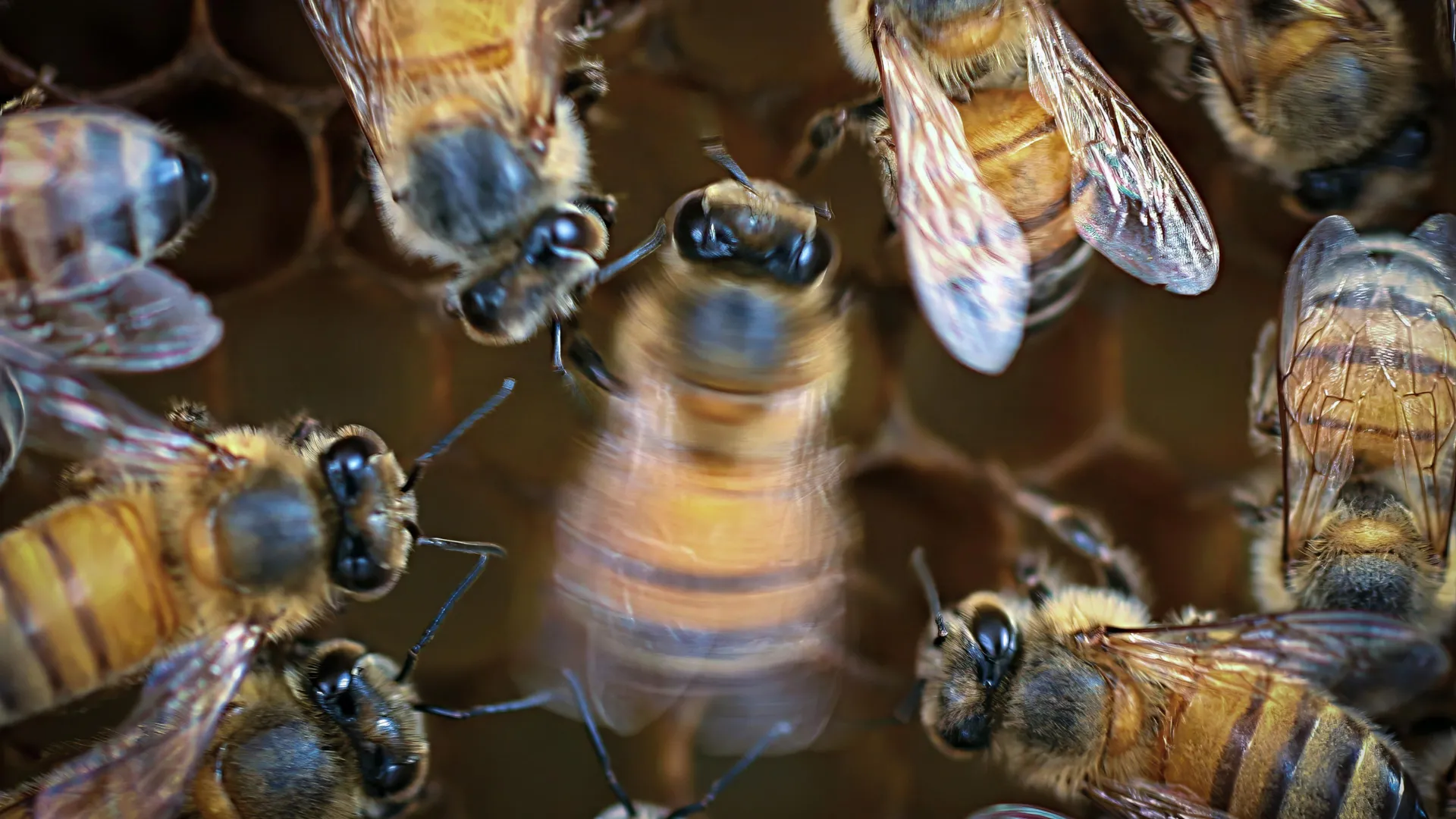
“Dancing like no one’s watching?” That idea doesn’t apply to bees.
Scientists have spent years deciphering the honey bee’s highly sophisticated form of communication, the “waggle dance.” Researchers from the University of California, San Diego and its international partners have now shown how this behavior allows bees to share detailed information about the location of food with other bees in the hive.
New research published in Proceedings of the National Academy of Sciences It shows that dance is not just for performers. It also depends on the audience. Researchers have discovered that foraging bees aren’t just transmitting a fixed message. Instead, how precisely they direct food to others changes based on who is watching.
How the waggle dance tells where food is
When the bees find a good food source, they return to the hive and quickly and repeatedly dance and share space. As nearby bees observe, the dancer moves forward, shaking its abdomen, then circles back, repeating the pattern within seconds.
The direction of the dance relative to the sun tells other bees where to go, and the length of each movement indicates the distance. This system allows the colony to find and utilize food efficiently.
Audience size affects dance accuracy
James Nee, a professor in the University of California, San Diego’s School of Biological Sciences, compares this behavior to street performers. A large audience allows performers to focus on delivering a consistent performance. But when the crowd gets smaller, they shift their attention to attracting and maintaining interest.
Honeybees show a similar pattern. With fewer nestmates to pay attention to, dancers move around more in search of followers. This additional movement makes it difficult to maintain the precise pattern needed to convey accurate direction.
“We’ve all seen street musicians and performers adapting to changing crowds,” says Nee, a faculty member in the Department of Ecology, Behavior, and Evolution. “We see a similar trade-off in hives: when there are fewer bees to follow, the dancers move more to find an audience, making the dance less precise.”
Experiment reveals the role of social feedback
Working with collaborators at the Chinese Academy of Sciences and Queen Mary University of London, Nie and his team studied honey bees in controlled hives designed to mimic natural conditions. They took a closer look at the hive’s “dance floor,” where bees congregate and socialize.
In one experiment, researchers varied the number of bees present to see how audience size affected performance. In another example, they kept the number constant but varied the audience by adding young worker bees who would not normally follow the dance. In both situations, dancers’ accuracy decreased when the audience was small or there were fewer participants.
“The waggle dance is often presented as a one-way communication,” said Ken Tang, the study’s senior author and a researcher at the Xishuangbanna Tropical Botanical Garden, Chinese Academy of Sciences. “Our data shows that audience feedback shapes the signal itself, in the sense that dancers are not only transmitting information, but also reacting to the social context on the dance floor.”
How do bees sense audiences?
The study also sheds light on how bees sense their audience. Other bees frequently touch the dancer with their antennae or body. These physical interactions may help performers sense how many bees are nearby and how engaged they are.
Lars Chitka, a researcher at Queen Mary University of London, said: “Humans are not the only ones who perform differently depending on the audience. Our research shows that bees literally dance better when they know someone is watching.” When there are fewer people around, dancers wander around looking for listeners, and in doing so their signals become more vague. This is a nice reminder that even in the miniature world of insects, communication is a very social event.”
Animal communication and its implications for the future
These discoveries extend beyond honeybees and provide insight into how animal populations share information. Many collective systems rely on the need to repeat, receive, and act on signals.
“The new findings show that the accuracy of a signal may depend not only on the motivation of the sender, but also on the availability of the receiver,” Nee said. “This kind of feedback can be important in animal societies, artificial herds, and other distributed systems where the quality of information can rise or fall depending on audience dynamics.”
Researchers on this study include Tao Lin, Shihao Dong, Gaoying Gu, Fu Zhang, Xiuchuan Ye, Tianyi Wang, Ziqi Wang, Jianjun Li, James C. Nieh, Lars Chittka, and Ken Tan.
Funding for this research was provided by the 14th Five-Year Plan of Xishuangbanna Tropical Botanical Garden. Chinese Academy of Sciences (E3ZKFF3B); Yunnan Province Revitalization Human Resources Support Plan (XDYC-QNRC-2023-0566). and the National Natural Science Foundation of China (32571753 and 32322051).
