


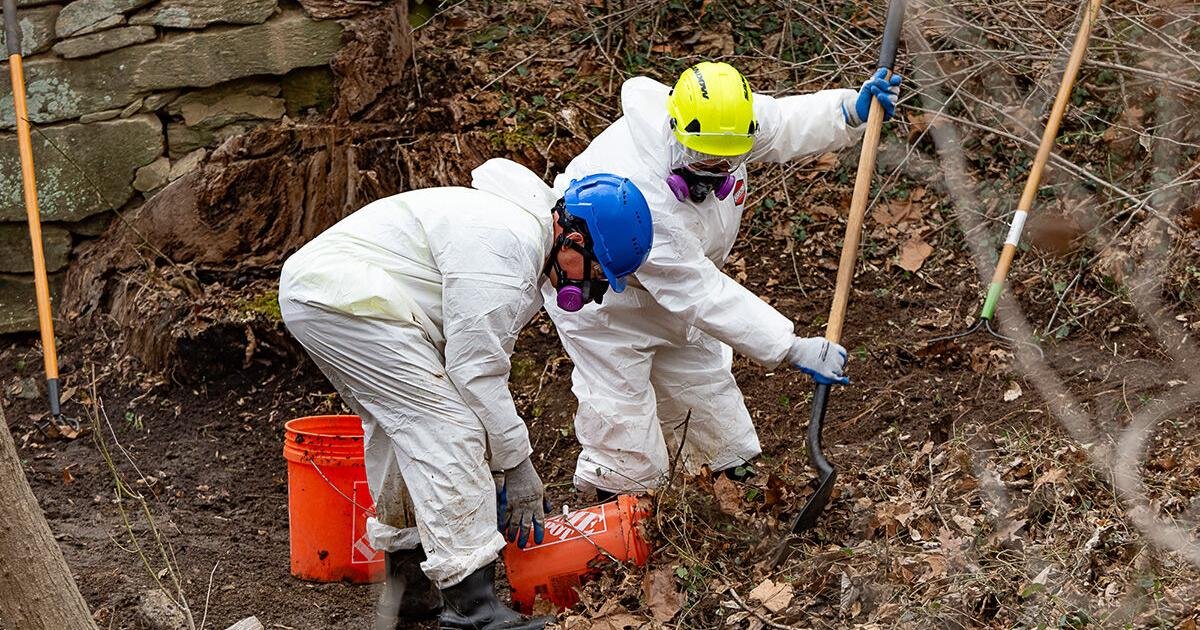

U.S. Army Corps of Engineers contractors are removing leaves and soil contaminated by untreated sewage spilled into the Potomac River in January 2026.
In a wooded ravine dozens of yards from the north bank of the Potomac River, workers wear white protective suits, thick gloves, rubber boots, hard hats and respirators. They spent hours using garden hoes and rakes to scrape out the top few inches of soil and whatever was in it.
In this case, “anything” means everything from human waste and toilet paper flushed down the toilet, to dirty dishwater, food scraps, and grease that spilled out of the main sewer pipe after it collapsed on January 19th.
“We’re trying to eliminate the effects caused by the sewage overflow,” said Amanda Zander, who is overseeing environmental remediation efforts for DC Water, the utility that owns the pipe. “The goal is to restore everything that wasn’t there before and return it to its original state.”
Emergency repairs were completed on March 14 to the so-called Potomac Interceptor, which ruptured just east of Interstate 495 in the Cabin John community in Montgomery County, Maryland. For the first time in 55 days, full flow has returned to the 6-foot-wide pipe. This allowed crews to drain water from a section of the C&O canal that was acting as an outdoor bypass while the pipe was being repaired.
But the chaos is not over yet. D.C. Water officials say the historic canal, which is under the jurisdiction of the National Park Service, will likely continue to stink until the remaining contaminated soil is removed, by May at the latest. Permanent repairs to the pipe are expected to be completed this fall.

Raw sewage from a January 2026 pipe collapse near the District of Columbia was diverted into the C&O Canal and then pumped back into the sewer system downstream.
Full environmental remediation of the site, including restoration of the affected canal locks, is expected to be completed by the end of this year.
Meanwhile, environmentalists continue to call for a larger cleanup.
“Reversing the immediate damage caused by the collapse is essential, but ensuring a complete ecological recovery will require extensive science-based watershed-scale restoration efforts, as well as transparent and active community engagement,” said Katie Blackman, vice president of strategic programs and partnerships at the Potomac Conservancy. She added that any final restoration would need to fit “the scale and scope of this unprecedented environmental disaster.”
The collapse is estimated to have spilled between 243 million and 300 million gallons of untreated sewage into the Potomac River.
Potomac Riverkeeper Dean Nauyokus said if there’s a silver lining, it’s that the breach happened where it happened. Public drinking water is not affected as the area’s intake pipe is located upstream of the collapse site. And it was another stroke of luck that the C&O Canal was on hand to stop the spill, he said.
“The C&O Canal was a huge savior for the river,” he added.

Potomac River Administrator Dean Nauyokus visited the site of a sewage spill into the Potomac River in January 2026.
Nauyokus called on D.C. Water and state environmental officials to continue expanding water extraction from the river beyond the summer to assure the public that the river’s water is safe.
“This is a popular access,” he said. “This is one of my favorite places to float on the river. I’ve swam here. So a lot of boaters don’t feel comfortable putting their boats out here.”
Nauyokus continues to independently monitor the site. His group published its own test results on March 9, showing extremely high levels of E. coli in the ditch that runs through the stone culvert beneath the canal. The announcement suggested that waste passing through the canal was seeping into the ceiling of the culvert and dripping into the ditch below.
2 days later bay journal When reporters and photographers visited the collapse site, U.S. Army Corps of Engineers workers were seen digging up dirt near the culvert, and they were installing a small dam to prevent water from the ditch from continuing to flow into the Potomac River.

U.S. Army Corps of Engineers contractors are removing leaves and soil in and around the Potomac River contaminated by raw sewage spilled into the Potomac River in January 2026.
A group of Maryland Department of Environmental Quality inspectors and other officials also roamed the site that day. “We’re out there every day,” said MDE Deputy Secretary Adam Ortiz, wearing a helmet. “And we check in regularly to see how things are progressing.”
The pipe collapse began to draw intense scrutiny in mid-February after President Trump called it a “massive ecological disaster” on social media.
Parking lots near the busy Clara Barton Parkway are crowded with construction trailers, including those belonging to D.C. Water, the Army Corps and the U.S. Environmental Protection Agency. It was still several days before the brownish-green torrent drained from the C&O Canal, and the air smelled of musty earth.
DC Water estimates it will cost $20 million to repair the pipe and clean up after the spill.
All public health advisories, including a temporary ban on shellfish harvesting, have been lifted for the Potomac River except for those closest to the flooding site.
The 54-mile Potomac Interceptor receives wastewater from a service area of more than 500,000 people, including Dulles Airport, parts of Northern Virginia, and Montgomery County, Maryland.

U.S. Army Corps of Engineers contractors carry buckets of contaminated soil as they leave the scene of a January 2026 sewage spill near C&O Canal Lock 10.
This pipe was built in the 1960s and is no secret that it is aging. A rotten section of sewer pipe just a few hundred yards west of the collapse underwent emergency repairs, which were completed in early January. Even before the collapse, plans were underway to restore the entire line at a cost of $625 million over 10 years.
D.C. Water officials were still working to determine the cause of the collapse as of mid-March. But the utility’s CEO, David Gaddis, said in an open letter that the incident was due to an unspecified “highly unusual event, one that could not have been reasonably predicted based on available testing data.”
In early March, D.C. Water officials announced a multi-year structural inspection conducted at or near the portion of the pipe expected to fail.
Most recently, last October, third-party inspectors used video cameras to inspect the inside of the pipe and discovered what the company described as two holes just a short distance upstream from where the eventual break occurred. Using industry grading standards, RedZone Robotics classified both locations as a 5, which indicates the highest level of urgency for repair. (This scale does not specify the remaining useful life of each grade.)
However, DC Water engineers dispute these findings, claiming that the alleged hole was actually black concrete. The utility said the structural failure did not appear to be “imminent” at the time.

After a pipe collapse near the District of Columbia in January 2026, the small river in the foreground left dumped millions of gallons of raw sewage into the Potomac River.
A law firm filed a federal class action lawsuit against DC Water on March 6 on behalf of property owners and boat owners near the spill site. The lawsuit alleges that the utility company was aware of extensive corrosion in the pipes before the accident but failed to take appropriate action.
A spokesperson for DC Water said the company does not comment on ongoing litigation.
