


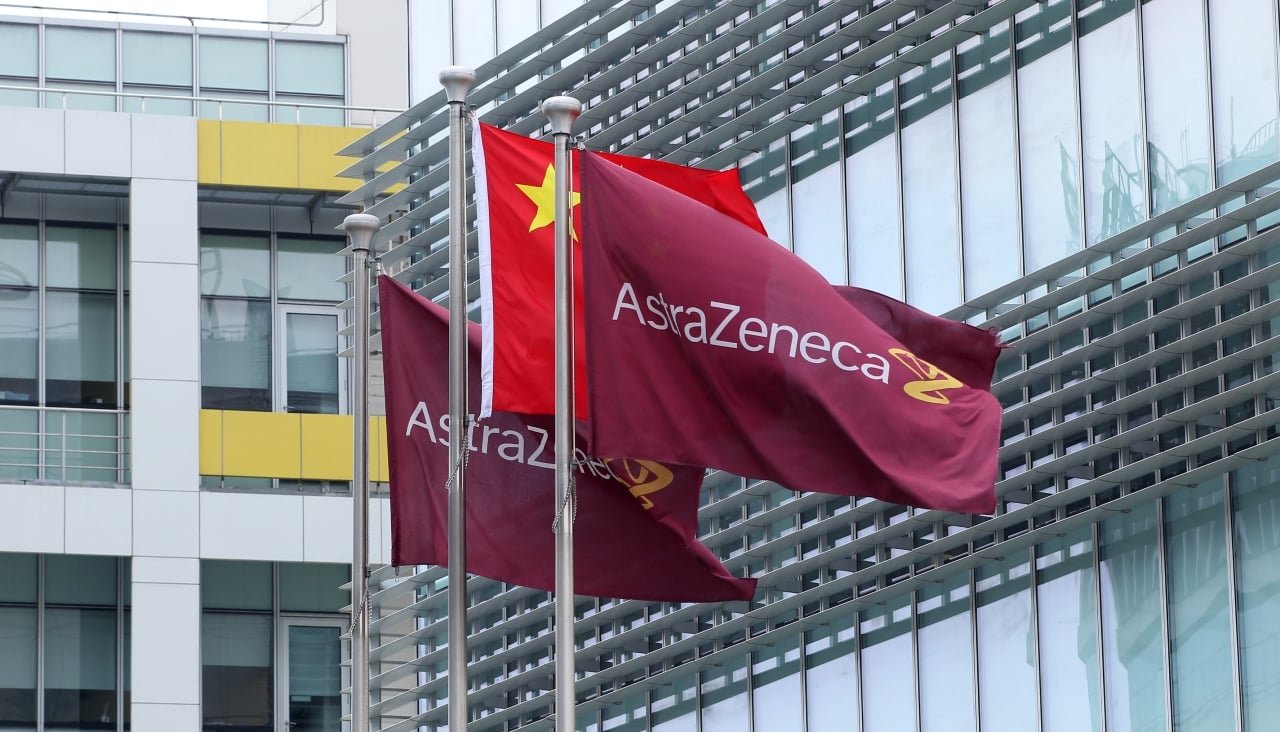
Following a major investment in China, AstraZeneca on Thursday announced plans to build a commercial cell therapy manufacturing site and a dedicated innovation center for the therapy in Shanghai.
The move will make the British drugmaker the first multinational pharmaceutical company to boast end-to-end cell therapy capabilities in China, from early-stage research to large-scale commercial production, AZ said in a statement (in Chinese).
These new facilities build on AZ’s $15 billion investment commitment to China outlined by CEO Pascal Soriot during a visit to China with UK Prime Minister Keir Starmer earlier this year. At the time, AZ highlighted among its goals the strengthening of its cell therapy and radioconjugate capabilities, new manufacturing facilities, and expansion of its research and development footprint. The investment pledge will last until 2030.
The new production site will be located in the Lingang Special Zone of the Shanghai Free Trade Zone and will supply autologous CAR-T therapy to China and other Asian markets. These include AZD0120, a dual-target BCMA and CD19 CAR-T that AZ acquired as part of its $1 billion acquisition of Gracell Biotechnologies.
Complementing the manufacturing facility, the new research and development center at Zhangjiang Hi-Tech Park will focus on early research, viral vector and plasmid construct development, analytical testing, clinical batch production and registration support.
“As one of China’s leading biopharmaceutical hubs, Shanghai has established a strong pathway from basic research and R&D to advanced manufacturing and fosters a vibrant innovation ecosystem,” Iskra Reik, AZ’s executive vice president of international affairs, said in a March 19 release.
In conjunction with the unveiling of the new site, AZ announced that it will work with partners to launch a new life science cooperation program between Shanghai and the UK. The initiative will “facilitate collaborative research, commercialization and business development, ensuring that innovations originating from both the UK and Shanghai benefit patients around the world,” Reic added.
As part of the project, AZ signed a multiparty memorandum of understanding with the Science and Technology Commission of the Shanghai Municipal Government, the University of Glasgow, King’s College London and HSBC.
The latest developments demonstrate AZ’s continued deep engagement with China. AZ is China’s largest foreign-funded pharmaceutical company with domestic revenue reaching approximately $6.7 billion in 2025, and the company already operates two global R&D centers and four manufacturing bases in Beijing and Shanghai.
“We believe we need to be in China not only to cooperate and partner with Chinese companies, but also to compete and learn from them,” Soriot said during AZ’s fourth-quarter earnings call last month. “[We]need to learn how to compete with them, and how they compete, not just from a commercial side, but primarily from an R&D perspective, because the world is changing and they are increasingly becoming a fundamental part of innovation in our industry. And some of them will become global companies at some point.”
AZ has frequently acquired innovations developed in China. The company’s Gray Cell deal, announced in 2023, marked the first outright acquisition of a Chinese biotech by a multinational pharmaceutical company.
In another CAR-T move, AZ recently signed a potential $630 million deal to acquire Averzeta Pharma’s 50% share of China rights to CAR-T therapy targeting autologous GPC3. Under the 2023 agreement, AZ already owns the non-Chinese rights and the remaining 50% of the Chinese rights.
More broadly, AZ provided $100 million in December and has pledged up to $1.91 billion in milestones to acquire rights outside China to Jacobio Pharma’s pan-KRAS inhibitor. Then the British drugmaker hit the headlines again in January when it signed a major obesity-focused deal with China’s CSPC Pharmaceuticals worth potentially $18.5 billion.
