


Anastasios (Andy) Tzanidakis was looking through archived telescope observations in 2020 when he noticed something unusual. A seemingly ordinary star called Gaia20ehk was behaving in a way astronomers rarely see. Located about 11,000 light-years from Earth near the constellation Pisces, Gaia20ehk is a stable “main sequence” star similar to the Sun. This type of star usually shines with a stable and predictable brightness. Instead, this started blinking erratically.
“The star’s light output used to be nice and flat, but since 2016 it has dropped three degrees in brightness, and around 2021 it went completely crazy,” said Tzanidakis, a doctoral candidate in astronomy at the University of Washington. “I can’t stress this enough, but stars like our sun don’t do that. So when we saw this star, we were like, ‘Hello, what’s going on here?'”
Evidence of a massive planetary collision
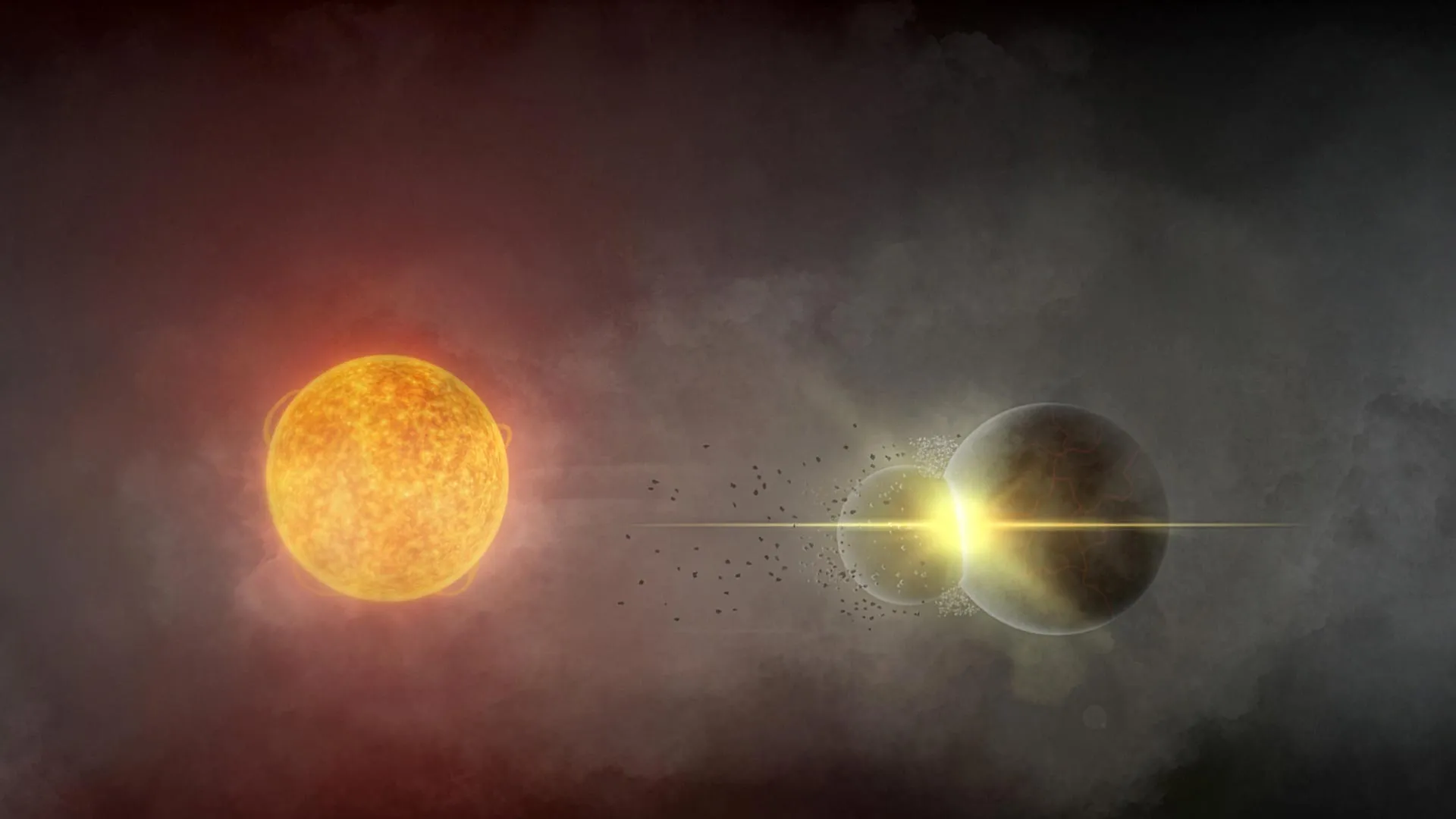
Researchers eventually determined that this strange behavior was not coming from the star itself. Instead, large amounts of rock and dust passed in front of it as it orbited the system, partially blocking the light heading toward Earth. The debris appears to have been created by an unusual event: a violent collision between two planets.
“It’s incredible that different telescopes captured this impact in real time,” Tzanidakis said. “There are only a few other recorded planetary collisions of any kind, and none have as many similarities to the ones that formed Earth and the moon. If we can observe more moments like this elsewhere in the galaxy, we could learn a lot about the formation of our world.”
The team’s analysis was published on March 11th. Astrophysics Journal Letter.
Why do planetary collisions occur?
Planet formation is a chaotic process. Around young stars, gravity pulls in materials such as dust, gas, ice, and rock debris that orbit the star. In the early stages of the solar system, collisions between growing planetary bodies occur frequently. Some worlds collide with each other, others are thrown into outer space. This process takes place over tens of millions of years, gradually forming and stabilizing just like our planetary system.
Although these collisions appear to be common in space, they are extremely difficult to witness from Earth. To detect it, orbiting debris would have to pass directly between us and the star, blocking some of its light. The resulting dimming pattern may develop slowly, sometimes over several years.
“Andy’s unique work leverages decades of data to find what’s happening slowly, the story of astronomy that unfolds over a decade,” said lead author James Davenport, assistant professor of astronomy at Wisconsin State University. “Not many researchers are looking for phenomena in this way, which means all sorts of discoveries are potentially possible.”
Infrared signals reveal hot debris
Tzanidakis, lead author of the study, focuses on stars that show dramatic changes in brightness over time. Previous research at the University of Washington helped identify a system of binary stars and large dust clouds that causes a solar eclipse that lasts seven years.
But Gaia20ehk presented a completely different puzzle. Its brightness first briefly decreased and then became very chaotic. Scientists struggled to explain this pattern until Davenport suggested looking at observations made with infrared light instead of visible light.
“The infrared light curve was exactly the opposite of visible light,” Tzanidakis said. “As the visible light began to flicker and dim, the infrared light spiked. This could mean that the material blocking the star is hot — hot enough to glow in the infrared.”
Violent collisions of planets could easily generate that level of heat. Such an event could also explain the initial dip in brightness observed by astronomers.
“It could be because the two planets are spiraling closer and closer to each other,” Tzanidakis said. “At first, there were a series of grazing collisions that didn’t produce as much infrared energy. Then there was a big catastrophic collision and the infrared light actually increased.”
Possible echo of Earth’s moon formation
There are also hints that this collision may be similar to the event that formed Earth and the moon about 4.5 billion years ago. The debris cloud around Gaia20ehk appears to orbit the star at about 1 astronomical unit, about the distance between Earth and the sun.
There, the ejected material could eventually cool and coalesce into new planetary bodies, forming something similar to Earth’s moon-like system. But scientists will have to wait until the debris cloud settles before knowing what will ultimately form. The process can take years or even millions of years.
Future telescopes could detect even more collisions
For now, the discovery highlights the importance of looking for impacts on more planets. The Simoni Survey Telescope at the NSF-DOE Vera C. Rubin Observatory is expected to play a key role when the Legacy Space-Time Survey begins later this year. Davenport roughly estimates that Rubin Observatory could detect about 100 similar collisions over the next 10 years.
The discovery of more such events could improve scientists’ understanding of how planetary systems evolve and help narrow the search for habitable worlds beyond our solar system.
“How rare was the event that created the Earth and the moon? That question is fundamental to astrobiology,” Davenport said. “The moon appears to be one of the magical elements that makes Earth suitable for life. It helps protect Earth from some asteroids, produces ocean tides and weather that allow chemistry and biology to mix on a global scale, and may even play a role in promoting tectonic plate activity. At this point, we don’t know how common these dynamics are. But as we capture more of these collisions, we’ll begin to understand.”
