


Almost a century ago, astronomer Edwin Hubble discovered that nearly all galaxies are moving away from the Milky Way. This observation became the basis of modern cosmology, as it provided important evidence that the universe was expanding and that it began with a big bang. But even in Hubble’s time, astronomers knew that this pattern was not universal. One notable exception is the neighboring Andromeda galaxy, which is moving toward the Milky Way at about 100 kilometers per second.
For about 50 years, scientists have puzzled over another related mystery. With the exception of Andromeda, most large galaxies near us appear to be moving away from us rather than being pulled inward by gravity. This seems surprising because these galaxies are located close to a local group (the Milky Way, Andromeda, and a few dozen smaller galaxies) whose combined mass should have a significant gravitational influence.
Huge space sheet around the local population
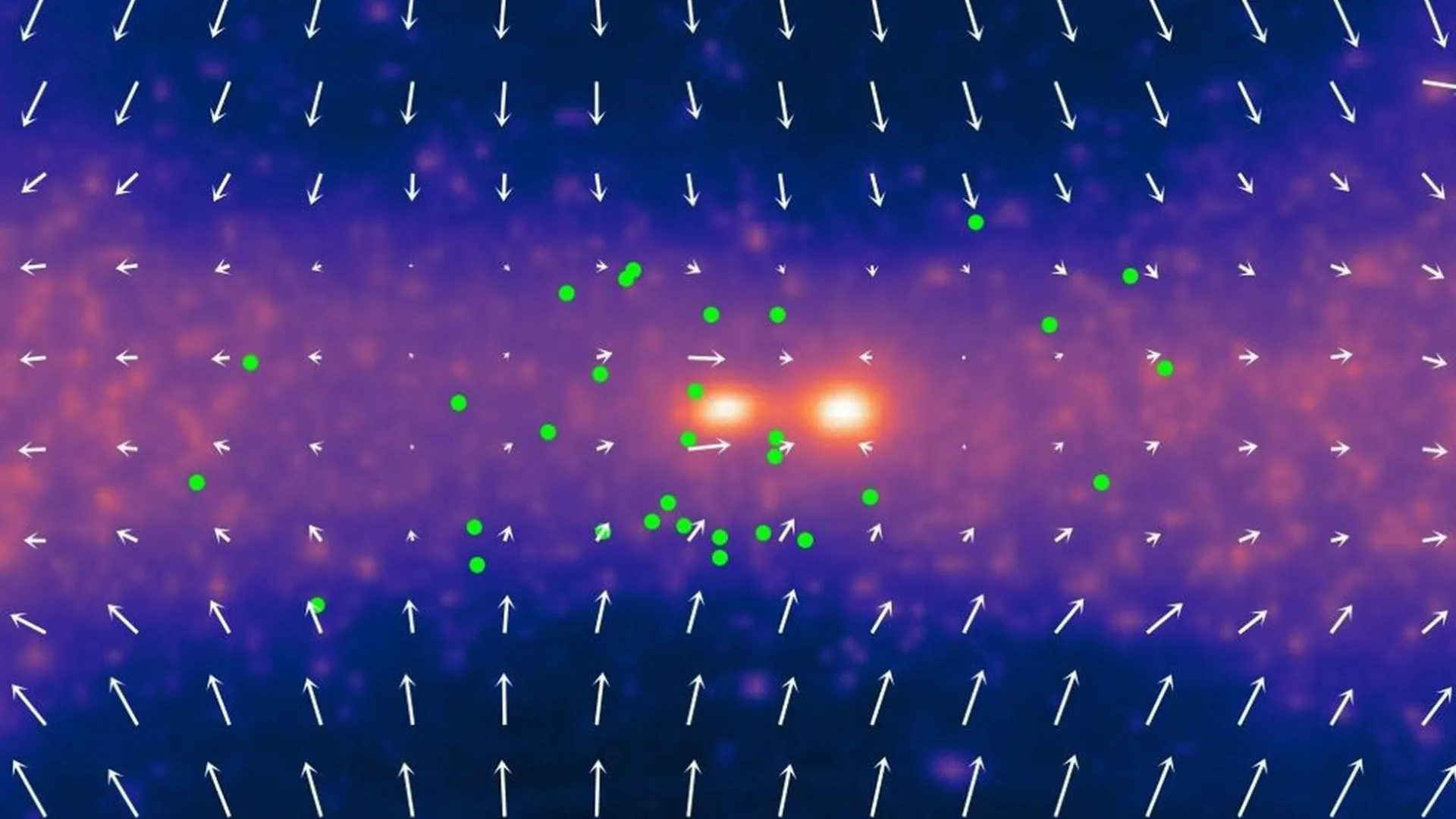
An international research team led by Eward Wempe, a PhD graduate at the Kaptein Institute in Groningen, believes they have found the explanation. Using advanced computer simulations, the researchers found that the material surrounding the local group is arranged in a broad, flat structure spanning tens of millions of light-years. This structure contains not only ordinary matter but also the invisible dark matter that surrounds galaxies. Above and below this flat region is a huge region of sky known as the Cosmic Cavity.
Simulations show that this arrangement of matter can accurately reproduce both the position and velocity of galaxies observed around us. In other words, the computer model successfully reproduces the same patterns that astronomers see in the real universe.
Create a virtual twin of our cosmic neighbor
To build the model, scientists started with conditions in the early universe. They used measurements of the cosmic microwave background radiation to estimate how matter was distributed immediately after the Big Bang. Powerful computers then evolved this early universe over time, eventually producing systems that correspond to today’s local groups.
The resulting simulation reproduces the masses, positions, and motions of the Milky Way and Andromeda, as well as the positions and velocities of 31 galaxies just outside the local cluster. This model is so similar to our environment that researchers describe it as a “virtual twin” of the space environment.
If the model includes a flat distribution of matter, the surrounding galaxies will move away from us at a speed similar to that observed in reality. Despite local group gravity, in-plane galaxies are affected by additional mass spread across the same plane. This distant mass balances the gravity of the local group. On the other hand, the regions outside the plane contain few galaxies, which is why we don’t see objects falling towards us from these directions.
A long-standing mystery is finally solved
The study is the first detailed attempt to elucidate the distribution and motion of dark matter in the region around the Milky Way and the constellation Andromeda, said lead researcher Eurd Wempe. “We are investigating all possible local configurations of the early universe that could ultimately lead to local groups. It’s great to have a model that is consistent with current cosmological models on the one hand and the dynamics of the local environment on the other.”
Astronomer Amina Helmi also welcomed the discovery, noting that this problem has puzzled researchers for decades. “We are excited to see that we can determine the mass distribution corresponding to the position of galaxies within and just outside the local cluster, based purely on the motion of the galaxies.”
