


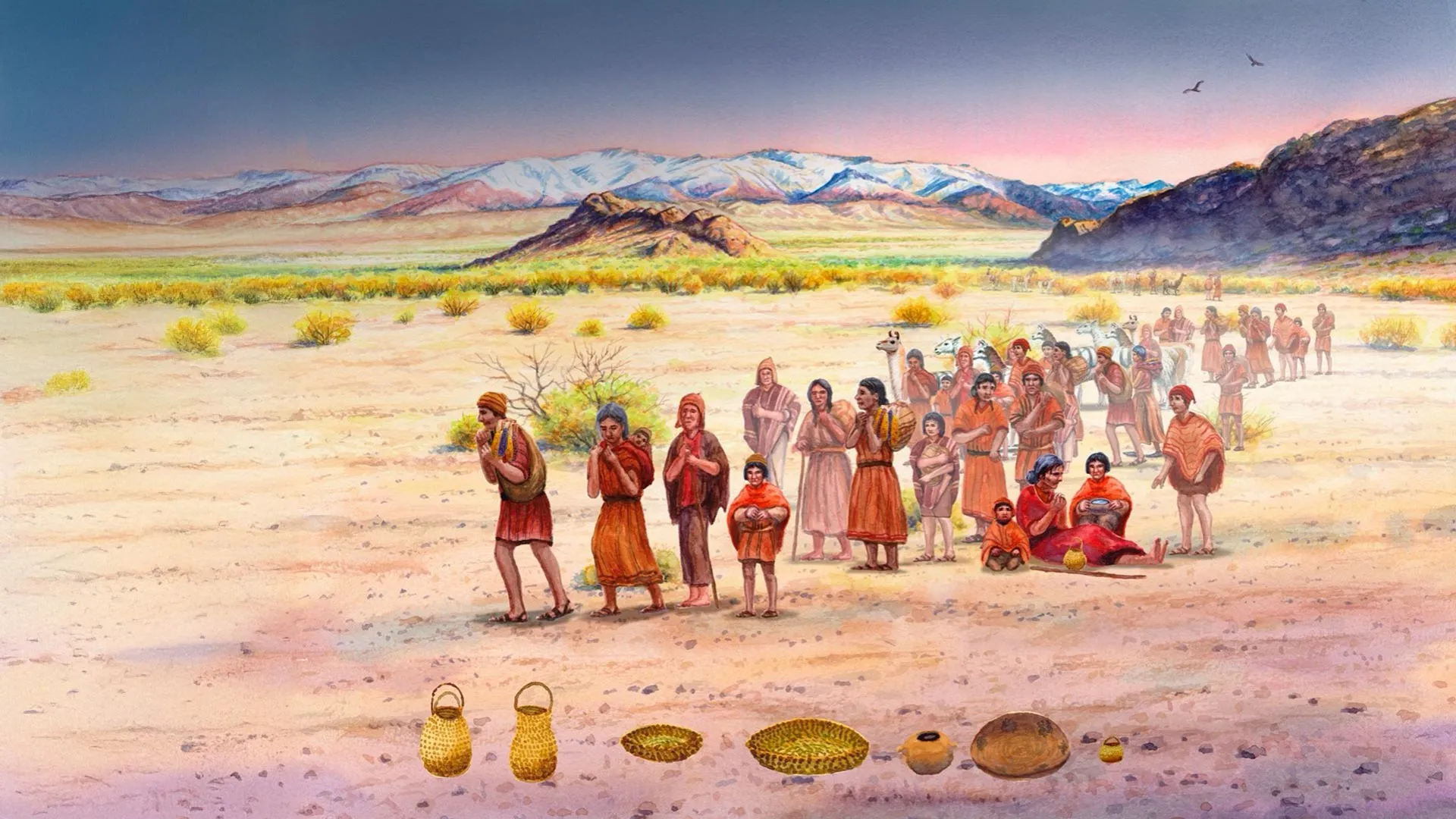
New interdisciplinary research presented at nature Tracing over 2,000 years of population history in Argentina’s Uspallata Valley (UV), an important southern tip of ancient Andean agriculture. This research provides new insights into how agriculture reshaped society and how people coped with long-term hardship. By combining ancient human and pathogen DNA with isotopic data, archaeology, and paleoclimate records, and working closely with Hualpe indigenous communities, the research team revealed how local hunter-gatherers adopted agriculture, how subsequent maize-based societies faced sustained stress, and how strong family bonds helped people endure precarious conditions.
One long-standing question is whether agriculture spread primarily through migrant farmers or through local groups who introduced crops and techniques. Archaeological evidence alone often does not clearly distinguish between these possibilities, as both can produce similar material remains. The Usparata Valley provides a unique opportunity to explore this question, as agriculture arrived later than in other regions of South America.
Researchers led by the Microbial Paleogenomics Unit (MPU) at the Pasteur Institute analyzed genome-wide ancient DNA from 46 people, ranging from early hunter-gatherers to late farmers. The results showed strong genetic continuity between hunter-gatherers (about 2,200 years ago) and people more than 1,000 years after corn cultivation and other crops became widespread. This suggests that agriculture was not introduced by large incoming populations, but was primarily adopted by local populations.
Deep genetic roots and indigenous continuity
The discovery also fills an important gap in understanding the genetic history of southern Andean populations. “Beyond the local story of Usparata, we are also filling a gap in the genetic diversity of South American humans by documenting a genetic component previously only suggested by analyzing modern populations, which is now highly prevalent in this region. “There is evidence of deep divergence and current persistence,” explains the study’s co-lead author Pier Luigi, a researcher at CONICET in Argentina who began the study as a postdoctoral fellow at MPU at the Institut Pasteur in France.
“The persistence of this ancestral genetic element in today’s populations is significant because it refutes narratives that claim that indigenous descendants in this region have become extinct since the establishment and growth of the Argentine state.”
Eating, moving, and transitioning to intensive corn farming
To understand daily life, researchers analyzed stable isotopes stored in bones and teeth. Carbon and nitrogen isotopes reveal long-term diet, and strontium isotopes indicate where a person lived and whether they moved during their lifetime.
The data show that maize consumption has changed over time, indicating flexible farming practices rather than a steady transition to complete agricultural dependence. But between about 800 and 600 years ago, a different pattern emerged at a major burial site called Potrero Las Colonias. Many individuals there showed traces of non-local strontium, which was highly dependent on maize and among the highest levels recorded in the southern Andes, indicating it had migrated to the region. Who are these immigrants and where do they come from?
Signs of migration, decline and stress
Further genetic and isotopic evidence suggests that these immigrants came from nearby regions rather than distant populations. They had close ties to local groups and were part of the same broader population network. Still, genomic data reveals that this group experienced a rapid and long-term population decline, indicating continued stress across generations.
Multiple lines of evidence point to a complex crisis. Paleoclimate records show that population declines were accompanied by periods of environmental instability. At the individual level (individual life), skeletal remains show signs of childhood malnutrition and disease. Ancient DNA also revealed that tuberculosis was present there, belonging to a lineage known from pre-contact South America. Its presence this far south, beyond previously recorded areas in Peru and Colombia, raises new questions about how the disease spread and persisted.
“It is surprising that tuberculosis was detected so far south in a pre-contact situation,” said Nicolas Raskovin, head of the microbial paleogenomics unit at the Pasteur Institute. “This expands the geographic framework for understanding how tuberculosis spread in the past and highlights the value of integrating pathogen genomics into broader reconstructions of human history.”
Family networks helped communities survive
Genetic analysis of family relationships adds another important layer. Although many of the immigrants were closely related, they were buried at different times, suggesting that migration to the valley continued over several generations. These kinship networks are primarily organized through the maternal line, with one mitochondrial lineage predominating, suggesting that women play an important role in maintaining family continuity and coordinating migration.
There is no evidence of violent conflict, and locals and newcomers are sometimes buried together, suggesting peaceful coexistence.
Taken together, these findings indicate that migration based on family ties functioned as a survival strategy amid the overlapping pressures of environmental instability, food scarcity, and disease. “Farmers do not abandon their fields and homes lightly,” said archaeologist Ramiro Barberena, co-author and CONICET researcher. “Our results are most consistent with people moving under force majeure and relying on family networks to survive the crisis.”
Barberena added: “Understanding how these changes are unfolding and what they mean for demographics, economies and health can help us better understand the paths that have shaped our societies today and think about the risks and challenges of climate change and demographic pressures.”
Collaboration with indigenous communities
The study also highlights the importance of collaboration with indigenous communities. Members of the Huarpe community participated throughout the research process and contributed to the interpretation and construction of the narrative. The study was co-authored by three community members: Claudia Herrera, Graciela Coz, and Matías Candito. Ongoing discussions helped address permissions, uncertainties, and how to share findings. A Spanish version with easy-to-access instructions was also created to support local participation.
“Archaeology and paleogenomics are not neutral when it comes to the ancestry of living people,” Raskovan says. “Working with communities changes the way we do science. It shapes the questions we ask, how we interpret evidence, and how we communicate what we can and cannot conclude.”
Rethinking how agriculture has shaped human history
More broadly, this study shows that the transition to agriculture, one of the most profound transformations in human history, did not follow a single path. Instead, developments varied depending on local environments and social dynamics. By combining genetic, archaeological, environmental, and pathogen data, this study reveals how ancient communities coped with overlapping challenges such as climate instability, food stress, and disease.
These long-term insights into how people have adapted and survived, particularly through cooperation and family networks, provide a valuable perspective for understanding resilience in the face of modern climate and health challenges.
