


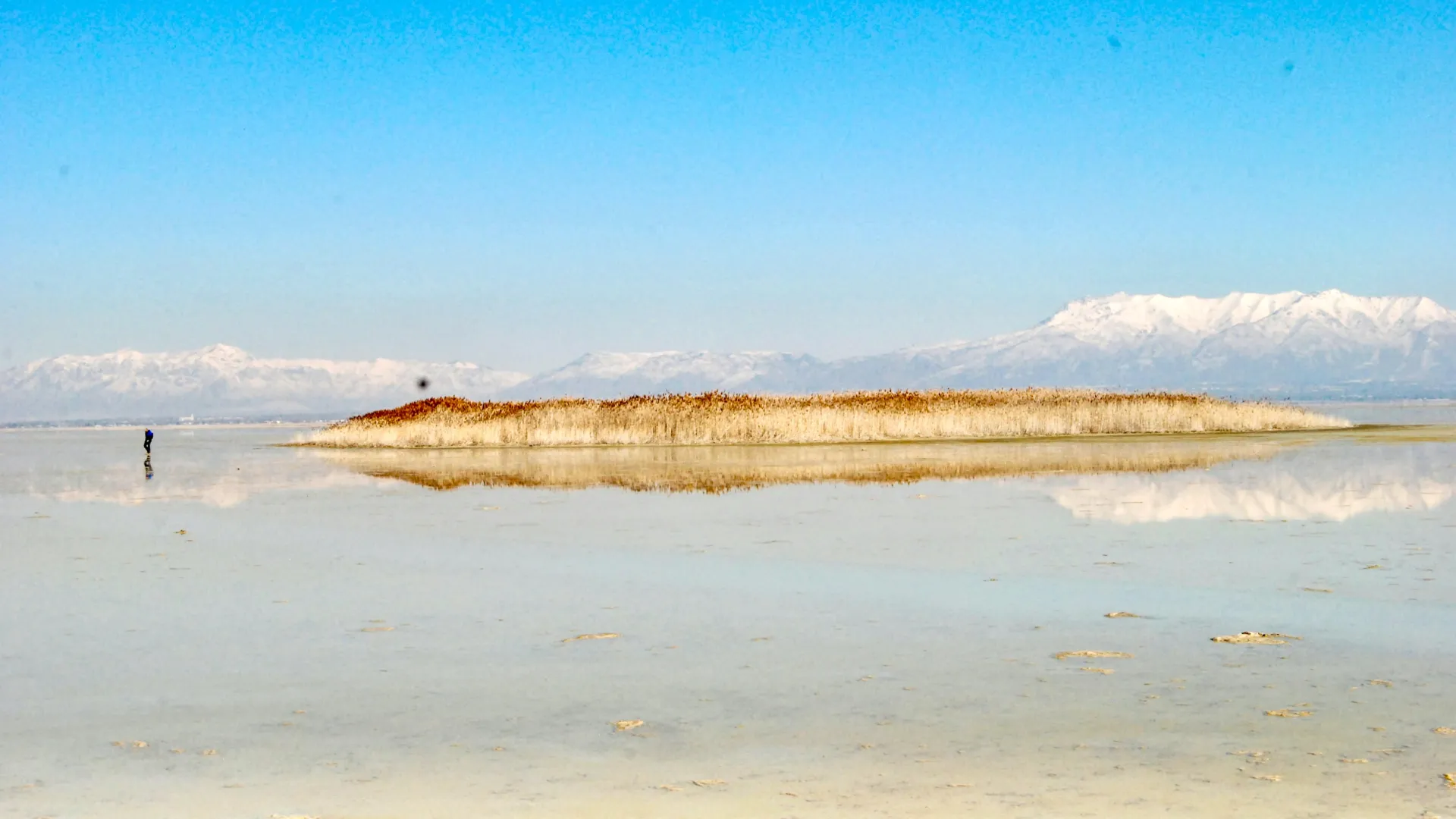
A newly identified subsurface freshwater system beneath the Great Salt Lake is becoming more apparent thanks to a study that used airborne electromagnetic (AEM) surveys to map the geological formations beneath Farmington Bay and Antelope Island along the southeastern edge of the lake.
Researchers at the University of Utah analyzed the data and found that fresh water filled the sediments beneath the salty lake’s surface, reaching a depth of 3 to 4 kilometers, or about 10,000 to 13,000 feet. The helicopter survey was carried out last year after scientists observed freshwater gushing under pressure on parts of Farmington Bay’s exposed lake bed, forming unusual mounds covered in dense reed fronds.
According to lead author Michael Zhdanov, this study marks the first time that AEM technology has successfully detected freshwater beneath a thin layer of conductive saline water on the surface of the Great Salt Lake. The researchers also estimated how deep the water-saturated sediments reach by mapping how far the fresh water extends beneath Farmington Bay and identifying the underlying subsurface structures.
“We were able to answer the question: how deep is this potential reservoir and what is its spatial extent below the eastern lake margin? Once we know how deep it is, how wide it is, and the porous space, we can calculate the potential freshwater volume,” said Zhdanov, distinguished professor of geology and geophysics and director of the Electromagnetic Modeling and Inversion Consortium (CEMI).
State-funded research on newly discovered aquifers
The results of this research were published in a Nature-related journal. scientific report. This study is part of a broader research initiative led by the University of Utah’s Department of Geology and Geophysics and funded by the Utah Department of Natural Resources. The goal is to better understand the groundwater of the Great Salt Lake, the largest terminal lake in the Western Hemisphere.
Senior faculty and graduate students are contributing to this ongoing effort, with two additional studies already underway and many more expected.
The new results show that freshwater may be moving underground toward the interior of the lake, rather than remaining near the edge, as scientists typically expect. Hydrologist Bill Johnson, co-author of the groundwater study, emphasized how unusual this pattern is.
“The unexpected part this time around wasn’t the salt lens that we see near the surface of the playa. It’s that the fresh water underneath is extending very deep into the interior of the lake, and probably underneath the entire lake. We just don’t know,” Johnson said on a recent appearance on KCPW’s Cool Science Radio show. “What we normally expect as hydrologists is that that salt water occupies the entire volume beneath that lake. It’s more dense than fresh water. You would expect fresh water from the mountains to come in from somewhere on the margins. But we found that it’s coming in toward the interior. And underneath that lens of salt water, there’s what looks like a deep volume of this fresh water coming in.”
Fresh water may help reduce toxic dust
The study was prompted by the recent appearance of circular mounds on the dry lakebed of Farmington Bay. These features are 50 to 100 meters in diameter and covered with tall reeds reaching about 15 feet. As the lake’s water level declines, the approximately 800 square miles of exposed lake bed becomes a source of dust pollution that impacts nearby communities.
Johnson and his colleagues are investigating whether excavated groundwater can be safely used to reduce dust containing harmful metals.
“This groundwater has beneficial effects that we need to understand before we extract more. The first goal is to understand whether we can use this freshwater to wet dust hotspots and make it rain in a meaningful way without disrupting the freshwater system too much,” Johnson said. “For me, that’s the primary objective, because it’s very practical and it’s impossible to fill in enough of Farmington Bay and other parts of the playa to avoid creating dust in the highlands. This would be a great way to accomplish that.”
Johnson, along with colleagues including Mike Thorne and Kip Solomon, is seeking funding to expand the study to cover a wider area of the lake.
Aerial survey reveals underground structure
In this study, scientists used airborne electromagnetic sounding to measure electrical resistivity up to about 100 meters, allowing them to distinguish between seawater and freshwater, which conduct electricity better. To carry out this work, Johnson and Zhdanov hired a Canadian geophysics team to fly an instrument suspended below a helicopter in February 2025. The aircraft completed 10 east-west survey lines across Farmington Bay and northern Antelope Island, covering a total of 154 miles.
Zhdanov’s team used this data to map where fresh and salt water meet underground. One of the reed-covered mounds was directly above a point where fresh water was rising through a crack in the impermeable layer below the lake.
“Red means very conductive, blue means resistive,” Zhdanov said, explaining the map. “You can clearly see that there’s salt water near the surface and resistant fresh water 10 meters down. You can clearly see that it’s everywhere.”
Revealing deep geological features with 3D imaging
The CEMI research group has developed a method to combine airborne electromagnetic data and magnetic measurements to create detailed 3D images of the subsurface. Using this approach, the team created a tomographic model extending deep into Farmington Bay, providing new insights into the region’s geological and hydrological framework.
According to their analysis, the playa’s underground is relatively shallow, less than 200 meters deep, and then drops rapidly to a depth of 3-4 kilometers. This abrupt transition occurs beneath one of the phragmite mounds and marks a major structural boundary that requires further investigation.
“For this reason, we need to study the entire Great Salt Lake. Then we will know the top and the bottom,” Zhdanov said. “To study the top, we use airborne electromagnetic methods, which tells us the thickness of the salt layer and where the fresh water begins below the salt layer. To study the bottom, we use magnetic data. We use a variety of techniques to study the vertical extent of this freshwater-saturated sediment and find the depth to the subsurface.”
Although this initial survey covered only a small portion of the lake, Zhdanov believes it is possible to expand the aerial survey to cover the lake’s entire area of 1,500 square miles.
A comprehensive study could support regional water management decisions and guide similar efforts to find freshwater beneath terminal lakes around the world.
