

Close Menu

    Subscribe to Updates

    Get the latest creative news from FooBar about art, design and business.

    What's Hot

    These tiny soil microbes could save crops from salty farmland

    June 29, 2026

    Melatonin reduces inflammation of fetal membranes associated with preterm birth

    June 29, 2026

    People who frequently experience feelings of inner emptiness may actually have higher levels of empathy

    June 29, 2026
    Facebook X (Twitter) Instagram
    Facebook X (Twitter) Instagram
    Health Magazine
    • Home
    • Environmental Health
    • Health Technology
    • Medical Research
    • Mental Health
    • Nutrition Science
    • Pharma
    • Public Health
    • Discover
      • Daily Health Tips
      • Financial Health & Stability
      • Holistic Health & Wellness
      • Mental Health
      • Nutrition & Dietary Trends
      • Professional & Personal Growth
    • Our Mission
    Health Magazine
    Home » News » Our Sun may have escaped from the center of the Milky Way, which has thousands of twin stars
    Nutrition Science

    Our Sun may have escaped from the center of the Milky Way, which has thousands of twin stars

    healthadminBy healthadminMarch 14, 2026No Comments4 Mins Read
    Our Sun may have escaped from the center of the Milky Way, which has thousands of twin stars
    Share
    Facebook Twitter Reddit Telegram Pinterest Email


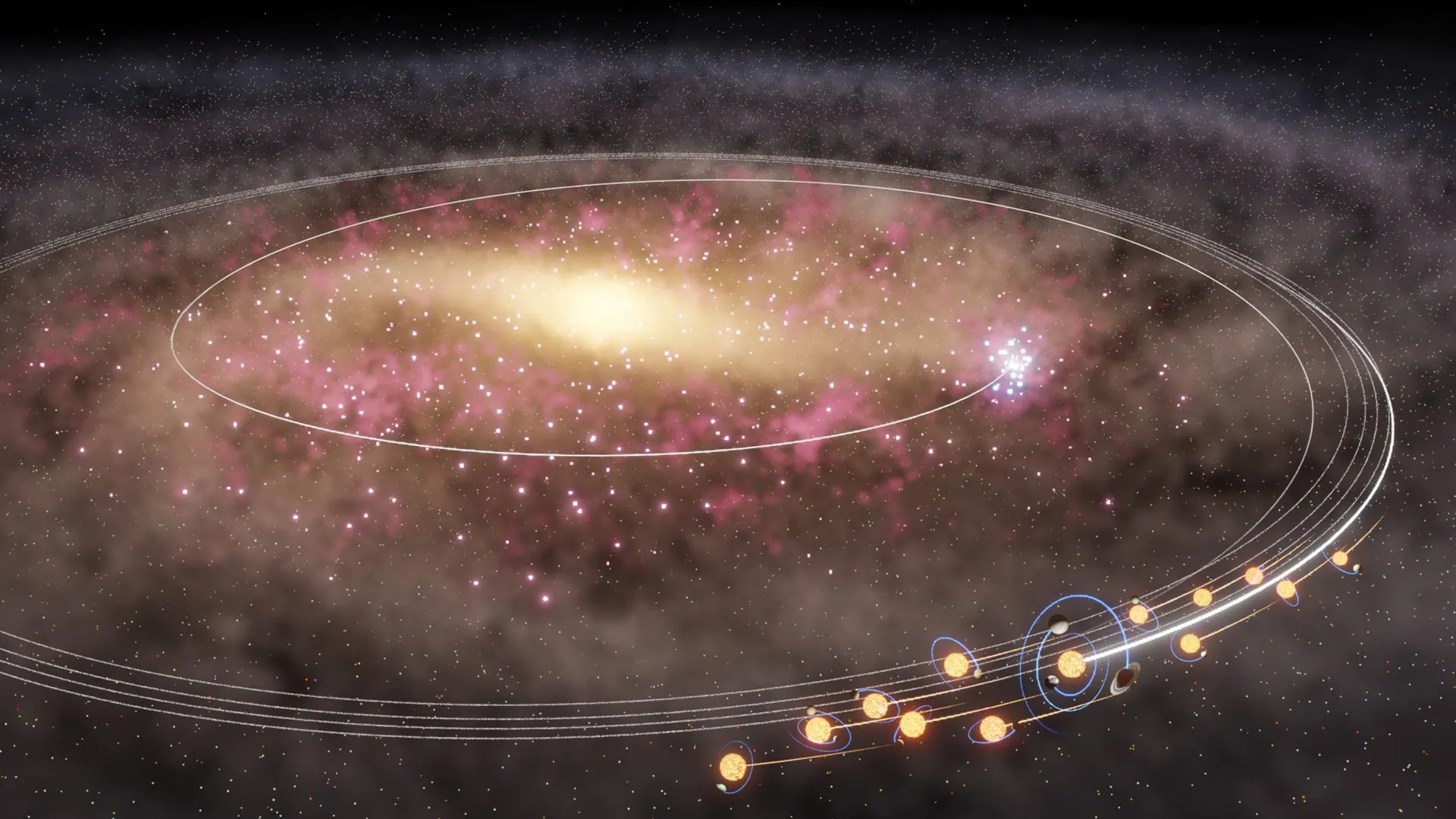
    Astronomers have discovered signs that our sun may have participated in a large-scale movement of similar stars that left the inner regions of the Milky Way galaxy about 4 billion to 6 billion years ago. To investigate this possibility, the researchers used observations from the European Space Agency’s Gaia satellite to compile and analyze a highly accurate catalog of stars. Their results provide new insight into how the Milky Way evolved, particularly the formation of the rotating bar-like structure at the galaxy’s center.

    On Earth, archeology reconstructs the past by studying ancient artifacts and ruins. In space, scientists use a similar approach called galactic archeology to piece together the history of stars and galaxies.

    Astronomers know that the Sun formed about 4.6 billion years ago more than 10,000 light-years closer to the center of the Milky Way than it is today. Evidence from the chemical composition of stars supports this idea, but the explanation has long puzzled researchers. When we look at our galaxy, we see a huge bar-like structure in its central region, creating what scientists call a “corotation barrier.” This gravitational effect makes it difficult for stars to travel far from the center of the galaxy.

    Studying the solar twins with Gaia

    To find out how the Sun arrived at its current orbit, a research team led by Assistant Professor Daisuke Taniguchi of Tokyo Metropolitan University and Professor Takuji Tsujimoto of the National Astronomical Observatory of Japan conducted a large-scale study of the Sun’s “twins.” These stars share roughly the same temperature, surface gravity, and chemical composition as the Sun.

    The researchers used the Gaia satellite mission, which collected detailed measurements of about 2 billion stars and other celestial objects. Using this vast dataset, they created a catalog containing 6,594 solar twins. This sample is approximately 30 times larger than the sample used in previous studies.

    Sharing migration as revealed by age distribution

    Using this expanded dataset, the team was able to determine the ages of these stars with unprecedented precision. They also corrected for a selection bias favoring brighter stars that are easier for telescopes to detect.

    When researchers investigated the ages of the solar twins, they found that they were apparently concentrated in stars between 4 billion and 6 billion years old. The Sun is also within this same age range. Many of these stars appear to occupy similar distances from the galaxy’s center. Taken together, these clues indicate that the Sun’s current position is no mere coincidence. Rather, it may have arrived here as part of a much larger outward movement of the star.

    Clues about the formation of the Milky Way’s central bar

    This discovery provides new information about the structure and history of the Milky Way. Under normal circumstances, the corotational barrier created by the galaxy’s central bar would prevent so many stars from moving away from the inner regions. However, the situation may have been different if bar structures were still forming during that period.

    The age of the solar twin not only indicates when this massive migration occurred, but also suggests the period during which the galactic bar developed.

    Why solar travel is important for life

    The inner Milky Way is much more hostile than the outer regions. Conditions near the galactic center include stronger radiation and more frequent interactions between stars. Researchers say the sun’s movement away from this crowded environment may have helped place our solar system in a quieter part of the galaxy.

    This tranquil region provided the conditions that allowed life on Earth to eventually emerge and evolve.

    This work utilized data products from the European Space Agency (ESA) space missions Gaia and Two Micron All Sky Survey. This research was supported by the European Union’s Horizon 2020 Research and Innovation Program under the Tokyo Metropolitan University Tokyo Center for Excellence Project, JSPS KAKENHI Grant Numbers 23KJ2149 and 23H00132, and SPACE-H2020 Grant Agreement Number 101004214 (EXPLORE project).


    Source link

    Visited 32 times, 1 visit(s) today
    Share. Facebook Twitter Pinterest LinkedIn Telegram Reddit Email
    Previous ArticlePennsylvania releases long-awaited study on radioactivity in landfill runoff
    Next Article Exercise during chemotherapy supports physical and cognitive health
    healthadmin

    Related Posts

    These tiny soil microbes could save crops from salty farmland

    June 29, 2026

    Only one exercise helped older adults lose fat without losing muscle

    June 28, 2026

    Common pesticides more than double risk of Parkinson’s disease

    June 28, 2026

    James Webb discovers exotic salt clouds in a mysterious pink world

    June 28, 2026

    Hawaii turns ocean plastic and fishing nets into roads

    June 28, 2026

    Yellowstone’s supervolcano may be fueled by something unexpected

    June 28, 2026
    Add A Comment

    Comments are closed.

    Categories

    • Daily Health Tips
    • Discover
    • Environmental Health
    • Exercise & Fitness
    • Featured
    • Featured Videos
    • Financial Health & Stability
    • Fitness
    • Fitness Updates
    • Health
    • Health Technology
    • Healthy Aging
    • Healthy Living
    • Holistic Healing
    • Holistic Health & Wellness
    • Medical Research
    • Medical Research & Insights
    • Mental Health
    • Mental Wellness
    • Natural Remedies
    • New Workouts
    • Nutrition
    • Nutrition & Dietary Trends
    • Nutrition & Superfoods
    • Nutrition Science
    • Pharma
    • Preventive Healthcare
    • Professional & Personal Growth
    • Public Health
    • Public Health & Awareness
    • Selected
    • Sleep & Recovery
    • Top Programs
    • Weight Management
    • Workouts
    Popular Posts
    • 1773313737_bacteria_-_Sebastian_Kaulitzki_46826fb7971649bfaca04a9b4cef3309-620x480.jpgHow Sino Biological ProPure™ redefines ultra-low… March 12, 2026
    • pexels-david-bartus-442116The food industry needs to act now to cut greenhouse… January 2, 2022
    • 1773729862_TagImage-3347-458389964760995353448-620x480.jpgDespite safety concerns, parents underestimate the… March 17, 2026
    • 1773209206_futuristic_techno_design_on_background_of_supercomputer_data_center_-_Image_-_Timofeev_Vladimir_M1_4.jpegMulti-agent AI systems outperform single models… March 11, 2026
    • 1774403998_image_28620e4b6b0047f7ab9154b41d739db1-620x480.jpgGait pattern helps distinguish between Lewy body… March 24, 2026
    • Leukemia-620x480.jpgBiomimetic platform powers CAR T therapy for… March 9, 2026

    Demo
    Stay In Touch
    • Facebook
    • Twitter
    • Pinterest
    • Instagram
    • YouTube
    • Vimeo
    Don't Miss

    These tiny soil microbes could save crops from salty farmland

    By healthadminJune 29, 2026

    Researchers have discovered an unexpected natural ally that could help farmers tackle one of agriculture’s…

    Melatonin reduces inflammation of fetal membranes associated with preterm birth

    June 29, 2026

    People who frequently experience feelings of inner emptiness may actually have higher levels of empathy

    June 29, 2026

    Magnetic muscle implant helps amputees feel coordinated movement of prosthetic hand

    June 28, 2026

    Subscribe to Updates

    Get the latest creative news from SmartMag about art & design.

    HealthxMagazine
    HealthxMagazine

    At HealthX Magazine, we are dedicated to empowering entrepreneurs, doctors, chiropractors, healthcare professionals, personal trainers, executives, thought leaders, and anyone striving for optimal health.

    Our Picks

    Magnetic muscle implant helps amputees feel coordinated movement of prosthetic hand

    June 28, 2026

    Only one exercise helped older adults lose fat without losing muscle

    June 28, 2026

    Can nighttime brain bursts predict performance on intelligence tests?

    June 28, 2026
    New Comments
      Facebook X (Twitter) Instagram Pinterest
      • Home
      • Privacy Policy
      • Our Mission
      © 2026 ThemeSphere. Designed by ThemeSphere.

      Type above and press Enter to search. Press Esc to cancel.