


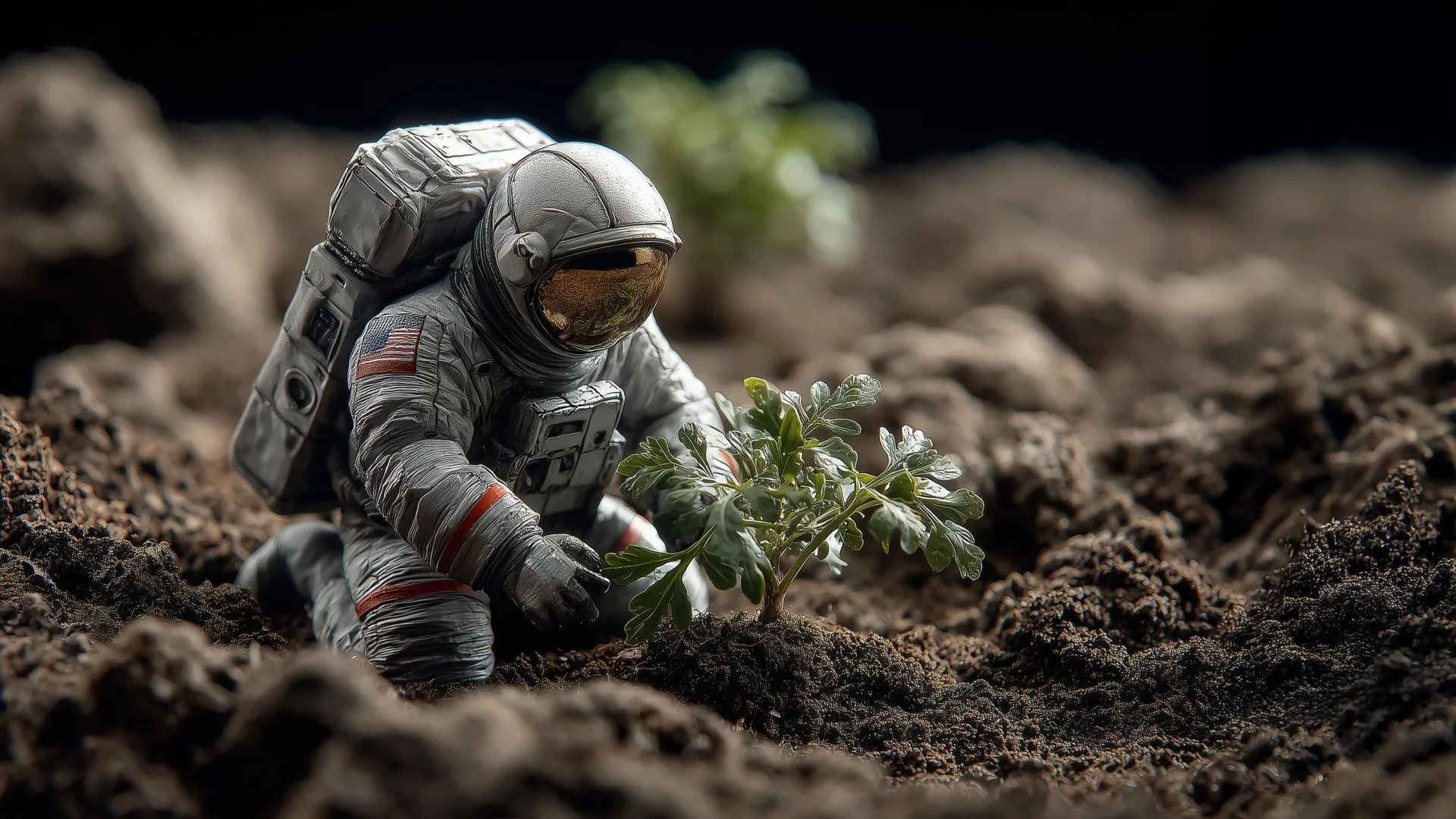
As NASA prepares for the Artemis II mission and a new push for lunar exploration, scientists are thinking about a practical challenge for future astronauts: what they’ll eat. A new study from the University of Texas at Austin suggests chickpeas may be part of the answer.
In a recent experiment, scientists successfully grew and harvested chickpeas using simulated “lunar soil.” This is the first time that crops have been produced with materials designed to mimic lunar soil. The study was conducted with collaborators at Texas A&M University and published in the journal. scientific report.
Sara Santos, the project’s principal investigator, said the discovery is an important step toward understanding how crops are grown on the moon.
“This study aims to understand the feasibility of growing crops on the moon,” said Santos, a distinguished postdoctoral fellow at the University of Texas Geophysical Institute (UTIG) Jackson School of Geosciences. “How can we turn this regolith into soil? What natural mechanisms cause this transformation?”
Challenges of growing plants in lunar soil
Lunar regolith is the scientific name for the dust-like material that covers the surface of the Moon. Unlike soil on Earth, it does not contain the microorganisms and organic matter necessary for plant growth. Regolith contains minerals and nutrients that can be used by plants, but it also contains heavy metals that can have a negative impact on plant development.
To test whether crops could grow in these conditions, the researchers used simulated lunar soil produced by Exolith Labs. This mixture is designed to closely resemble the composition of lunar samples brought back during the Apollo mission.
Create better soil with vermicompost
To improve the growing environment, the team mixed simulated moonsoil with vermicompost. This nutrient-rich substance is produced by red wiggler earthworms when they digest organic waste. Vermicompost contains valuable phytonutrients and a diverse microbiome that support plant health.
In a space mission setting, the worm could produce compost from waste materials such as food debris, cotton clothing, and sanitary products that would otherwise be discarded.
Before planting, the researchers coated the chickpea seeds with arbuscular mycorrhizal fungi. These fungi have a symbiotic relationship with plants. These help plants absorb key nutrients and at the same time reduce the amount of heavy metals taken up from the soil.
Chickpeas grow in simulated moon soil
Santos and her team planted chickpeas in various mixtures of moon soil and vermicompost.
The results showed that plants could grow normally in mixtures containing up to 75% simulated lunar soil. When the amount of lunar soil increased above that level, the plants experienced stress and began to die more quickly.
Even under difficult conditions, plants treated with fungi survived longer than non-inoculated plants. This highlights how important fungi were for helping plants grow. The researchers also discovered that the fungus was able to colonize simulated lunar soil. This suggests that fungi may only need to be introduced once into a real lunar farming system.
Is it safe to eat chickpeas grown on the moon?
Harvesting chickpeas from simulated lunar soil is an important milestone, but some questions remain. Scientists need to determine whether plants absorb harmful metals from the soil and whether chickpeas will provide the nutrients needed by astronauts.
“We want to understand its viability as a food source,” said Jessica Atkin, lead author of the paper and a doctoral candidate in the Texas A&M University Department of Soil and Crop Sciences. “How healthy are they? Do they have the nutrients that astronauts need? If they’re not safe to eat, how many generations will they last?”
The project was initially funded by Santos and Atkin themselves. It has since received additional support through a NASA FINESST grant, which will help advance research into growing food for future missions to the moon.
