


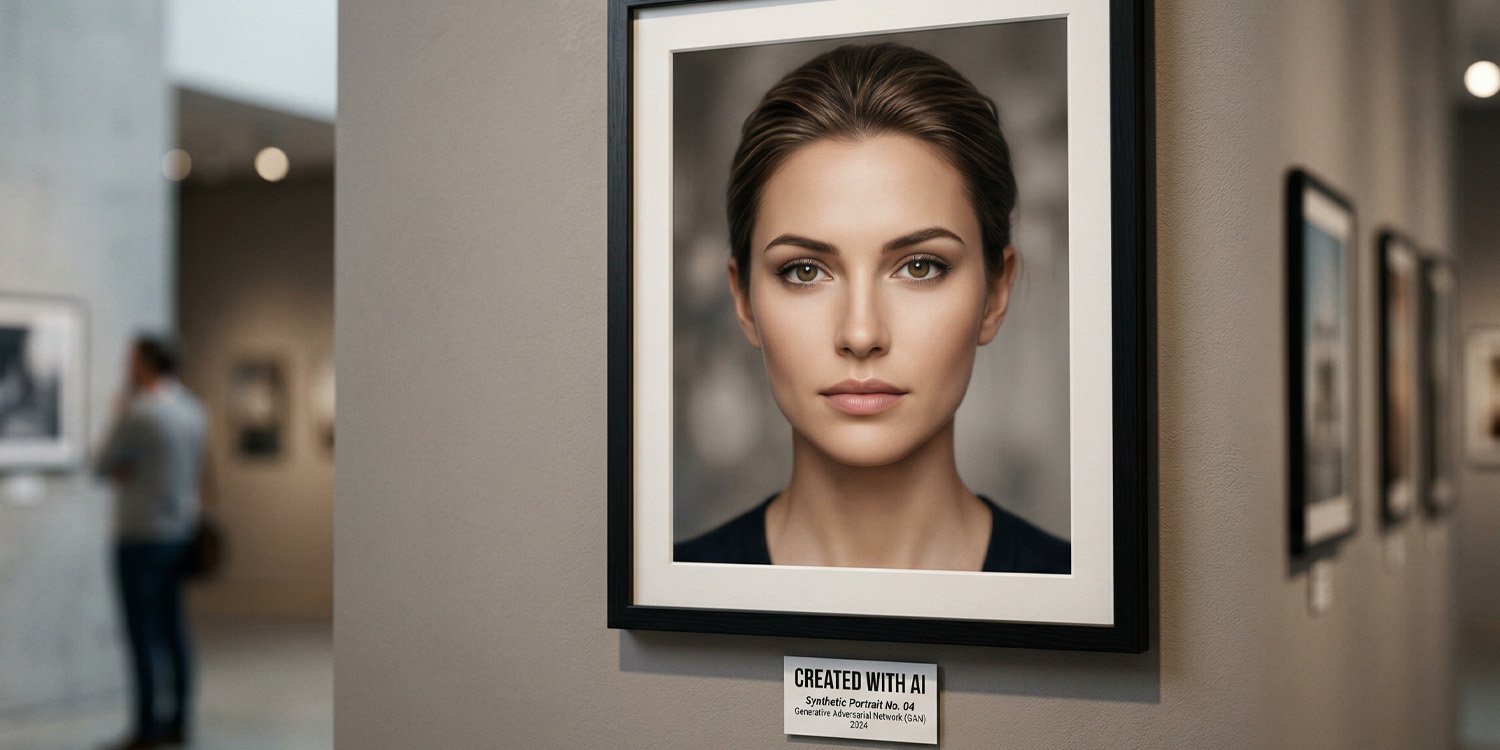
Recent research published in British Journal of Psychology This suggests that people with good facial recognition skills are slightly better at distinguishing faces generated by artificial intelligence from real faces. This study provides evidence that computer-generated faces tend to look mathematically very average, subtle cues that these top facial recognition devices subconsciously detect. Overall, our findings demonstrate that visual intuition alone is no longer sufficient for finding modern synthetic faces, highlighting their increasing vulnerability to digital fraud.
Historically, human facial processing systems have evolved to extract emotion and social meaning from real people. Artificial intelligence programs can now generate synthetic faces that are nearly indistinguishable from real humans.
These synthetic faces pose a serious threat in the real world. Bad actors routinely use artificial faces for illegal activities, such as creating fake profiles for corporate cyberespionage, perpetrating online dating scams, and spreading propaganda through automated accounts. Previous artificial intelligence programs had obvious visual errors, such as crooked teeth or strange backgrounds, that made it easy for people to spot fakes.
As technology advances, these obvious glitches have largely disappeared. Scientists wanted to find out whether certain people have advanced perceptual abilities that allow them to recognize more subtle structural differences between real and generated faces.
“AI-generated faces are now so realistic that most people cannot reliably tell them apart from real faces,” said study author James Dunn, lecturer at UNSW Sydney and principal investigator at the Institute of Facial and Forensic Psychology. “This creates real-world risks, from fraud and fake job applicants to misinformation campaigns using synthetic IDs. At the same time, we know that some people are very good at recognizing faces (‘super-recognizers’), but no one has tested whether that expertise can help AI detect them. We wanted to understand not only who is good at finding faces in AI, but also why.
For the study, the scientists recruited a total of 125 participants. The sample included 36 super-recognizers who had previously achieved top-level scores on standardized facial recognition tests and 89 highly motivated control participants with above-average but exceptional skills. Participants completed an online task that presented them with a series of 200 facial images. (You can take the test here.)
Half of these images were of real white men and women. The other half is an artificial intelligence-generated face designed to match a real face in gender, posture, and expression. For each image, participants had to decide whether the face was real or computer-generated, and rated their confidence in their decision on a scale of 0 to 100.
To understand the hidden structure of artificial faces, the researchers also used artificial neural networks to analyze the images. These are sophisticated computer programs designed to mimic the way the human brain processes information, and are specifically trained here to recognize facial identities. Scientists used these computer models to map out a mathematical landscape called Facespace.
A face located at the center of this mathematical space is considered very average. This means they lack distinct or unusual physical proportions. Computer analysis provides evidence that faces generated by artificial intelligence are significantly closer to this center than real faces. In other words, the artificial face was very typical and symmetrical, lacking the natural features of a real human face.
When observing human participants, researchers found that typical people’s performance was no different from flipping a coin. The control group only correctly identified faces 50.7% of the time. The performance of the super recognizer improved slightly, achieving an average accuracy of 57.3 percent.
Although the Super Recognizers had only a small advantage, they showed a greater awareness of their own performance. If hyperrecognizers are very confident in their guesses, they are more likely to be correct. Control participants showed no such relationship between confidence and actual accuracy.
The researchers also found that superrecognizers and regular participants relied on very different visual cues. Superrecognizers unconsciously used the centrality of face space as a warning sign. If a face looked too perfectly average and symmetrical, superrecognizers tended to classify it as artificial.
“One of the surprising findings is that AI faces are more centered in ‘face space,’ a kind of mental map of faces, than real human faces, and that cue is what gives super-recognizers an advantage,” Dunn told SciPost. “While traditional theory might assume that the most human-looking face should be placed in the center, we found the opposite. This goes back to the ‘hyperaverage’ of AI faces.”
Regular participants completely missed this structural cue. Instead, the control group relied heavily on perceptions of youthfulness. Ordinary participants frequently made the mistake of assuming that aged-looking faces were real people, leading to incorrect guesses.
To see if working together in groups improves accuracy, the scientists ran a statistical simulation called “wisdom of crowds.” They combined responses from multiple participants to see if consensus selection was more accurate. Aggregating the responses of eight super-recognizers significantly improved the group’s detection accuracy, but applying the same mathematical technique to the control group showed no improvement at all.
One potential misconception of this research is the assumption that human experts can consistently protect us from artificial intelligence deception. Even highly skilled super-recognizers achieved only 57% accuracy, far below typical performance on standard face identification tasks.
“The performance benefits we observed were significant, but not dramatic,” Dunn explained. “Super-recognizers performed about 7% better than motivated controls, and their accuracy improved even more when combining small group responses. But even they were far from perfect. So while facial expertise is helpful, it’s not a complete solution to real-world AI deception, at least not yet. We use the insights from this paper to improve AI We want to develop training that can provide significant benefits for everyone when it comes to detecting faces.
Additionally, “some of the people who were best at finding faces in the AI weren’t super recognizers,” Dunn said. “This gives us hope. It means that everyone, including those with prosopagnosia and facial blindness, may be able to tell AI faces from real faces.”
Researchers note that visual judgment can no longer be trusted in high-stakes security situations. The subtle structural differences detected by Super Recognizers are too small to rely on for fraud prevention or online identity verification. Because synthetic faces are designed to mimic real-life statistical characteristics, their features often overlap with those of highly attractive or symmetrical real people.
Future research should explore new methods to improve detection accuracy. Scientists hope to investigate whether a hybrid system that combines human judgment and algorithmic tools can provide better protection against synthetic media. They also plan to look for individuals who may have a special natural talent for detecting artificial faces that differs from traditional facial recognition skills.
“We are interested in whether we can train people to better detect statistical cues that distinguish AI faces from real faces,” Dunn explained. “We are also exploring hybrid approaches that combine human judgment with algorithmic tools. More broadly, we want to understand how increased exposure to AI-generated faces may reshape human facial perception over time.”
“One broader implication is that AI-generated faces may not be neutral stand-ins for real humans. AI-generated faces are systematically more ‘average’, which could impact memory, trust judgments, and even the development of children’s mental representations of faces.” As synthetic identities online become more common, understanding these subtle perceptual changes will become increasingly important.
The study, “Too Good to Be True: Synthetic AI Faces Are More Average than Real Faces, and Super Recognizers Know It,” was authored by James D. Dunn, David White, Clare AM Sutherland, Elizabeth J. Miller, Ben A. Steward, and Amy Dawel.
