


Audio recording is automated for accessibility. Humans wrote and edited the stories. Please take a look at our AI policy and give us your feedback.
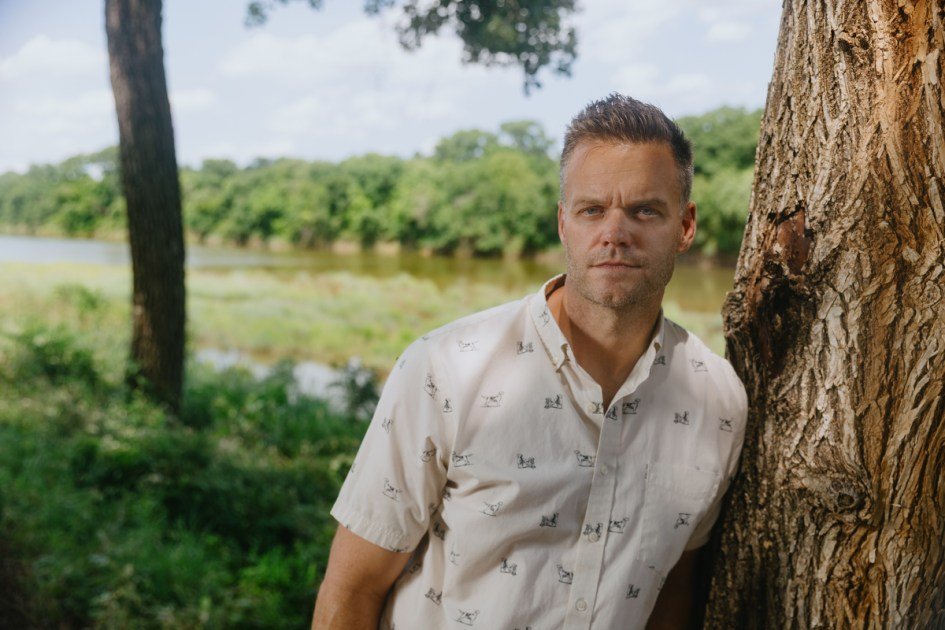
Matt Long stood before the Granbury City Council at its April city planning meeting and opposed the influx of data centers planned for Hood County, likening them to spiritual abominations.
“We consider ourselves a Christian city within a Christian county,” said Long, a member of the county’s Development Commission who lives near Granbury. “As a Christian, do you think trading 2,100 acres of natural beauty for a godless technological complex brings you closer to creation, or does it take you further away from creation?”
“Do you think negotiating with Google, Meta, and Amazon is more like making a deal with God or with the devil?” he asked the council.
Christians must stand up to the data center, Long concluded to applause.
Controversy over data center construction has roiled Texas in recent months, with a bipartisan coalition of opposition growing, especially among rural and suburban residents. With at least 248 data center projects planned and 335 in operation, Texas is poised to become a leader in data center development.
Opponents are also united around religious appeals from a theologically diverse group of residents, leaders, and politicians who view data center development as an affront to their most sacred values.
Many of the opponents focus on the environmental impact and the large amounts of water and power required for large-scale facilities operating AI applications.
Clayton Tucker, a Democrat running for Texas Agriculture Commissioner, is a leader in the anti-data center movement. A Catholic, he thinks data centers are like apples in the Garden of Eden.
“If we take a bite of that apple of knowledge, will it kick us out of this blue marble of Eden…the place we call Earth?” Tucker said.

Religion is not just the domain of dissidents. Texas Railroad Commissioner Wayne Christian (R) said he supports building data centers because “Christians throughout history have embraced innovations that improve our lives, from the printing press to modern medicine.”
“We should approach data centers the same way: leveraging their benefits while ensuring they are built responsibly,” Christian said in a statement.
For a long time, Bible passages such as Daniel 2 and Revelation 13 have made it clear that there is a spiritual meaning to replacing God’s creation with “man’s creation.”
Known as apocalyptic literature, the books of Daniel and Revelation have been interpreted in some theological circles as warnings about the misuse of technologies such as artificial intelligence that threaten God’s intended order and greatly increase government surveillance capabilities.
“They’re going to be able to track our money, where we’re going. … They basically have to maintain order socially,” said Long, who believes this generation will be judged by its response to data centers.
“I don’t want to read about everybody obeying, everybody capitulating, everybody quitting. I want to hear about this few people who held fast to their principles and saw it coming from a mile away and said, ‘We’re not going to budge,'” he said.
Joseph Locke, a professor of Texas and American religious history at the University of North Texas, said he is not surprised that Texans are making religious claims against data centers.
“Texans often use religion when they want to enact social and political change,” he said in a statement, adding that “spiritual warfare rhetoric is particularly common among Christian nationalists and their conservative allies today.”
Long has hosted well-attended prayer meetings at his home and waged his fight online, but he’s not alone there. Religious arguments regularly appear in the comments of dozens of Facebook groups opposing data center development.
Last month, Clarendon resident Maria Miller called on members of the Texans United Against Data Center Facebook group to pray against the data center.
Miller said he sees parallels between the rapid growth of data centers and the end-times story told in Revelation at the end of the New Testament. “In some ways, it’s a no-brainer,” she said in an interview.
“People of faith feel a moral obligation.”
Not all faith-based opponents see data centers as apocalyptic or part of a larger cosmic battle between good and evil.
“People of faith feel a moral obligation to make sure people have what they need to live dignified and fulfilling lives, and water and energy are really important to that,” said Rev. Becca Edwards of the interfaith advocacy group Texas Impact.
“We are called to be stewards of creation, and that means taking care of the world as God does. And I think what we see in the story of creation is that the world was created to be a place of fruitfulness and abundance,” Edwards said.
Locke said many Texans are using their faith to “attack inequality, feed the poor, and advocate for environmental protection.”
Additionally, conservative Christians “generally support Texas’ conservative economic and environmental policies,” Locke said.
“For example, the oil industry has long been associated with conservative Christianity,” he says. “Billy Graham was backed by Texas oilmen, and George W. Bush, who helped bring Texas religious politics to Washington, D.C., had roots in the oil industry.”
Locke said the Texas church also spoke out against inequality during the Gilded Age, a period of rapid industrial growth in the late 19th century that created extreme wealth inequality. Evangelical leaders “helped organize the populist rebellions of the 1880s and 1890s,” he said, and other leaders “urged Texans to understand the sins of our economic system.”
“Texas’ conservative Christian nationalism may get the most headlines, but Texas religion includes many religions,” Locke said.
Tucker, the Democratic candidate for agriculture commissioner, is a fifth-generation Texan who has tied his campaign to the populist movement in Texas, focusing on the issues that have the most petition signatures on his website.
The data center development petition has been the most successful, and as long as it remains popular, “that’s going to be our top priority,” Tucker said in his car between anti-data center rallies, often held at churches.
“If I had said a year ago that I was running for agriculture commissioner and that I was talking exclusively about data centers, I would have gotten some funny looks,” he said, adding that the facility’s heavy water use caught his eye.
“Once the water is gone, nothing else matters,” he said.

Mr. Long, who identifies as a conservative-leaning liberal, said Mr. Tucker, a Democrat, is “the only politician who says anything negative about data centers.” He added that older Republicans “don’t understand the battle of good versus evil that I believe in.”
Polls show that opposition to data centers often cuts across political party lines. A June poll by the Texas Politics Project found that 71% of registered Texas Democrats and 44% of registered Texas Republicans oppose data centers, with only 14% of Republicans strongly supporting them. National polls show even greater bipartisan alignment, with a May Gallup poll finding that 63% of Republicans and 75% of Democrats oppose data centers.
Long also said he found himself in surprising alliances with some “liberal white women” over data centers.
“After the meeting…we hugged and we were all on the same page to fight this issue,” he said.
“Humanity over injury and profit”
Elizabeth Dempsey Beggs, a Democrat running for the Virginia House of Representatives, said opposition to data centers is a “unifying factor” that cuts across political lines. Virginia has the world’s largest data center market, with about 685 data centers operating or planned, and Texas advocates are eyeing the state for alarm.
“If yes, he would be out there flipping tables right now,” Beggs said in recent public testimony against the data center.
“People need a safe place to raise their children, and we know the harm that data centers do,” Beggs said in an interview. “That is unacceptable as a mother, as a citizen, and as a Christian.”
Long, who has nine children, said in testimony earlier this year that data centers create “victim zones” that negatively impact children. He said it’s ironic that Hood County adopted a “sanctuary for the unborn” ordinance even though it is not a sanctuary for the born.

Some Jewish leaders object on religious grounds.
“At the heart of most religious traditions is a recognition of the sacredness of life and humanity over harm or profit,” Rabbi Jenny Rosen of the Jewish climate change advocacy group Da’en said in a statement.
Rosen said the data centers are an affront to Judaism’s most fundamental teachings: “Life not death (bachalta bahayim), protecting creation (shomrei adama), pursuing justice (tildov tzedek), not wasting anything (bar tashchit), protecting the most vulnerable (shomer ger yatom varmana), and ensuring the continuation of life (from generation to generation).”
“If this sounds like Judaism’s biggest hit, that’s because it is,” Rosen continued. “The explosive growth of data centers across our country thus fundamentally threatens the values that we, and many other people of faith, hold most dear.”
Jane Banner, treasurer of the progressive advocacy group Unitarian Universalists for a Just Economy Community, said Unitarian Universalists across the country are calling for a moratorium on data center construction based on “respect for the interdependent web of life of which we are all a part.”
“We want companies to benefit not only their shareholders, but also the people around them,” Banner said.
Tucker expects faith-based opposition could influence the data center debate in Texas.
“The appeal of faith takes on special weight when you can connect (data centers) to the stories that are the foundation of Christianity and the foundations of many of our worldviews,” he said.

This article is a collaboration between The Texas Tribune and Religion News Service.
Disclosure: Amazon, Facebook, Google, Meta, and the University of North Texas have financially supported The Texas Tribune, a nonprofit, nonpartisan news organization that is funded in part by contributions from members, foundations, and corporate sponsors. Financial supporters play no role in The Texas Tribune’s journalism. See the complete list of them here.
