


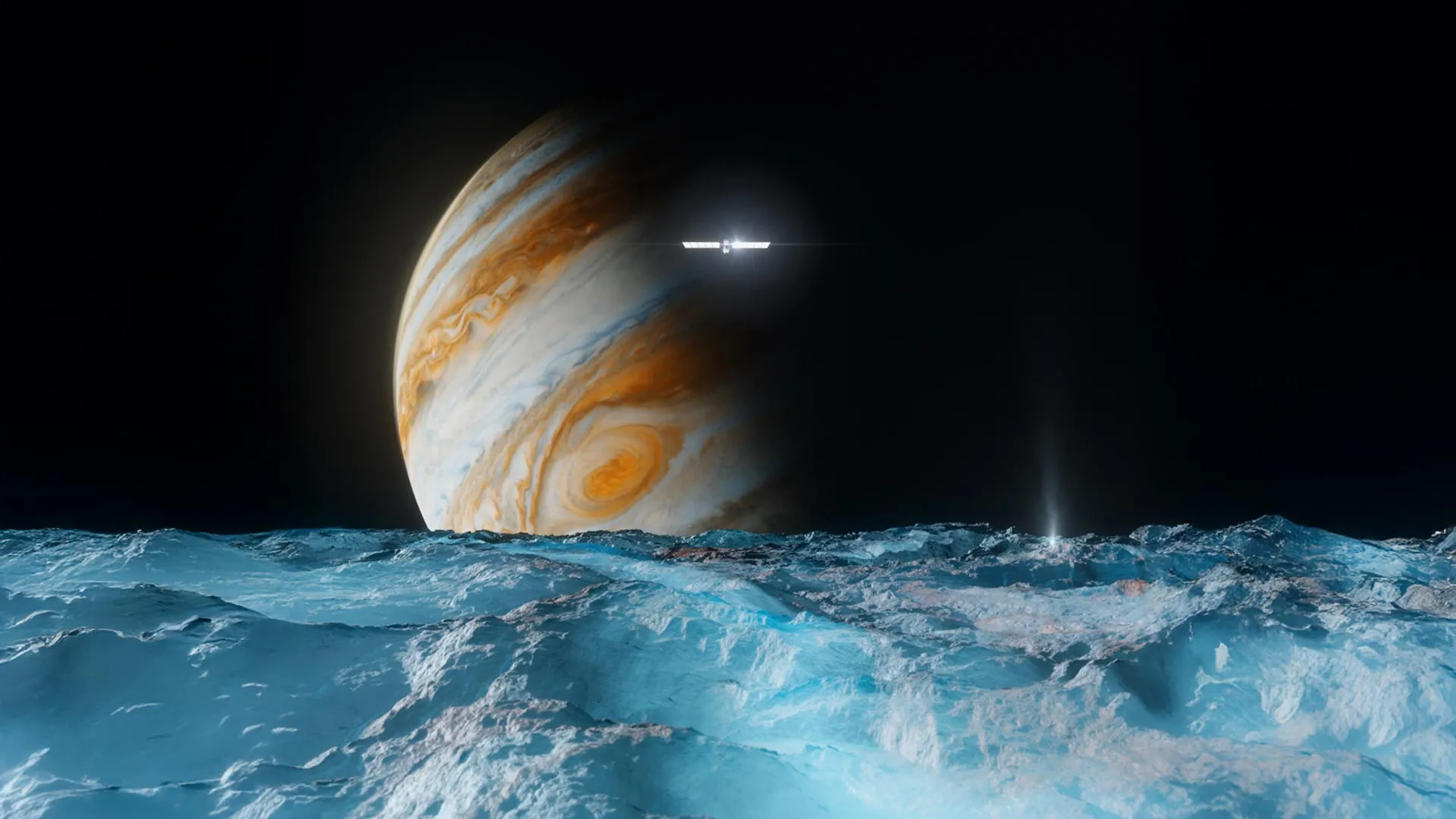
Europa has fascinated scientists for decades because it may harbor a vast ocean of liquid water beneath its frozen surface.
This buried ocean makes Jupiter’s icy moons one of the solar system’s most promising locations for investigating whether conditions suitable for life exist beyond Earth. But new research led by Rutgers University scientist Rugendra Ojha shows that getting materials from Europa’s deep oceans may be much more difficult than previously thought.
Testing potential routes through Europa’s ice
In a study published in natural astronomyOjha and his colleagues used computer simulations to examine whether water from Europa’s global ocean could migrate upward through cracks in the ice and accumulate in shallow underground reservoirs. If such pockets exist, future spacecraft may be able to detect or sample them more easily than in the oceans far below.
“The mystery we wanted to solve was whether this journey was actually possible,” said Ojha, an associate professor in the Department of Earth and Planetary Sciences at Rutgers School of Arts and Sciences. “Can liquid water rise from Europa’s deep ocean to the surface without freezing along the way?”
The results suggest that travel from the deep ocean to the upper layers of the ice is much less likely than many scientists assumed.
“There’s a shell of ice, and there’s water underneath. There’s a lot of speculation about how that water comes from deep underground and gets all the way to the top without freezing on the way,” Ojha said. “That’s actually what we think we’ve disproved.”
Shallow water may have another source of water
This conclusion could have a major impact on how scientists interpret future discoveries about Europa. If the spacecraft detects shallow pockets of liquid water beneath the surface, those reservoirs may not contain water that comes from the moon’s deep ocean. Instead, it may have formed when part of the ice shell melted locally.
This distinction is important because scientists are drawn to Europa by its combination of liquid water, chemistry, and energy. These are all essential elements when assessing whether an environment can support life. Shallow bodies of water are much easier to investigate than deeply buried oceans. However, if these reservoirs are isolated from the ocean, they may provide little information about Europa’s most scientifically compelling environment.
Europa Clipper and JUICE approach Jupiter
The discovery comes as two major missions move toward the Jupiter system. NASA’s Europa Clipper mission is expected to launch in October 2024 and arrive at Jupiter in April 2030. The mission will orbit Jupiter and complete 49 flybys of Europa. The European Space Agency’s Jupiter Icy Satellite Exploration Mission, known as JUICE, is scheduled to launch in April 2023 and arrive at Jupiter in July 2031.
Together, these probes are expected to provide a clearer picture of Europa’s frozen shell, surface chemistry, and potential groundwater. The radar aboard the Europa Clipper could help researchers determine whether a shallow reservoir exists and reveal its size and structure.
Far beneath Europa’s frigid exterior, the global ocean may remain liquid as Jupiter’s massive gravitational pull repeatedly stretches and contracts the moon. This movement generates internal heat, which is trapped under a thick ice shell.
Is it possible for water to seep in through the cracks?
The new study investigated dykes, narrow cracks that could theoretically act as channels for seawater moving upward through the ice. This concept is loosely analogous to how lava moves through cracks in the Earth’s crust before causing a volcanic eruption. In a frozen world, similar activity involving water and ice rather than melted rock is called cryovolcanism.
Ojha cautioned that there are obvious limitations to comparing the two processes.
“Ice and liquid water are fundamentally different from the lava and volcanoes we see on Earth,” he says. “I think there’s some fundamental physics missing here, so I wanted to explore that.”
One factor that previous models may have underestimated is turbulence. Previous simulations often assumed that water rose through Europa’s ice in a relatively smooth, organized flow. Instead, the Rutgers-led study suggests that the water moves rapidly and chaotically, mixing repeatedly on the cold walls of the cracks and rapidly transferring its heat to the surrounding ice.
“This water is going to rise, so it’s going to be turbulent,” Ojha said. “It moves side to side, it moves up and down, it has a swirling motion. And when that happens, that liquid water cools down very quickly as it gets closer to the surface.”
Ice crystals can clog roads
Rising water loses heat and can become supercooled and remain liquid even after its temperature drops below its normal freezing point. In that condition, small crystals known as flagyl ice may begin to form. Over time, those crystals can build up and block the fracture.
Simulations show that narrow cracks can freeze closed within hours. Under ideal conditions, larger cracks may transport more water, but turbulence also makes such conditions much more unfavorable. The researchers found that moving enough water to form some of Europa’s visible surface features would require cracks of unrealistic length, or an unusually large number of them.
The discovery points to a version of Europa where shallow liquid water may have formed separately from the global ocean. It may have been created when localized heat melted parts of the ice shell, rather than moving up from depth.
“Our study suggests that Europa’s icy shell may be a stronger barrier between the ocean and the Earth’s surface than previously thought,” Ojha said. “This will help future missions interpret what they discover and better understand where to look for signs of habitability.”
