


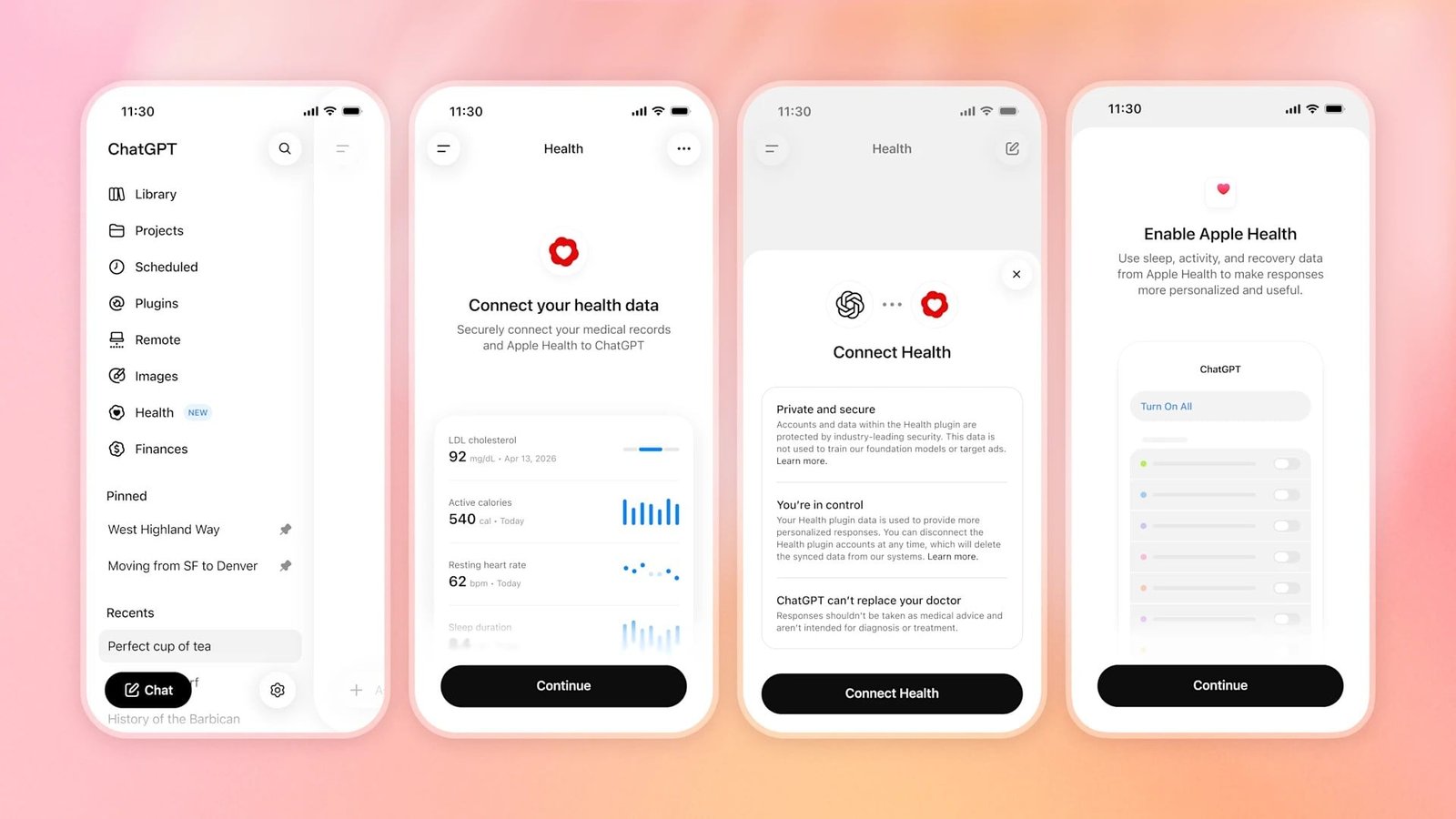
OpenAI on Thursday made its Health in ChatGPT feature widely available, allowing users in the United States to connect its artificial intelligence chatbot with medical records and wellness apps.
With medical records integration, the AI company aims to move ChatGPT from a general health Q&A tool to a more personalized health companion that can leverage users’ medical and wearable data for deeper context.
According to OpenAI, more than 300 million people use ChatGPT every week for health-related questions, up from 230 million in January.
OpenAI executives said in a media briefing that the “Health in ChatGPT” feature, first announced in January, is designed to help users understand and navigate their health information by bringing together information that is often scattered across patient portals, medical records, apps and wearables.
OpenAI executives stressed that ChatGPT is not intended for use in diagnosis or treatment, and is not designed to replace the care or judgment of a qualified medical professional.
“The reality is that we live in a time when not everyone has access to quality care or care in a timely manner. The average doctor visit in the United States lasts less than 15 minutes, and we often need to sort through a lot of fragmented information to make sense of it all and take the next step,” said Ashley Alexander, vice president of health products at OpenAI, in a briefing with reporters. “The chats have been extremely helpful for people in preparing for doctor visits, preparing for next steps, digesting information, and building healthier daily lives.”
OpenAI executives say users will be able to connect their Apple Health data to supported medical records, including hospital systems connected to Epic and Oracle Health electronic health records systems, and medical records connected to One Medical and Function Health.
“We are starting with the sources that provide the clearest, most widely useful health-related information, and will continue to explore further integrations,” an OpenAI spokesperson said. “When an app integrates with Apple Health, ChatGPT can use the data available there, with permission. Users can also combine connected health contexts with other apps and connectors in conversations, subject to additional safeguards against sensitive actions.”
OpenAI announced the Health in ChatGPT feature in January and tested it with an initial waitlist tester. The company uses feedback from these users to improve the experience, while also continuing to improve the model that powers it, Alexander said.
OpenAI also works with a global network of hundreds of physician advisors across 60 countries to train and evaluate medical intelligence capabilities such as ChatGPT Health, executives said. These doctors are testing the model’s performance on health questions and developing realistic health scenarios and detailed rubrics that define what a strong response should be, according to an OpenAI blog post. These evaluations measure qualities such as accuracy, safety, communication, situational awareness, completeness, and appropriate escalation.
“Models don’t just have to be good at answering textbook health and medical questions. They have to be able to answer real-world questions from real users. To do this in a meaningful way, they need to test in ambiguous, messy, noisy, and poorly specified situations,” Dr. Rebecca Soskin Hicks, a pediatrician and director of OpenAI’s Physician Network, said in a media briefing. “And now we’re evaluating the ability of models to do this with connected information, meaning not just users asking health questions, but users who have connected health data through electronic health records and other connectors asking health questions.”
She added: “We have moved beyond the rungs of the evidence generation ladder and continue to make improvements and continue to work closely with the physician community to define what is actually good.”
OpenAI executives also emphasized continued performance improvements to the model. GPT‑5.5 Instant, available to users of the ChatGPT free plan, delivered “significant benefits” in recognizing when emergency care is needed, asking for relevant context, explaining uncertainty, and making complex information easier to understand, executives said. “In our most challenging health assessments, it performed as well as our Frontier Thinking Model at the time of the assessment,” the company said in a blog post.
OpenAI said GPT‑5.6 Sol, which is available to paid users, is “the most powerful model for health to date.” This model shows stronger performance on tasks that require complex detailed reasoning, clear communication, and careful judgment. “It helps explain visit records in plain language, understand how test results have changed over time, consider factors across options discussed by the doctor, and prepare questions for follow-up appointments,” OpenAI said.
According to OpenAI, all GPT-5.6 models outperformed GPT-5.5 on HealthBench Professional (Opens PDF), an assessment of AI performance on difficult health tasks.
OpenAI executives also said that ChatGPT’s Health is built with multiple layers of privacy and security protections. All conversations in ChatGPT are encrypted at rest and in transit, and information connected in Health receives additional encryption protection.
Information connected to Health is not used to train OpenAI underlying models or target ads. Executives said in a blog post that regardless of the model training settings users choose for ChatGPT, connected medical records and Apple Health information, as well as conversations that leverage it, will not be used to train the underlying model or target advertising. Conversations without this data follow standard ChatGPT model training settings selections, which users can change at any time, the company says.
Users can decide when ChatGPT can use information connected to Health. By default, ChatGPT will ask for your permission before using your connected medical record and Apple Health information to personalize your responses, according to the company. Users can also disconnect their health information at any time.
When OpenAI first introduced Health in ChatGPT for initial testing in January, we introduced a dedicated health experience that required access to a separate space in ChatGPT to take full advantage of its benefits.
“What we heard from users was that this really didn’t work,” a member of OpenAI’s health products team said in a media briefing. “We found that more than 70% of them still had health conversations in the main chat experience, and when we looked into that, we found that it makes a lot of sense. It’s very difficult for people to separate their health from the rest of their lives.”
Moving to another space added an unnecessary step for users. Based on that feedback, OpenAI designed Health for ChatGPT to allow users to choose to pull relevant information connected in Health to ChatGPT throughout a conversation. With your permission, ChatGPT can consider related information you’ve connected to, such as your medications, test results, recent visits, sleep, and activity, along with the goals and context you’ve shared.
OpenAI executives say users can control where they can ask health questions, what health data is associated, and when that data is used for context.
Millions of people are now using AI chatbots to check their health symptoms, find out their conditions, and understand treatments and bills. But studies, including those published in Nature Medicine and BMJ, warn that chatbots can provide inaccurate, inconsistent or even dangerous medical advice.
The New York Times reported this week that a Florida man has sued OpenAI, claiming the company’s chatbot ChatGPT provided “extremely dangerous medical recommendations” that led to delays in treatment for a life-threatening pulmonary embolism last year. The plaintiffs in the case and Tech Justice Law, the nonprofit group representing them, are seeking financial damages and are asking the court to halt ChatGPT Health’s operations until an independent evaluator determines it is safe, the NYT reported.
In response to a reporter’s question about the lawsuit, Alexander said, “It’s important to zoom out and look at the big picture: hundreds of millions of people already go to the internet every day for information to support their health, and AI can make the answers they find more clear to them.” “We can really improve that experience by helping them make sure that they’re safe. And again, looking at the bigger picture, we live in a world where not everyone has equal access to quality care or timely quality care,” she said. “We think that treating chatbots as the whole story behind people’s medical decisions is a huge oversimplification of everything here, and actually risks preventing us from bringing the beneficial impact of this chatbot into the hands of as many people as possible in a way that can actually help them on their health journey.”
He emphasized that ChatGPT is not intended for diagnosis or treatment, and emphasized extensive physician-led testing and safety evaluation.
“Our latest GPT-5 model correctly recommends that people go to urgent care immediately when they should have done so more than 99% of the time. We also believe it is important to avoid unnecessary escalation to emergency care 99% of the time for a similar assessment,” Alexander said.
