


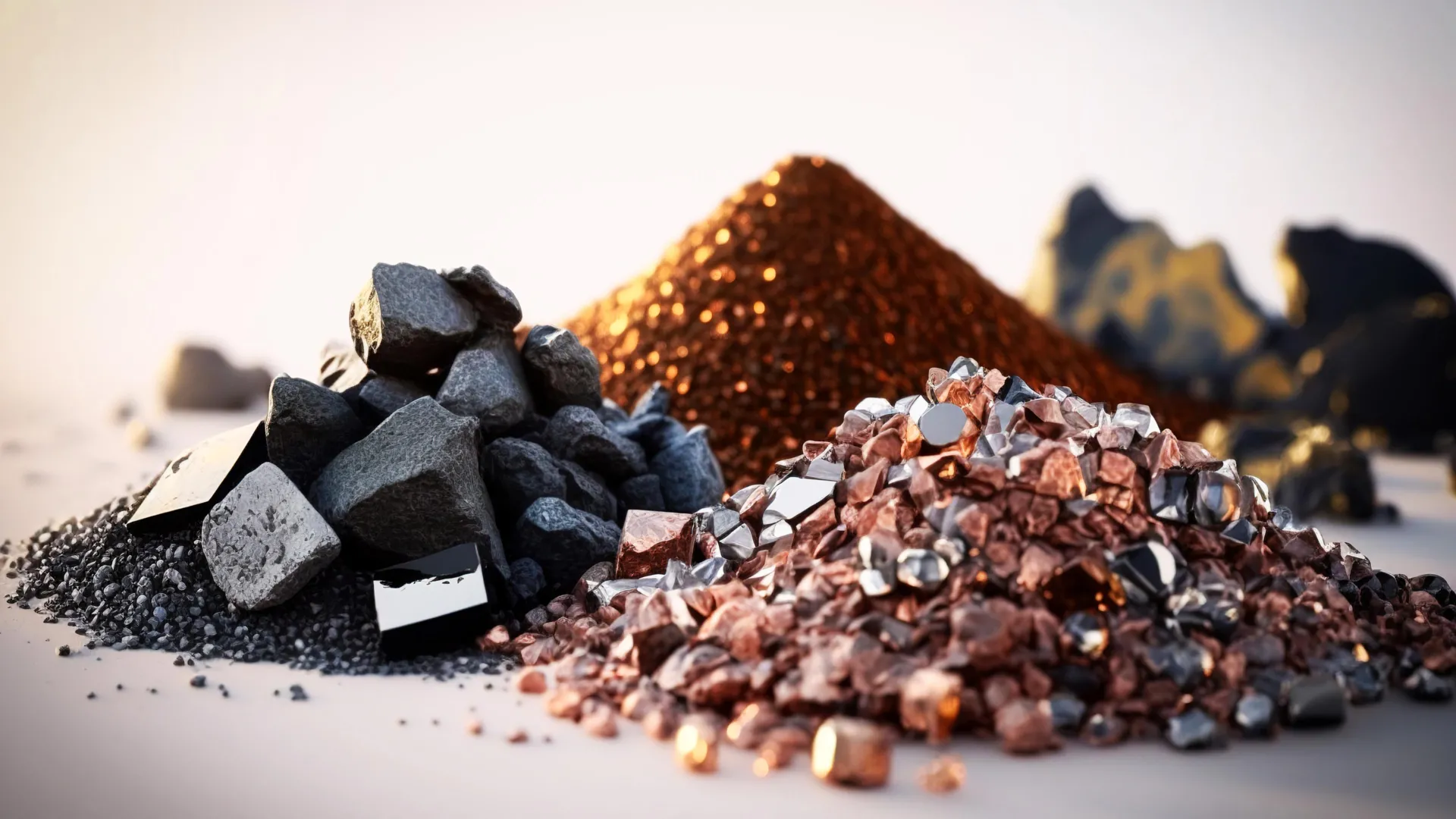
Researchers in Sweden are studying how the country’s mineral resources could support cleaner production of rare earth elements (REEs) and the powerful magnets made from them. As part of his research field on sustainable materials and material flows, Martin Thalberg is investigating whether Swedish mineral deposits could form the basis of a more sustainable magnet industry.
Many of the materials needed for clean energy systems and advanced technologies are still produced through processes that have significant environmental costs. For example, rare earth magnets are mainly manufactured in China, where environmental regulations and industrial standards are different from those in Sweden.
Rare earth magnets and global supply risks
“This is a geopolitical issue,” says Martin Thalberg, professor of materials chemistry at Uppsala University.
“Last year, with the trade war and US tariffs, we saw China halt exports of rare earth elements. You could also point to Trump’s move on Greenland and the Ukraine-US minerals agreement as other examples of geopolitical conflicts.”
The production of rare earth materials is also environmentally difficult. Separating and cleaning elements from mineral deposits often requires toxic chemicals, and radioactive materials are often present in the same geological formations.
“Business today is a rather dirty business,” says Martin Thalberg.
Rare earth elements are more common than their names suggest
Rare earths are essential for functional materials such as displays and magnets, which play a key role in the transition to a sustainable society. However, despite its name, the element itself is not particularly rare.
The real challenge is finding deposits that are present in concentrations high enough to make extraction economically practical.
“In Sweden, the potential for rare earth extraction is relatively good compared internationally,” he says.
Sweden has known rare earth mineral deposits in Kiruna, Bergslagen, and Nora Carr outside Grenna. Sahlberg’s research aims to build the scientific foundation needed to mine these resources domestically, as well as develop new functional magnets.
Rather than forcing the Swedish mineral to fit into existing manufacturing methods, the researchers hope to design a magnet whose chemical composition closely matches materials naturally occurring in local deposits. This approach reduces the amount of processing required and has the potential to reduce the environmental impact of both purification and manufacturing.
“Today, China basically dominates the world, but not only do they have mineral deposits, but they also have good access to water and relatively cheap energy. We are interested in leading the green transition here in Sweden as well,” he continues.
Taking inventory of Sweden’s mineral resources
Interdisciplinary efforts are expected to continue for many years. One of our first priorities is to obtain a detailed picture of the rare earth minerals available throughout Sweden.
“It’s a bit like a TV show. what’s in the fridge” says Martin Sahlberg to explain the process.
“Historically, we have mined specific metals (such as iron, copper, or gold). Here we are taking a broader approach to find out what elements are present in the deposit and in what proportions. We create an inventory of ‘what’s in the fridge’ so that we can use all these elements in the most efficient way possible. We create new ‘magnet recipes’ based on the elements that are available,” he explains.
Rather than targeting a single precious metal, the researchers plan to examine the complete mixture of elements within each deposit. The goal is to use as much of that material as possible and develop a magnet formulation tailored to the resources already available.
Building a cleaner path from stone to magnet
Theoretical Materials Physicists, geologists, and materials engineers are working together to identify the most sustainable route from raw mineral deposits to finished products. Their combined expertise allows us to evaluate every step of the process, from geological understanding to magnet design and manufacturing.
Sahlberg describes this effort as basic research with applications in mind. Although this research focuses on fundamental scientific questions, it is closely related to technologies that are likely to become increasingly important for Sweden and the wider green economy.
“What we are doing is basic research, but it is a field of great technical importance.
