


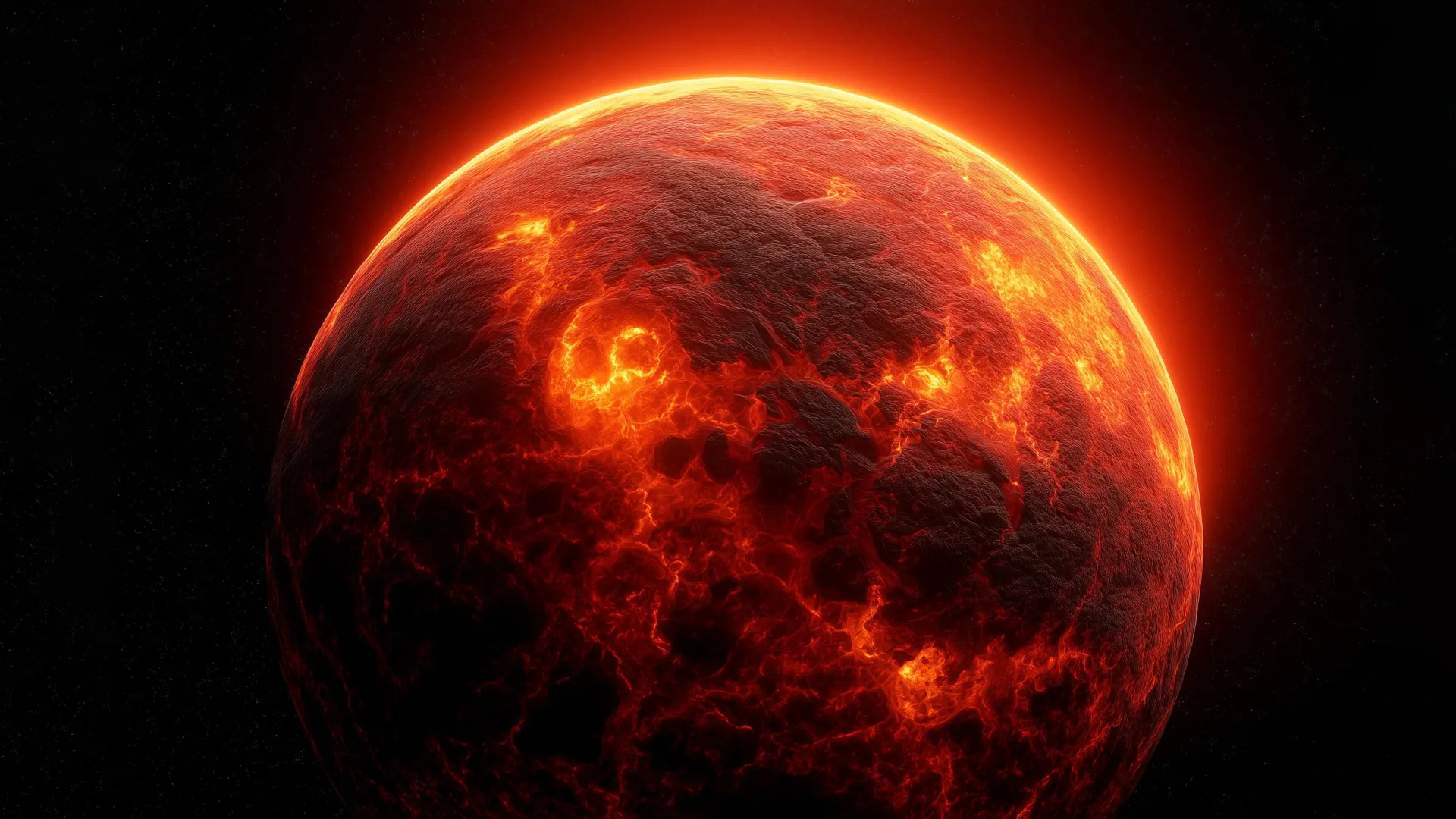
Imagine the year 2158. You’re pursuing a PhD in planetary volcanology at Utopia Planitia University on Mars, surviving on freeze-dried ramen while searching for the best exoplanets to study. After studying Jupiter’s volcanic moon Io, we need rocky worlds outside our solar system where intense volcanic activity is caused not by gravity but by the scorching heat of nearby stars. Even better, the distance must be within 50 light years to keep faster-than-light (FTL) research missions within budget.
Although that scenario is hypothetical, astronomers today are already studying notable candidates.
Researchers used NASA’s James Webb Space Telescope (JWST) to study super-Earth 55 Cancri e (55 Cnc e), an extremely rocky planet about 41 light-years from Earth. The planet, which is about 1.88 times the radius of Earth and about 8 times the mass of Earth, orbits a sun-like star in just about 0.7 days. By comparison, Mercury takes 88 days to orbit the Sun.
55 Cancri orbits so close to its star that scientists believe its surface is hot enough to remain molten. Their findings have been submitted for publication. natural astronomycould provide valuable insight into how lava exoplanets form and evolve.
James Webb detects hydrogen-rich atmosphere
The research team used JWST to observe five eclipses of 55 Cancri and compared the results to long-standing models of the evolution of rocky exoplanets. These models generally predict an atmosphere rich in carbon monoxide (CO) and carbon dioxide (CO2).
Instead, new observations point to the atmosphere containing abundant carbon monoxide, relatively small amounts of carbon dioxide (CO2), and surprisingly large amounts of hydrogen.
The researchers also found differences between the five eclipse observations. They suggest that these fluctuations could be caused by volcanic outgassing or by clouds forming from material ejected from the planet’s interior. The researchers say these clouds could temporarily cool the planet’s surface before dispersing through continued outgassing.
The study states, “The secondary atmosphere of a rocky planet is determined by its interior composition and subsequent outgassing, so atmospheric composition is directly related to the interior’s redox state. Therefore, the preference for hydrogen-rich models and the steep inversions they produce suggest an interior with relatively low oxygen fugacity, consistent with outgassing from a reduced magma ocean.”
What planetary chemistry reveals
A planet’s redox state describes the chemical balance between oxygen and hydrogen/iron within its interior. In the case of 55 Cancri e, the results show a strong preference for hydrogen over oxygen, helping to explain why the planet appears to have a hydrogen-rich atmosphere.
Because atmospheres can reflect what’s happening deep within a planet, these observations could provide a valuable window into the internal chemistry of other worlds.
Lava exoplanets are becoming increasingly common
55 Cancri itself was first identified in 2004, but interest in lava exoplanets has grown rapidly over the past decade as more of these extreme worlds are discovered.
Other known lava exoplanets include K2-141 b, L 98-59 d, TOI-561 b, HD 63433 d, and CoRoT-7 b. Their orbital periods are approximately 6.7 hours, 7.5 days, 10.5 hours, 4.2 days, and 20.4 hours, respectively.
Like 55 Cancri, these planets are tidally locked to their host star and endure extreme temperatures. At 55 Cancri e, molten rock is thought to be concentrated on the side that is always illuminated by the sun. Other worlds, such as L 98-59 d, may be covered by global magma oceans similar to the volcanic landscape of Jupiter’s moon Io.
Io vs. Lava Exoplanet
Io exoplanets and lava exoplanets are both characterized by large-scale volcanic activity, but the forces driving that activity are very different.
Io’s volcanoes are powered by tidal heating. Jupiter’s massive gravity causes its small moons to continually expand and contract, generating enough internal heat to fuel widespread volcanic eruptions.
In contrast, lava exoplanets like 55 Cancri e are heated primarily because they orbit very close to their host star. The star’s intense heating melts rock on the surface, and because many of these worlds are tidally locked, the melted regions may remain permanently concentrated on the sunny side.
As astronomers continue to use powerful observatories like JWST, Cancri 55 and other lava worlds may reveal more about the formation, evolution, and hidden interiors of the most extreme rocky planets ever discovered.
