


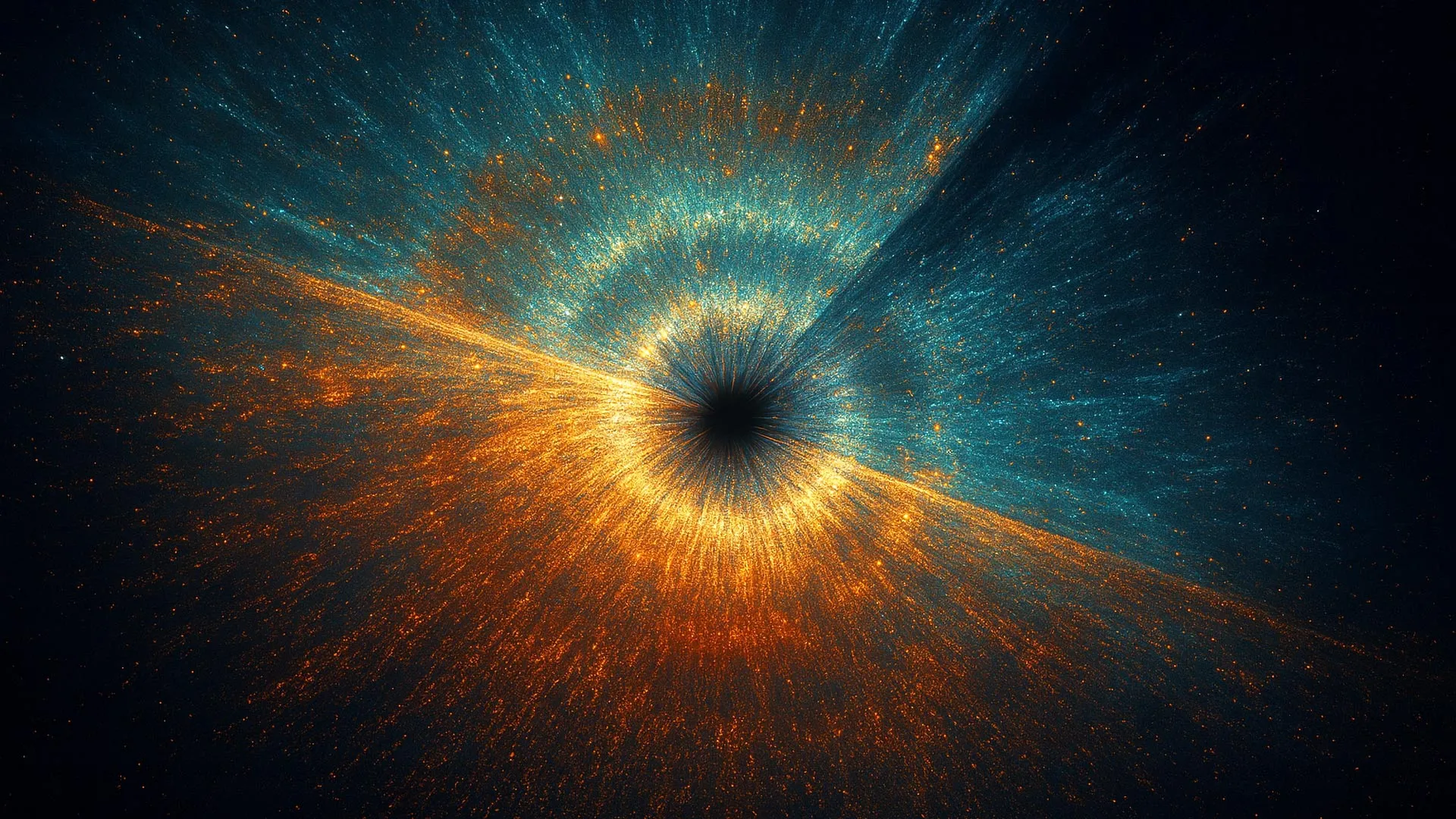
Dark matter has long been one of astronomy’s biggest mysteries. Although it cannot be seen or touched, its gravitational influence helps form galaxies and large-scale structures in the universe. For decades, scientists have relied on the “cold dark matter” model to explain how galaxies form and evolve. But as telescopes and observations have become more precise, researchers have uncovered some puzzling features that are difficult to explain with the standard model.
Among the biggest mysteries are the surprisingly low concentrations of dark matter found at the centers of some dwarf galaxies and the unexpectedly dense clumps of dark matter inferred from powerful gravitational lensing. Although these observations seem to point in opposite directions, new research suggests they may share the same underlying explanation.
A new theory of dark matter
Physicists at the Zishan Observatory of the Chinese Academy of Sciences (CAS) propose that dark matter may not be made up of a single type of particle. Instead, it may be composed of particles of different masses.
Their new “two-component self-interacting dark matter” model involves at least two types of dark matter particles, one heavier and one lighter. In addition to gravitational interactions, these particles can also directly collide with each other. These interactions lead to a process called “group segregation.”
Simply put, heavier dark matter particles gradually drift toward the center of the galaxy, while lighter particles spread outward over time. The researchers liken this behavior to a star cluster, with the most massive stars slowly moving inward and less massive stars moving away from the center.
Simulations match space observations
Using high-resolution computer simulations combined with detailed theoretical modeling, the team found that mass separation naturally reproduces a wide range of astronomical observations.
In dwarf galaxies, this process produces dark matter cores with relatively low central densities, consistent with recent observations of galaxy clustering. In larger, more complex environments, some dark matter halos become increasingly compact, producing dense structures that can produce powerful gravitational lenses.
This model also raises the possibility of small-scale gravitational lensing events. As heavier dark matter particles accumulate in key regions, the dark matter substructure becomes more effective at magnifying light from distant background galaxies. This could help explain why astronomers are observing strong lensing events on a smaller scale than traditional models predict.
A richer depiction of the invisible universe
Researchers say these seemingly contradictory cosmological puzzles may actually point to the same conclusion. Rather than requiring separate explanations, they all likely reflect the fact that dark matter has more complex internal properties than previously thought.
As future sky surveys and gravitational lensing observations become more precise, scientists will have new opportunities to test whether dark matter is truly made of multiple components. These natural “cosmic magnifiers” may provide some of the strongest evidence yet for this new picture of the invisible universe.
The discovery is the second study by the Purple Mountain Observatory team searching for two-component, self-interacting dark matter. Their previous works are Physical Review Dinvestigated how mass separation affects the wide range of dark matter core densities observed in dwarf galaxies. The new research science bulletin. The study’s authors are Daneng Yang, Yi-Zhong Fan, Siyuan Hou, and Yue-Lin Sming Tsai.
Zishan Observatory, part of the Chinese Academy of Sciences, is one of China’s leading dark matter research centers. The institute plays a key role in indirect dark matter detection with the DAMPE (Wukong) satellite and conducts influential research in astrophysics, cosmology, dark matter, and galaxy evolution.
