


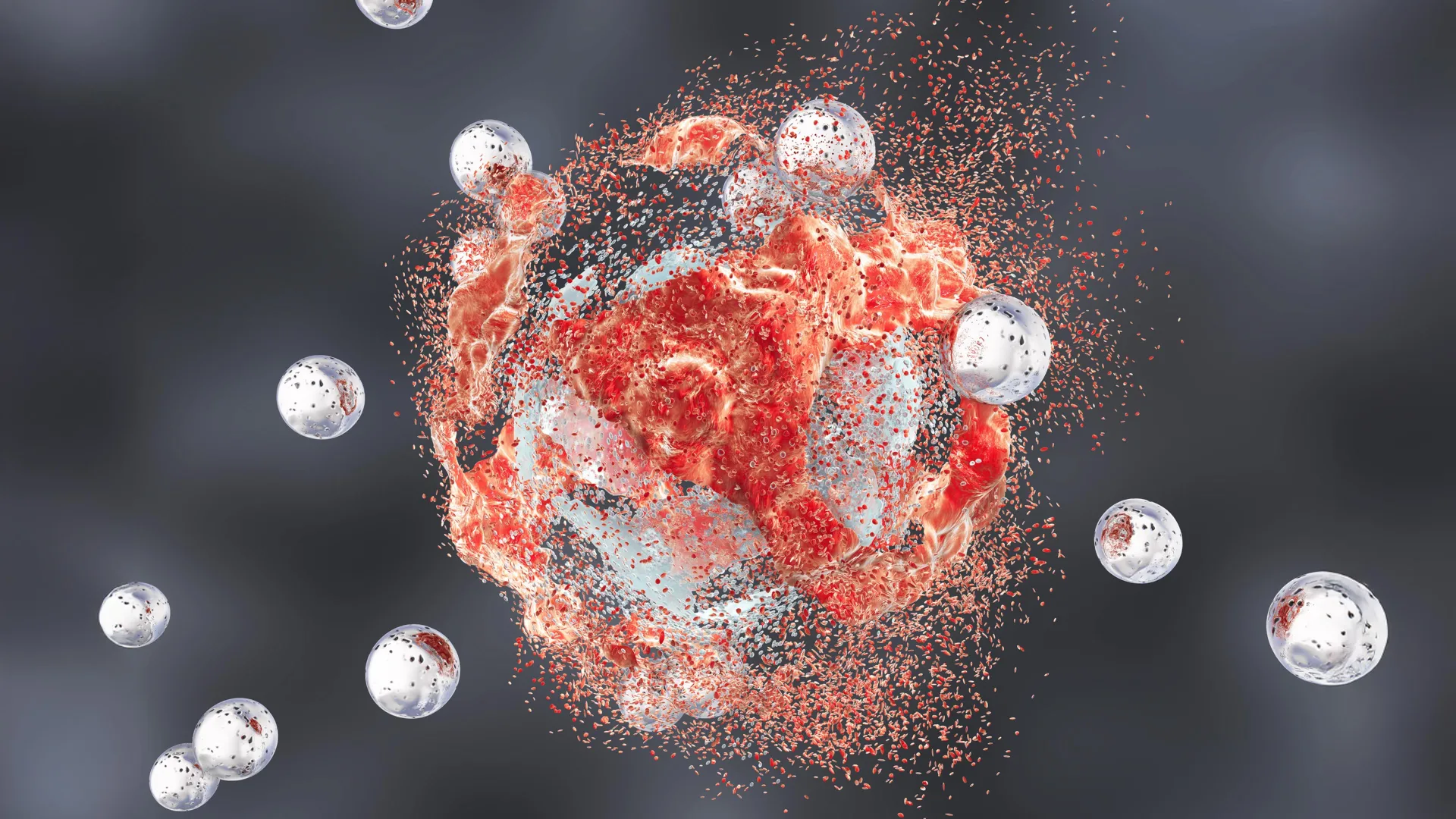
Researchers have developed tiny silica nanoparticles that can directly destroy prostate tumors while simultaneously awakening the body’s immune system to fight cancer, according to a new preclinical study led by scientists at Weill Cornell Medical College and Cornell Duffield Polytechnic Institute. In a mouse model of advanced prostate cancer, the targeted particles produced several complete tumor remissions, providing encouraging evidence that this approach could eventually advance to human clinical trials.
The engineered nanoparticles, made from amorphous silica, a type of silicon dioxide found naturally in food and the fossilized remains of microorganisms, appear to attack prostate cancer in multiple ways at once.
Tiny nanoparticles with dual cancer-fighting strategies
The nanoparticles, known as ultra-small fluorescent core-shell silica nanoparticles or Cornell prime dots (C’ dots), were originally created to improve medical imaging. They are already progressing into late-stage clinical trials for image-guided surgery and other therapeutic applications.
More recently, researchers have discovered that the particles themselves can selectively damage cancer cells, leaving healthy cells largely intact.
In a new study published on June 15th, cancer researchBased on the Journal of the American Association for Cancer Research, the research team tested the nanoparticles on mice with advanced prostate cancer. They found that the particles made tumor cells highly vulnerable to a type of self-destruction, while simultaneously changing the tumor environment from an immunoresistant “cold” state to an immunoactive “hot” state. This change could significantly improve the effectiveness of existing immunotherapies.
“We are very encouraged by these results. Therapies that directly induce tumor cell death while altering the immune microenvironment in this way may represent a new clinical paradigm,” said senior author Michelle Bradbury, Ph.D., Endowed Professor of Radiology Imaging, director of the Institute for Molecular Imaging Innovation at Weill Cornell Medicine, and neuroradiologist at NewYork-Presbyterian/Weill Cornell Medical. Center.
This research is part of a long-term collaboration between Dr. Bradberry’s lab and that of co-corresponding author Dr. Ulrich Wiesner, the Spencer T. Olin Professor in the Department of Materials Science and Engineering and a professor in the Department of Design Technology in the School of Architecture, Art, and Planning. This research was supported in part by the Parker Institute for Cancer Immunotherapy at Weill Cornell Medical College.
How silica particles kill cancer cells
One of the most unusual discoveries concerned a process called “ferroptosis,” a specialized form of cell death caused by overwhelming oxidation within cells. During ferroptosis, oxidation damages important molecules, especially the fat molecules that make up cell membranes, ultimately causing cell destruction.
Scientists still don’t fully understand how nanoparticles trigger this process. But evidence suggests that the particles, originally designed to carry contrast agents, can collect positively charged iron ions from the bloodstream and transport them to tumor cells. Once inside, these iron ions can promote severe oxidation leading to ferroptosis.
wake up the immune system
Nanoparticles not only directly kill tumor cells, but also reshape the immune environment surrounding cancer.
Researchers observed that T cells, macrophages, and other immune cells near tumors transition from an inactive or immunosuppressed state to active cancer-fighting cells. The nanoparticles also further increased tumor responsiveness to approved immunotherapy drugs. At the same time, they interfered with metabolic processes across several cell types within the tumor microenvironment, further slowing tumor growth.
To ensure that the drug reached prostate cancer cells, the researchers attached a targeting molecule that recognized PSMA, a protein on the surface of prostate tumor cells. Some particles temporarily accumulated in other organs, such as the spleen, but the researchers found no signs of toxicity outside the tumor.
“It seems unrealistic, but how is it possible that all these effects occur not in a single pathway, but at the same time only in tumors and not in healthy tissue?” Dr. Wiesner said. “We wonder if the very early ubiquity of tiny silica in the environment and in foods such as leafy vegetables and grains may have given it a link to biology that we are only beginning to glimpse.”
Combination therapy produced the strongest results
The most dramatic discovery came from a survival study of mice with aggressive prostate cancer.
C’dots and immunotherapy alone slightly improved survival compared to no treatment. However, when nanoparticles were combined with immune checkpoint blockade therapy, four out of 10 mice had complete or near-complete remission and indefinite survival.
Adding a third treatment called CSF-1R blockade, which targets tumor-associated macrophages, increased the number of complete responses to 5 out of 10 patients.
“We don’t think there is anything else out there that has such a strong and long-lasting effect on suppressing tumor growth,” Dr. Bradbury said.
“One of the most exciting aspects of this study is the convergence of direct killing of tumor cells and widespread immune remodeling,” said study co-author Dr. Jed Walchok, director of the Sandra Edward Meyer Cancer Center, professor of medicine at Weill Cornell Medical College, director of the Parker Institute for Cancer Immunotherapy at the Meyer Cancer Center, Weill Cornell Medical College, and oncologist at NewYork-Presbyterian/Weill College. Cornell Medical Center. “By creating conditions that support a more effective anti-tumor immune response, these particles may help unlock the full potential of immunotherapy in prostate cancer, where sustained responses have historically been difficult to achieve.”
The next step is human clinical trials
Dr. Bradbury also acknowledged the work of the study’s co-lead authors, Drs. Careful synthesis and characterization of the nanoparticles was essential to the project, with Nabil Siddiqui, Li Zhang, Gabriel DeLeon, and graduate students Nada Naguib and Rachel Lee in Dr. Wiesner’s lab leading many of the biological, mechanistic, and translational studies.
“This research reflects years of collaboration across multiple laboratories and would not have been possible without the dedication, creativity and perseverance of this incredible research team who helped advance the science,” she said.
The research team is continuing to explore these tiny core-shell silica particles as a new type of cancer therapy that can simultaneously impact inflammatory, immune, and metabolic pathways. Their long-term goal is to evaluate the safety and effectiveness of the treatment in human clinical trials.
Doctors. Michelle Bradbury and Ulrich Wiesner are inventors on patents related to the technology described in this study.
This research was funded by the Department of Defense (PC220534). National Cancer Institute, part of the National Institutes of Health (through grant numbers R01CA253658, R01CA243085, U54CA199081, Cancer Center Support Grant (P30 CA008748), and Cycle for Survival/Parker Institute funding).
