


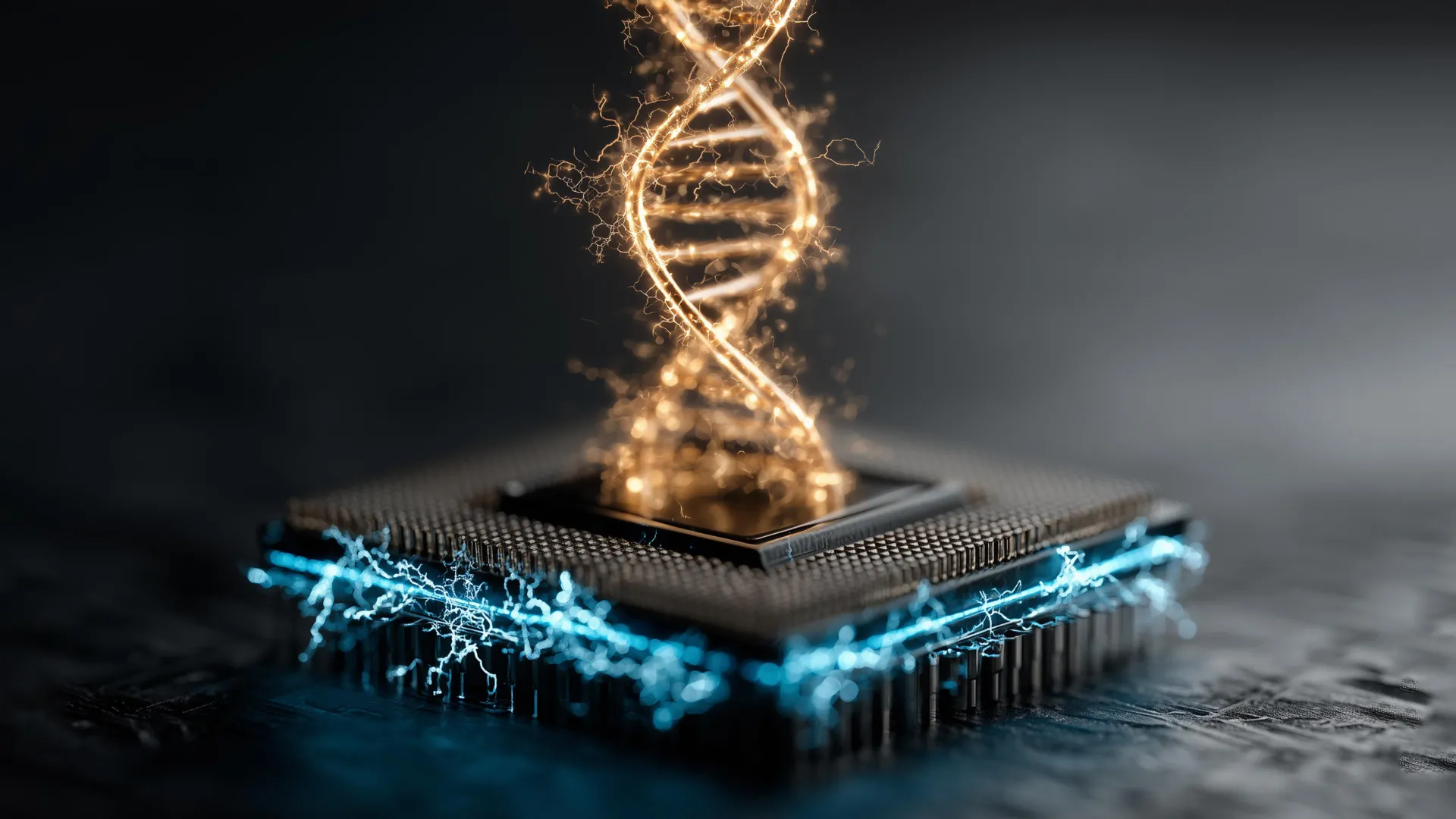
Silicon chips have been the foundation of modern computing for decades. Now researchers are giving them a whole new role in biotechnology. In addition to processing information, these chips are increasingly being used to study living systems by recording neuron activity, reading DNA, and even creating DNA.
In a new study published in nature electronicsa Harvard University-led research team has unveiled a silicon chip that can synthesize 64 different DNA sequences simultaneously. Instead of relying on the solvent-intensive chemical processes commonly used to make synthetic DNA, the device uses a water-based enzymatic approach. Carefully controlled electrical currents trigger DNA-building reactions at specific locations throughout the chip.
The research was led by John A. Armstrong Professor in the John A. Paulson School of Engineering and Applied Sciences (SEAS) and Dong-Hee Ham, Elizabeth S. Armstrong Professor of Engineering and Applied Sciences.
A cleaner way to produce DNA
Synthetic DNA is essential to many areas of modern science and medicine, including diagnostics, genome engineering, and cancer research. Currently, most custom DNA is produced using phosphoramidite chemistry. This is a well-established method that can produce millions of DNA sequences in parallel. However, the process relies on hazardous organic solvents and typically requires specialized centralized facilities.
Scientists have been exploring enzymatic DNA synthesis as a gentler alternative because it uses water and more closely resembles the way living cells build DNA naturally. This approach could ultimately lead to smaller, safer, and more widely available DNA synthesis systems.
Until now, however, enzymatic methods have lagged far behind traditional manufacturing methods in terms of the number of DNA sequences that can be produced simultaneously. Previous demonstrations were limited to about 12 sequences at a time. The Harvard team’s chip successfully synthesized 64 different DNA sequences, each 39 nucleotides long, in parallel, establishing a new milestone in the technology.
How silicon chips write DNA
DNA is assembled one nucleotide at a time. As each nucleotide is added, a temporary blocking group prevents further growth. Before attaching the next nucleotide, that blocking group must be removed through a process called deprotection. This process is caused by acidic conditions or low pH in the water.
To generate many different DNA sequences simultaneously, the pH needs to be lowered only at selected positions during each synthesis cycle. The Harvard chip accomplishes this using tiny electrical currents.
Its surface contains 64 synthesis sites. Each site has two concentric electrodes surrounding a fixed DNA molecule in the center. When a specific location is activated, internal electrodes generate protons that lower the local pH and allow DNA strand growth. At the same time, the outer electrode removes the outwardly spreading protons and confines the acidic region to that single site.
By repeating this process over multiple cycles, the chip independently builds 64 unique DNA sequences across its surface.
From brain research to DNA synthesis
Interestingly, this chip was not originally designed to manufacture DNA.
Jeffrey Abbott, a former doctoral student in Hamm’s lab, originally developed silicon electronics to record electrical activity within large populations of neurons. After redesigning the surface electrode, the researchers discovered that they could use the same underlying technology to precisely control the chemical conditions needed for DNA synthesis.
“A distinctive feature of this chip was the precision current injection we used to permeabilize the nerve membrane for intracellular access,” Hamm said. “At some point, we thought we might be able to redirect the same current control from cells to molecules, replacing the neuron-facing electrode with a ring electrode pair that could localize the pH of DNA synthesis. It worked.”
DNA data storage could be a future application
Beyond potential applications in synthetic biology and medical diagnostics, the research team demonstrated another possibility by encoding 169 bytes of text using 64 synthetic DNA sequences.
Although DNA-based data storage remains a long-term goal due to the need for large-scale DNA manufacturing, the researchers believe water-based enzymatic synthesis may become increasingly attractive as production volumes increase. Reducing solvent use has the potential to significantly reduce the environmental impact of large-scale DNA manufacturing.
“DNA data storage requires performing DNA synthesis on a scale far beyond today’s needs,” said Woobin Jeong, co-lead author of the study and currently an assistant professor of chemical engineering at Pohang University of Science and Technology (POSTECH), who worked as a postdoctoral researcher in Ham’s lab. “That’s why enzymatic synthesis in water could be important. Being able to synthesize much more than 64 sequences in parallel could provide an environmentally friendly route to very large-scale DNA writing.”
Chemistry is the next hurdle.
The researchers also wanted to see how much the chip could be scaled. They fabricated a chip that placed the synthesis sites closer together in hopes of increasing the number of DNA sequences produced simultaneously.
Although the experiment was not successful, it yielded important insights. The chip itself confines low pH precisely to the intended location. The real limitation lay in the chemicals used during deprotection.
Rather than directly removing the blocking group, the lower pH generates an intermediate molecule that performs the deprotection step. These intermediate molecules can drift to adjacent synthesis sites, reducing separation between reactions, even if the pH remains tightly controlled.
“The chip did what we asked it to do: locally identify low pH in selected areas,” said study co-lead author Han Se Jeong, a former graduate student and current postdoctoral fellow at Harvard University. “This limitation was due to the deprotection chemistry rather than the silicon. This leaves a clear next step for the field: to develop a more direct acid deprotection chemistry that can keep pace with the chip.”
Joint research and research support
The project was a collaboration between researchers at Harvard University, the Broad Institute, DNA Script, and later POSTECH. Harvard University’s Office of Technology Development has applied for intellectual property related to the platform. The study is titled “Parallel enzymatic DNA synthesis using semiconductor chips.”
This research was supported in part by the Office of the Director of National Intelligence (ODNI), Intelligence Advanced Research Project Activity (IARPA), 2019-19081900002, Horizon Europe, Hyperion Project ID: 101115253, and the Samsung Research Funding & Incubation Center for Future Technologies at Samsung Electronics under project number SRFC-IT2402-09.
