


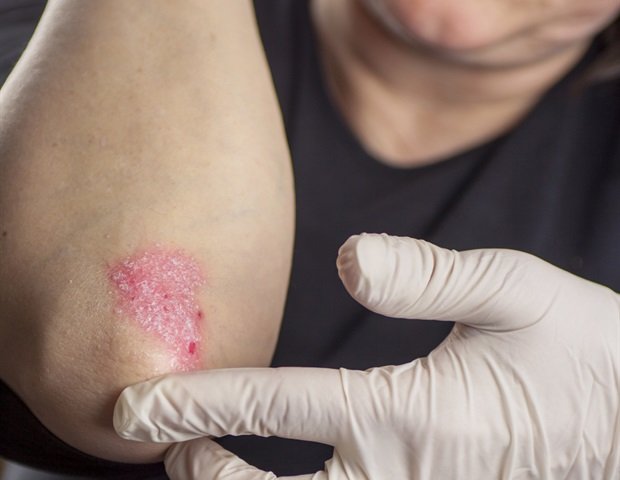
Biohub researchers conducted what is believed to be the first genome-wide CRISPR study in primary human adult skin cells, using an AI model to mine results for overlooked psoriasis drug targets. They discovered an unlikely candidate. It is a receptor for oxytocin, a hormone involved in childbirth and also called the “love hormone” for its additional role in social bonding.
As reported in nature communicationsWhen the team formulated topical gels containing compounds that inhibit oxytocin receptors and another promising target, both gels reduced psoriasis inflammation in mice as effectively as the injectable drugs used by many patients.
“AI-guided CRISPR screening at this scale has provided answers and surprisingly effective treatments that the field has not had access to before,” said Shanna O. Kelly, president of bioengineering and director of Chicago’s Biohub. At the biohub, scientists are deciphering the inflammatory processes that cause a wide range of diseases. Kelley co-led the study with Abdalla M. Abdrabou, a principal scientist in Biohub’s Functional Immunogenomics Group.
We think of this as a blueprint. While the specific targets we have found in psoriasis are exciting, the method itself is what we are most proud of. This is a generalizable way to find cures that those of us who study diseases may not even know how to look for. ”
Abdalla M. Abdrabou, Principal Scientist, Functional Immunogenomics Group, Biohub
Psoriasis affects approximately 125 million people worldwide. In mild cases, symptoms can often be effectively managed with topical treatments such as steroid creams. However, for many patients with moderate to severe disease, systemic therapy is required, all with trade-offs. Biologics that target immune signaling proteins must be injected, cost tens of thousands of dollars a year, and carry the risk of extensive immunosuppression. While recently approved treatments in pill form may reduce the burden of injections, the drugs still circulate throughout the body and affect immune pathways beyond the skin.
What is missing is an approach that targets disease pathways that are specific enough to act locally on the skin cells where psoriasis begins and do not broadly disrupt immune function. To get there, we need to understand the biology of keratinocytes, the outermost skin cells that are the primary site of psoriasis, at a level of detail that is lacking in the field. This is because these cells are stubbornly resistant to large-scale genetic screening using CRISPR.
Standard chemicals used in research to deliver gene cargo to cells are toxic to keratinocytes even at low concentrations, making genome-wide CRISPR screening in these cells impractical. The Biohub team solved this problem by developing a method that uses force generated by a centrifuge rather than chemicals to deliver CRISPR to cells.
Using a library of about 77,000 guide RNAs, the researchers knocked out about 19,000 genes one by one in keratinocytes from two human donors and measured how each gene affected IL17RA, a protein that helps skin cells respond to inflammatory signals involved in psoriasis. Gene sequencing revealed which knockouts altered the amount of IL17RA in cells, providing a genome-wide map of IL17RA regulators in skin cells that are thought to be most relevant to the disease.
Genome-wide screens generate thousands of hits that represent known biology. To find truly new mechanisms, ones that no one had previously linked to the disease, the team used a tool they built called VirtualCRISPR, a large-scale language model trained on published scientific literature. For each gene, we asked the model whether existing research predicted it to be a hit. Genes that have been strongly implicated in CRISPR screening but have received little or no attention in the literature were prioritized for further study in the hope that they may indicate new disease biology in psoriasis.
Two genes have cleared this hurdle that appear to be highly practical for drug development. The first was ALOX5, which encodes an enzyme that is the target of zileuton, an FDA-approved asthma drug. The second is OXTR, which encodes the oxytocin receptor, which has not been linked to psoriasis or any type of skin inflammation. A compound known as cligosiban inhibits the action of OXTR.
The research team tested both targets in three-dimensional skin cultures invented at the biohub that replicate the layered structure of real human skin and found that zileuton directly reprograms keratinocyte metabolism and suppresses inflammatory and proliferative genetic programs without the presence of immune cells, demonstrating that the drug acts on the skin cells themselves rather than through secondary immune effects.
When researchers formulated zileuton and cligosiban as topical gels and tested them in a mouse model of psoriasis in conjunction with commonly used injectable anti-IL17RA drugs, both gels reduced disease severity over five days. Within a week, both achieved results comparable to injected drugs. The skin regained its normal thickness, and immune cell signaling redirected toward an anti-inflammatory state. Additionally, cligosiban produced the most extensive skin recovery, suggesting that OXTR blockade may address not only the inflammatory symptoms but also the ‘barrier dysfunction’ that underlies chronic psoriasis.
Because zileuton and cligosiban target keratinocyte-specific pathways and do not involve global immune function, local delivery should act locally without the extensive immunosuppression of current systemic therapies. And the compound is safe. Zileuton’s safety profile has been established through decades of asthma use, and OXTR antagonists, including those used to delay preterm birth, also have an established safety record in humans, which may accelerate clinical research into OXTR blockade in dermatology.
“This study exemplifies a biohub approach to deciphering the biology of inflammation in the search for new treatments,” Kelly said. “The combination of AI and advanced laboratory techniques will accelerate the entire disease research process and bring new treatments for psoriasis and other conditions to patients faster.”
sauce:
Chan Zuckerberg Initiative
Reference magazines:
Chao, C. Others. (2026) AI-guided CRISPR screening reveals therapeutic targets for psoriasis. nature communications. DOI: 10.1038/s41467-026-75249-5. https://www.nature.com/articles/s41467-026-75249-5
