


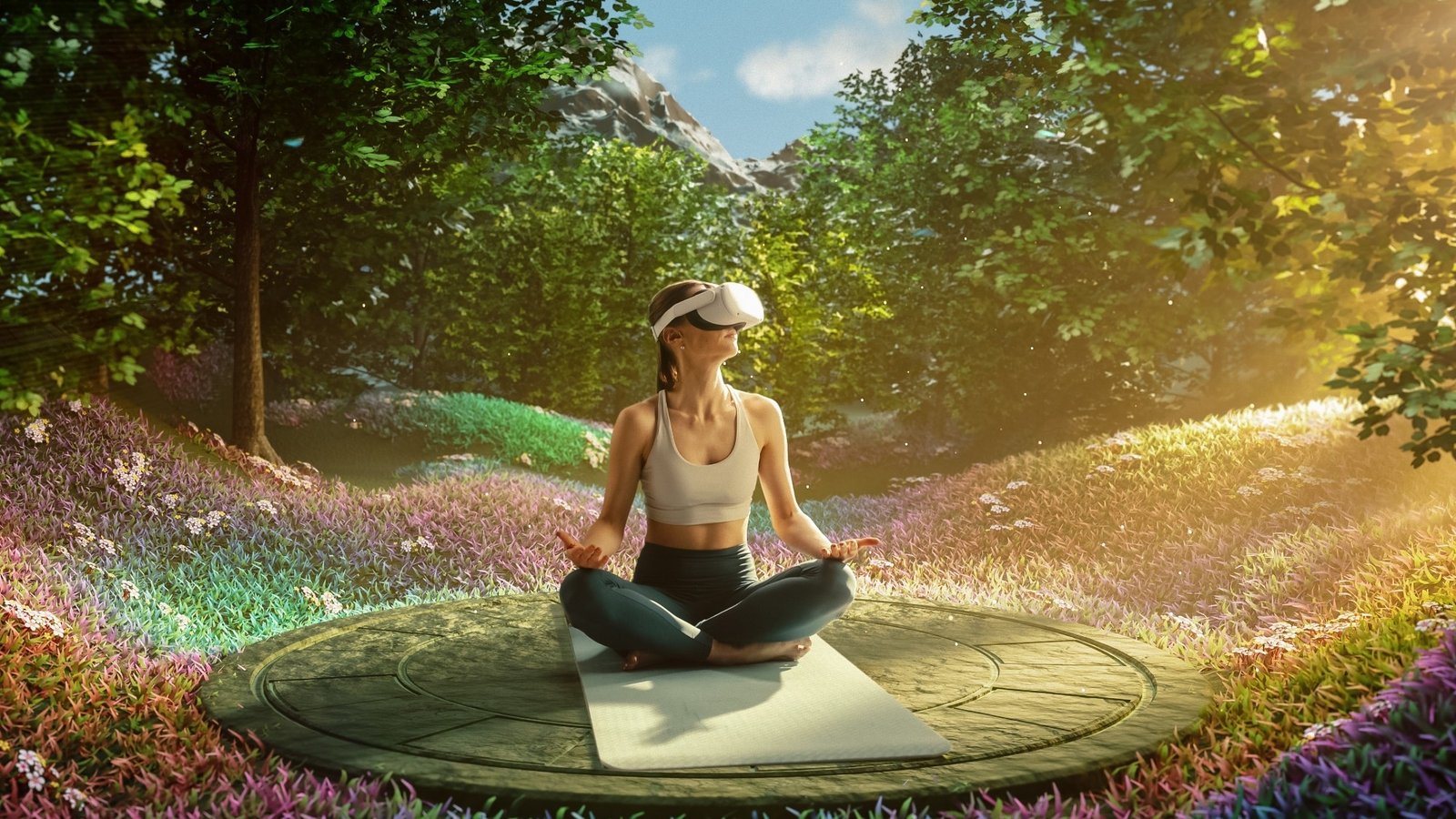
Researchers found that adding synchronized scents to an immersive virtual nature experience improved short-term mood in U.S. Navy personnel. However, larger studies are needed to determine whether these benefits can be sustained in isolated and confined operational environments.
 Research: The scent of tranquility: Lessons learned from virtual reality enhanced sense of smell for stress reduction in isolated and confined environments. Image credit: Gorodenkoff/Shutterstock.com
recent frontiers of psychology This study evaluated the immediate and long-term effects of olfactory-enhanced virtual reality (VR) on mood, stress perception, and cognitive performance in an isolated operational environment and investigated whether it could serve as a practical behavioral health tool.
Can virtual nature offset the effects of isolation?
Chronic stress has significant negative effects on psychological and behavioral health, especially in isolated, confined, and extreme (ICE) environments such as those encountered by astronauts and military personnel. ICE environments introduce additional stressors such as isolation, monotony, and unpredictability, which exacerbate psychological deterioration and cognitive decline. Sensory deprivation and monotony further increase the risk of negative behavioral health outcomes, especially when sustained cognitive performance is important.
Naval personnel, in particular, face environmental challenges that disrupt circadian rhythms, impede recovery processes, and thereby increase psychological strain. The prevalence of severe stress within this group highlights the critical need for scalable and targeted interventions in rigorous operational environments.
It is well known that natural environments support psychological well-being and help restore mental resources. However, access to these environments is inherently restricted in the ICE configuration. VR provides a portable way to recreate natural environments and has been shown to reduce stress and anxiety in a variety of environments, including ICE environments. Although most current VR interventions rely on visual and auditory experiences, incorporating additional senses such as smell could further enhance immersion and psychological benefits.
Due to technical barriers to odor transmission, olfactory stimulation is largely absent in VR applications. Given that the olfactory system is directly related to emotional regulation and cognitive function, integrating scent could significantly enhance VR-based interventions. Importantly, the long-term and cognitive benefits of olfactory-enhanced VR in ICE environments have not yet been fully investigated.
Researchers tested scent-enhanced VR on a warship
The current study used a parallel group design to investigate the psychological and cognitive effects of natural repeated exposure to VR over 2 weeks with and without olfactory enhancement. Twenty-nine active-duty US Navy personnel, ranging in age from 18 to 64, were recruited, all with a functional sense of smell and in good health. They boarded the warship and completed a pre-test questionnaire. Participants were randomly assigned to one of three groups using block randomization: control (no VR), audiovisual VR, and olfactory-enhanced VR (OVR). Six participants were unable to complete the full study due to administrative demands.
The VR and OVR groups each completed four approximately 30-minute immersive nature sessions that included approximately 15 minutes of VR exposure with post-session surveys and feedback. Participants were free to choose and explore different virtual environments during the session. All sessions took place in a designated space and were supervised by trained research assistants who ensured proper use of equipment and participant safety.
VR was delivered via an HTC Vive Pro Eye headset with controllers for navigation, adaptive 3D audio, and, for the OVR group, pulsing scents synchronized with the virtual environment to enhance multisensory immersion.
The protocol included a familiarization session followed by three assessment points: baseline (T1), midpoint (T2), and endpoint (T3). Participants completed cognitive tests and surveys during familiarization and baseline. Cognition and mood were reassessed at T2 and T3, and an exit survey was conducted at T3. The control group received no intervention.
Long-term mood and cognition changed little
The researchers found that emotional responses changed little after the VR session, with one notable exception. Participants who experienced olfactory-enhanced VR reported a significant reduction in negative emotions immediately after the intervention. In contrast, positive emotions remained unchanged in both the standard VR group and the olfactory-enhanced VR group.
Although both VR experiences were generally perceived to have restorative effects, neither created a stronger sense of presence or immersion than the other. Participants in both groups remained relatively aware of their real-world environment while using the headset, although participants in the standard VR group reported slightly higher overall and spatial presence. Despite these differences, there were no significant differences in presence or resiliency measures between the two groups.
When researchers looked at changes over the two-week study period, they found that mood and stress perceptions remained stable across all groups. However, participants with higher resilience consistently reported lower levels of negative emotions and perceived stress, regardless of whether they received the VR intervention.
Cognitive performance also changed little over time, with no clear evidence that the VR intervention improved thinking speed or accuracy. Higher resilience was shown to improve performance on a small number of cognitive tasks, but modest declines were observed on measures of emotion recognition, vigilance, and risk-taking. The researchers noted that these changes were small and inconsistent across tests and should be interpreted with caution.
Participants described the VR intervention as relaxing and fun, and most would use it again. The forest was my favorite environment. In the OVR group, scents were considered to be a positive and memorable addition, with participants stating that scents were pleasant, evoked memories, and could evoke personal memories. Feedback highlighted that immersive, multisensory features improve engagement.
Multisensory VR could support mental health in isolation
Olfactory-enhanced VR may be a short-term tool to reduce negative mood, but research results are still preliminary. Although immediate emotional benefits were observed, the study found: There is no evidence that psychological or cognitive benefits persist under the exposure conditions tested, and long-term psychological and cognitive effects remain unclear.
Further research should investigate whether repeated or long-term use results in sustained effects and investigate the underlying mechanisms driving these improvements. As multisensory VR technology becomes more accessible, it has the potential to become an important supplement to traditional mental health interventions, especially for individuals who do not have regular access to natural environments.
Download your PDF copy now.
