


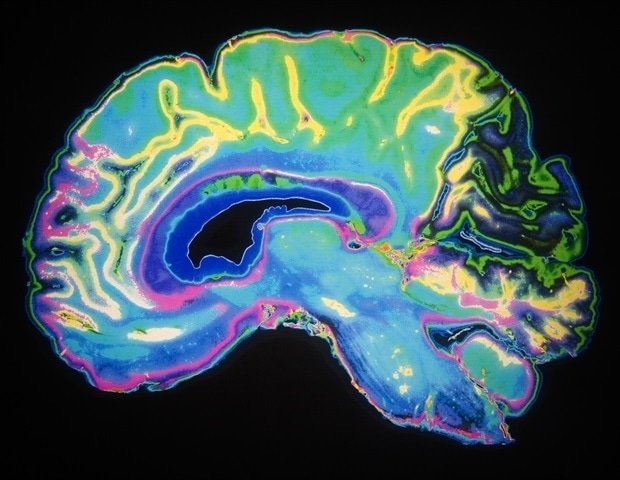
Nuttida Rungratsameetaweemana challenges the narrative that neuroscience has been telling us for decades. According to the traditional explanation, our eyes collect raw information and transmit it through a series of nerves and relay stations deep into the brain, eventually reaching the cortex. There, thinking begins when information is processed and used for higher-order tasks such as reasoning, judgment, and decision-making.
Her group’s activities complicate that explanation. Last year, the team published fMRI scans showing unexpected levels of activity in the cortex’s earliest visual areas, the areas that first receive visual signals. Rather than passively communicating what the eye received, these early regions appear to have processed the same information differently depending on what the study participants were doing. When asked to sort shapes according to a certain rule, participants’ early visual systems operated in one direction. If you are asked to apply different sets of rules to the same shape, the behavior will be different.
In a new paper published today in PLOS Biology, Rungratsameetaweemana and his team at Columbia Engineering show how the brain accomplishes this. They built a simple neural network that obeys many of the rules that govern real brains. Similar to the brain, their model included a class of neurons that caused other neurons to fire, and another class that suppressed their firing.
The research team had the model perform tasks similar to those performed by human participants inside an fMRI machine. When the researchers looked inside the model to see how the neural network solved the problem, they found that it relied on the placement of a single digital neuron. Inhibitory neurons that inhibit other inhibitory neurons appear to pass important information from the “thinking” part of the system to the “sensing” part of the system.
To test whether that wiring is essential, we weakened the connections in the model and disrupted the ability to switch between tasks. If you weaken other types of connections, performance will remain largely unchanged. This pattern also applied to living brains. In recordings from the visual cortex of mice, silencing the inhibitory cells that anchor this circuit reduced the cortex’s ability to track task context, as predicted by the model.
We spoke to Rungratsameetaweemana, Maa-Liao Assistant Professor of Biomedical Engineering, to learn more about this research.
This is based on fMRI research from last year. Why turn to AI models next?
Brain scans provide images of the entire brain, but the images are grainy and cannot see what individual cells are doing or what’s happening at the circuit level. Seeing which areas were lit up and patterns of activity gave us reason to dig deeper. To understand the mechanism, I needed something I could break down and change, so I turned to neural models. Because we build these from scratch, you can see exactly what the network is doing to solve your task.
Why keep the model so simple?
If the model has abilities that the brain doesn’t have, what we find in the model won’t tell us much about the real brain. So we did the opposite and built something that only included features that we know to be true about biology. Much of it builds on previous work by Thomas Gallo Aquino and Robert Kim, co-lead authors of the paper, among other studies. We know that there are excitatory neurons and inhibitory neurons, so we included them. We know that the brain is hierarchical, so in the second part of the paper we gave the network two regions. One is the sensory module that receives the input directly, and the other is the downstream higher-level module. You can then ask how the network uses these elements to perform its tasks.
Why is this relationship between restraint and restraint so important?
These give the system great control over how information is represented. It turns out that these inhibitory neurons are very important for controlling everything properly and expressing the right things in the right way. There are four types of connections between these cells, and the key to this type of flexible processing is inhibition acting on inhibition. I know this is important because deleting the model causes it to fail. I still don’t understand why it has to be this particular wiring. This question is an important topic for research teams around the world.
What made you start researching this field?
In 2015, I began treating patients who were missing the hippocampus, which is responsible for forming and retaining memories. If the brain were truly modular, losing that middle section would make it incapable of doing so many things. But that’s not the case. These patients are still able to perform all kinds of tasks. This was, for me, the first real evidence that early areas of the brain do more than just convey sensory information. And that indicates something useful. If information is stored redundantly, you can survive even if you lose some of it. I think that’s how the brain actually works.
What does that mean for AI?
Compare Brain to things like ChatGPT and large-scale language models. We can do so much more, in so many more situations, with so much less energy, without training all over the internet. The brain got there through evolution, through redundancy built into its wiring. Our model is a recurrent neural network, which is quite different from the transformers behind today’s large-scale language models. The goal is to unravel these principles one by one and use them to make AI leaner and more adaptable. This inhibition-on inhibition motif is one of them.
What’s next?
We are back to being human. We work closely with clinical collaborators who monitor patients with epilepsy by placing electrodes deep in the brain, allowing us to directly record neural activity while patients perform cognitive tasks. These fine-grained measurements provide data to test hypotheses against real neural activity.
This research was funded by an ARL Human-Guided Intelligent Systems Grant (W911NF-23-2-0067) and a Strengthening Teamwork for Robust Operations in Novel Groups (STRONG) Grant (W911NF-22-2-0148).
sauce:
Columbia University School of Engineering and Applied Sciences
