


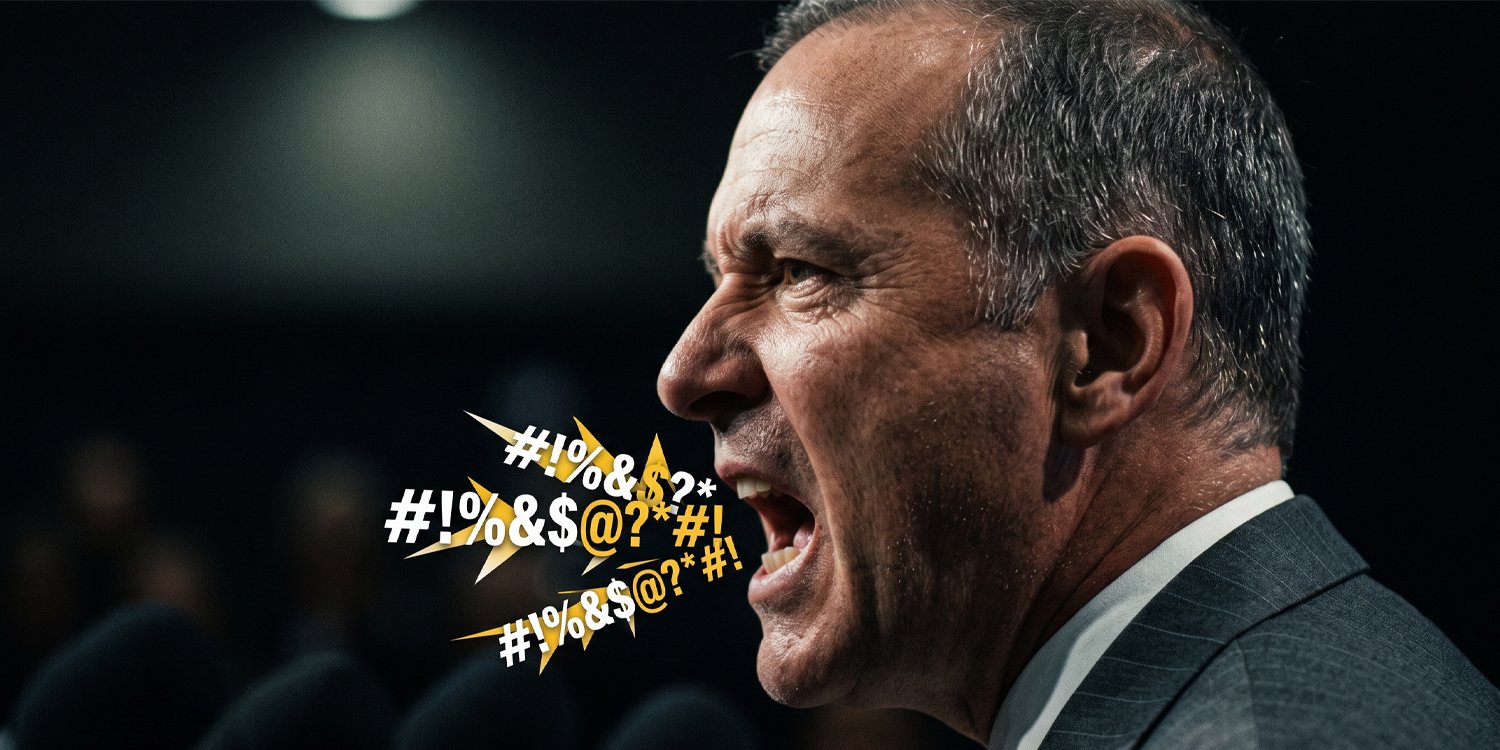
Politicians frequently use offensive and derogatory language to mobilize voters and attack their opponents. Recent psychological experiments have revealed that exposure to this particular communication style makes people feel like their core values are under attack, regardless of their political affiliation. The findings, published in the journal Current Psychology, show that polarizing rhetoric can directly reduce people’s willingness to give free speech to their political opponents.
In recent years, political communication has increasingly fragmented into adversarial territory. Around the world, various political leaders have achieved success by using unconventional and confrontational speaking styles. Researchers refer to this communication style as inflammatory discourse.
Demagogical discourse typically relies on three specific elements. First, it ascribes responsibility to specific groups and actively targets them as scapegoats and threats. Second, by leveling personal and moral insults at his opponents, he ignores basic political etiquette. Third, it attacks the basic institutions of democracy, regularly accusing the free press of distributing fake news.
Many observers believe that this type of offensive speech is actively harmful to the fabric of society. However, there are surprisingly few empirical tests of the psychological effects of such political language. Marcos Dono, a researcher at the University of Santiago de Compostela in Spain, and colleagues designed a series of experiments to test these assumptions.
The research team set out to determine whether inflammatory speech directly causes two specific psychological responses. First, they wanted to measure value threat. This occurs when people feel that their basic moral principles are threatened. Second, they measured political tolerance. In this context, it is defined as a person’s willingness to allow his or her least favorite political opponent to exercise fundamental freedoms such as public speech.
For the first experiment, researchers recruited 310 people living in Spain. They presented participants with a realistic but fictitious political news article that discussed housing regulations. Half of the participants read a version in which the politician gave a moderate, dialogue-oriented speech. The other half was an incendiary version filled with insults, attacks on the media, and aggressive rhetoric.
The researchers also manipulated the political leanings of the fictional politicians. They did this to test whether the psychological effects depended on participants sharing the politician’s ideology. After the reading exercise, participants answered a series of psychological survey questions.
The results confirmed the researchers’ predictions. Exposure to demagogic speech increased perceptions of threat to values. Participants felt that their core moral values were under attack. The inflammatory speech also reduced political tolerance, making participants reluctant to give free speech to the political groups they disliked the most.
The researchers found that ideological congruence between participants and politicians did not make a statistically significant difference in these outcomes. This aggressive speech intimidated people regardless of whether they agreed with the politician’s broader political platform. For supporters, the speech successfully portrayed the opposition as a serious threat. To opponents, the hostility of the language itself felt threatening.
To expand on their findings, the researchers conducted a second experiment with 309 participants in the United States. They tailored the fictitious news story to the American political context. In these scenarios, right-wing leaders attack the Black Lives Matter movement, or left-wing leaders attack the alt-right movement.
This second study replicated the first findings regarding value threats. Participants exposed to demagogic discourse once again felt a heightened threat to their core values. The researchers controlled for the text’s perceived complexity and aggressiveness, confirming that the inflammatory style itself evoked feelings of threat.
However, inflammatory speech in the second study did not result in a statistically significant decrease in overall political tolerance. To understand this contradiction, the researchers turned to a second variable they measured: satisfaction with democracy. They found that participants’ satisfaction with their current democratic system moderated their reactions to offensive speech.
For American participants who were generally satisfied with the workings of democracy, exposure to inflammatory discourse decreased political tolerance. These satisfied people likely responded by taking issue with aggressive rhetoric and wanting to suppress extremist voices.
Conversely, for participants who were highly dissatisfied with American democracy, inflammatory rhetoric actually appeared to slightly increase tolerance for disliked groups. Researchers theorize that disaffected individuals may resonate with anti-establishment rhetoric. These people may develop a penchant for a lawless political arena where all rules of civility are waived, and want to secure the same rights for themselves, allowing others to make extreme statements.
The researchers conducted a third experiment with 380 American participants to confirm these mixed findings. This final study ensured that all participants read speeches from politicians that matched their ideology. They also divided the concept of value threats into three different categories: individual values, societal values, and democratic values.
Because participants were reading articles about politicians they generally agreed with, the researchers controlled for participants’ baseline support for that leader. Given support for this baseline, the researchers found that inflammatory speech increased all three types of value threat. This offensive text made people feel that their personal morality, the foundations of society, and the fabric of democracy were all at risk.
The third study fully replicated the complex dynamics between political tolerance and satisfaction with democracy. Once again, people who prefer democracy today have lost their tolerance for opponents after reading offensive texts. Those who were dissatisfied with the system did not have this restrictive reaction.
The research team provided several caveats regarding the study. This experiment relied on a single, discrete exposure to a short political text. In the real world, citizens experience repeated and prolonged exposure to political rhetoric. Continued exposure can amplify these psychological reactions or lead to emotional habituation over time.
Additionally, research was conducted in two Western democracies. Researchers note that cultural norms regarding civility and civil obedience vary widely around the world. Demagogical discourse can provoke very different psychological reactions in East Asian countries and countries with a recent history of authoritarian rule.
Future research may also consider other ways to measure political tolerance. Restrictions on free speech are a sure indicator of intolerance, but America’s two-party system often forces participants to answer to mainstream political opponents rather than fringe extremist groups. Customizing tolerance indicators to suit specific political situations can yield different insights.
Ultimately, this experiment suggests that adversarial political communication is more than just an empty posturing. When leaders use language that insults opponents, scapegoats groups, or attacks democratic institutions, they actively alter the state of mind of voters. This communication style succeeds in making the public feel deeply threatened, creating a hostile environment in which it becomes increasingly difficult to achieve democratic compromise.
The study, “Investigating the psychological effects of inflammatory discourse on threat perception and political intolerance”, was authored by Marcos Dono, Chantal D’Amore, Mónica Alzate, Marco Brambilla, Martin van Zomeren, and José Manuel Subcedo.
