


Earthquakes occur when stress built up in the Earth’s crust is suddenly released along cracks known as faults. These faults often form where giant plates become stuck moving past each other, allowing pressure to build for years or even centuries before rupture occurs.
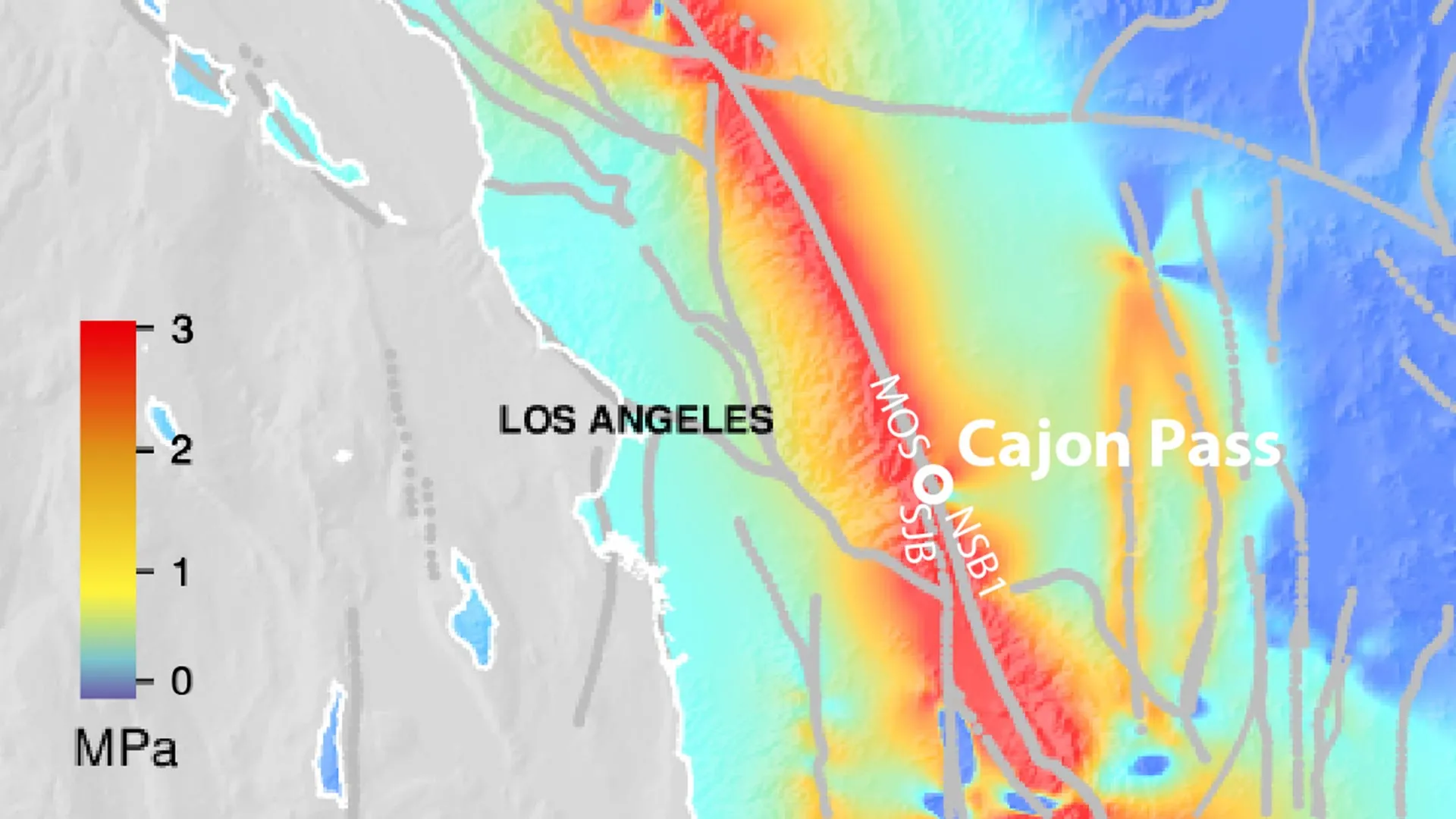
In Southern California, the two most important fault systems in the region are the San Andreas and San Jacinto faults. Together they account for most of the tectonic movements in the region. At Cajon Pass, northeast of Los Angeles, the two systems are close together. This is a geologically complex area where cracks on one fault can jump to the other. Stress has continued to build up along these fault segments since the magnitude 7.9 Fort Tejon earthquake in 1857. This unusually long period of silence has raised concerns among scientists about the possibility of future major earthquakes.
A new study led by Dr Lilian Burkhard from the Department of Space Research and Planetary Sciences (WP) at the Institute of Physics at the University of Bern examined 1,000 years of seismic activity along the Southern San Andreas and San Jacinto fault systems to estimate the current stress levels of the Cajon Pass. The international research team included scientists from the University of Hawaii at Manoa, the U.S. Geological Survey’s Earthquake Science Center in Pasadena, and the Scripps Institution of Oceanography at the University of California, San Diego.
Their findings indicate that tectonic stresses in the region have reached, and in some places exceeded, levels seen at any point in the past millennium. The researchers also introduce a new concept that describes Cajon Pass as a “seismic gate,” a critical turning point that determines whether a major earthquake stays on a single fault or spreads across both fault systems simultaneously. This study Geophysical Research Journal: Solid Earth.
Reconstructing 1000 years of seismic activity
To understand how stresses have changed over time along the San Andreas and San Jacinto faults and the Cajon Pass, the research team developed a physically-based four-dimensional seismic cycle model. The model simulates fault behavior in three dimensions while also tracking changes over time.
The researchers provided the model with 1,000 years of earthquake history reconstructed from geological evidence such as radiocarbon dating, tree-ring records, and historical observations of ground failure.
“The model tracks how each earthquake changes stress on adjacent fault segments, how stress accumulates during quiet intervals between earthquakes, and how deeper layers of the Earth’s crust slowly relax after a large rupture,” Burkhardt explains.
“This simulation allows us to understand how stress in fault systems accumulates over centuries,” continues Burkhardt. “By running a simulation of Southern California’s earthquake history, we can estimate how stressed the fault system is already currently.”
The results show that stress levels across the region are now higher than at any point in the 1,000 years examined by the model.
Role of “seismic isolation gate”
One of the study’s most important findings concerns the role of Cajon Pass as an “earthquake gate.” Researchers describe this as a fault juncture that influences whether rupture stops at one fault or continues across both the San Andreas and San Jacinto systems.
Past earthquakes provide examples of both outcomes. The 1857 Fort Tejon earthquake stopped at Cajon Pass and did not rupture the San Jacinto Fault. In contrast, the 1812 Wrightwood earthquake passed through the junction and propagated through both fault systems as a single event.
“The seismic gate concept captures something important about how fault junctions work,” Burkhardt explains. “The Cajon Pass doesn’t just block or transmit earthquakes; it responds to stress conditions, and those conditions change over centuries.”
The researchers found that the important factor is not just the amount of stress on individual faults. Equally important is how well the stress levels of the two fault systems match each other.
As stress builds up to similarly high levels on both faults, conditions become more favorable for large fractures propagating across the joint into both systems. If the stress levels are significantly different, the failure is more likely to stop at Cajon Pass rather than proceeding further.
The model estimates that stresses in the San Jacinto-Bernardino section reach 3.6 MPa, exceeding any value recorded during the entire 1,000-year simulation period. The adjacent south Mojave section of the San Andreas Fault is currently at 2.8 MPa. Because both sections experience high, relatively similar levels of stress, the fault system is historically configured to precede multiple fault ruptures.
“So not only are we concerned that stresses are reaching historic highs, but we are also concerned that the relative stress state between the two fault systems is approaching the range of what would be considered a large-scale rupture across both faults simultaneously, a scenario with greater consequences for the region,” Burckhardt said.
What does a multi-fault earthquake mean?
Earthquakes that rupture both the San Andreas and San Jacinto faults through Cajon Pass can be much more severe than earthquakes confined to a single fault system.
Such an event could impact some of the nation’s most densely populated and infrastructure-dependent regions, including the greater Los Angeles area, San Bernardino, Riverside, and the Coachella Valley. The Cajon Pass itself includes major transportation corridors, rail lines, and energy infrastructure.
“The question of when and how the next major earthquake will occur in this region is one of the most pressing questions in applied geosciences. Our results provide a clear, physics-based picture of the current stress state of fault systems, and the framework we have developed is applicable not only to California but also to other complex fault junctions around the world,” Burkhardt says.
At the same time, Burkhardt emphasizes that the findings should not be interpreted as predictions.
“This study does not predict when earthquakes will occur. What we can say is that systems are under significant stress and physics-based models like ours can give us a clearer picture of a wide range of scenarios for which we should be prepared. This information is important for hazard assessment, infrastructure planning, and emergency preparedness.”
