


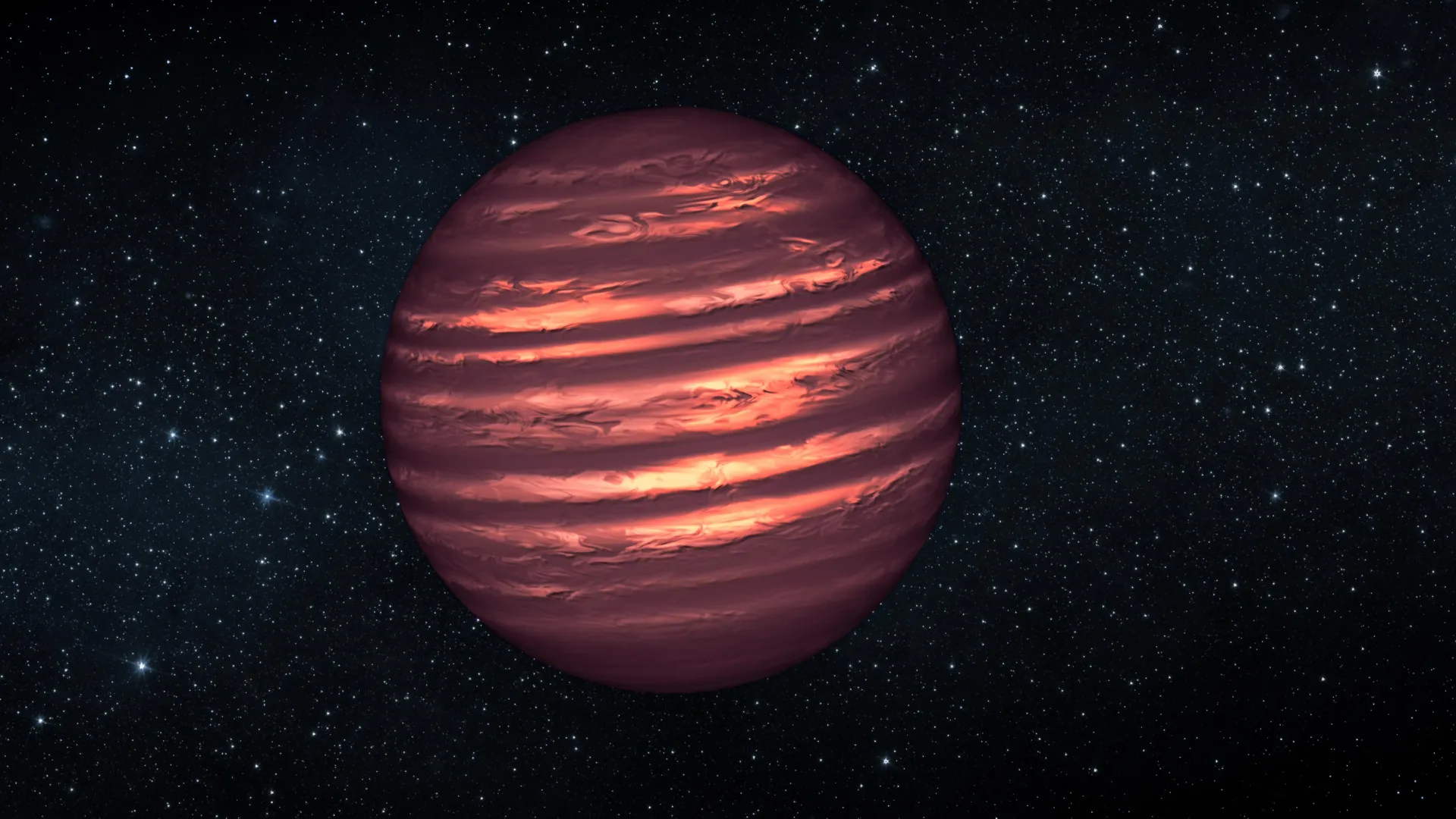
Astronomers have long suspected that there is a relationship between a planet’s mass and its rotation speed. In our solar system, Jupiter and Saturn are notable examples. Despite their enormous size, both complete one revolution in about 10 hours and account for most of the solar system’s total rotational energy.
To test whether this relationship extends beyond our immediate universe, researchers used the W. M. Keck Observatory on Mauna Kea, Hawaii, to study a large sample of giant, distant worlds. Their study included 32 gas giant planets and brown dwarf companions from other star systems, including six planets larger than Jupiter and 25 brown dwarf companions.
Observations revealed an interesting trend. Considering factors such as mass, size, and age, gas giant planets tend to rotate faster than more massive brown dwarfs. To enhance their analysis, the researchers also incorporated previous spin measurements from other studies to create a carefully selected dataset containing 43 stellar/substellar companion stars and giant planets, and 54 free-floating brown dwarfs and planetary mass objects.
The international team was led by scientists from Northwestern University’s Center for Interdisciplinary Exploration and Research in Astrophysics (CIERA). Collaborators included researchers from UC San Diego’s Center for Astrophysics and Space Sciences (CASS), Caltech’s Division of Geological and Planetary Sciences (GPS), W. M. Keck Observatory, Steward Observatory, James C. Wyant College of Optical Sciences, NASA’s Jet Propulsion Laboratory, and several other institutions. Their discovery is astronomical journal.
Measuring the rotation of distant worlds
Many of the planets studied orbit their stars at distances of tens to hundreds of astronomical units (AU), the distance between Earth and the sun. Scientists are still working to understand how these distant worlds form. Some may emerge gradually in a disk of gas and dust surrounding a young star, while others may form through a process similar to the collapse that gives rise to stars themselves.
To investigate, the researchers used the Keck Planet Imager and Characterizer (KPIC), a specialized instrument that can isolate the light coming directly from these distant worlds. As the planet rotates, features in its atmosphere subtly broaden its spectrum. By measuring these changes, astronomers can determine how fast an object is rotating.
Lead author Dino Chih-Chun Hsu, a CIERA researcher, explained the importance of these measurements in a press release from the WM Keck Observatory.
“Rotation is the fossil record of how planets form. By measuring how these worlds rotate, we can begin to piece together the physical processes that formed them tens of millions to hundreds of millions of years ago. Using KPIC, we can shed light on planets’ rotations around other nearby stars. Our results suggest that both the mass of the planet and the ratio of the planet’s mass to the star’s mass influence the speed at which the planet ultimately rotates. This helps narrow down the physics of how these systems rotate. ”
Giant planet outpaces much larger neighbor
One of the clearest examples is in the HR 8799 system. There, a gas giant planet about seven times the mass of Jupiter spins six times faster than its brown dwarf companion, which has about 24 times the mass of Jupiter.
The researchers think this difference may be related to magnetic interactions early in the object’s history. A stronger magnetic field could cause stronger interactions with the surrounding circumplanetary disk, slowing its rotation over time. In this case, the more massive brown dwarf may have lost more of its original spin due to the stronger magnetic field.
The discovery is helping scientists better understand the origins of distant planetary systems as well as our own solar system. Sue said:
“How angular momentum is distributed between planets influences the overall structure of a planetary system. Even Earth’s rotation and magnetic field are ultimately related to how the spin allocation was divided during the formation of the solar system. KPIC is the first instrument of its kind, opening up a completely new way to study exoplanets, allowing us to measure properties like spin that were previously almost impossible to detect.”
Future research on rogue planets and exoplanet atmospheres
The researchers plan to extend this work by studying the rotation of floating planets (FFPs), often referred to as “rogue planets.” The researchers also want to investigate the chemical composition of these worlds’ atmospheres.
Future observations will benefit from new technologies such as Keck Observatory’s HISPEC (High-Resolution Infrared Spectrometer for Exoplanet Characterization), which is scheduled to become operational in 2027. Hsu said the new equipment will allow scientists to study smaller and more distant worlds than ever before.
Jason Wang, assistant professor at Northwestern University and co-author of the study, said:
“We took the lessons learned from KPIC and translated them into HISPEC, which has better sensitivity, higher spectral resolution, and a wider wavelength range. With HISPEC, we can significantly increase the number of planets whose spins can be measured, and we can especially study planets that are close to Jupiter in nature to see if our Jupiter is typical.”
Researchers believe they are just beginning to uncover what the planet’s rotation reveals.
“We’re just beginning to study what the rotation of a planet can tell us,” Hsu said. “With future instruments and larger telescopes, we will be able to measure the rotations of even more worlds and link rotation, chemistry, and formation history across planetary systems.”
