


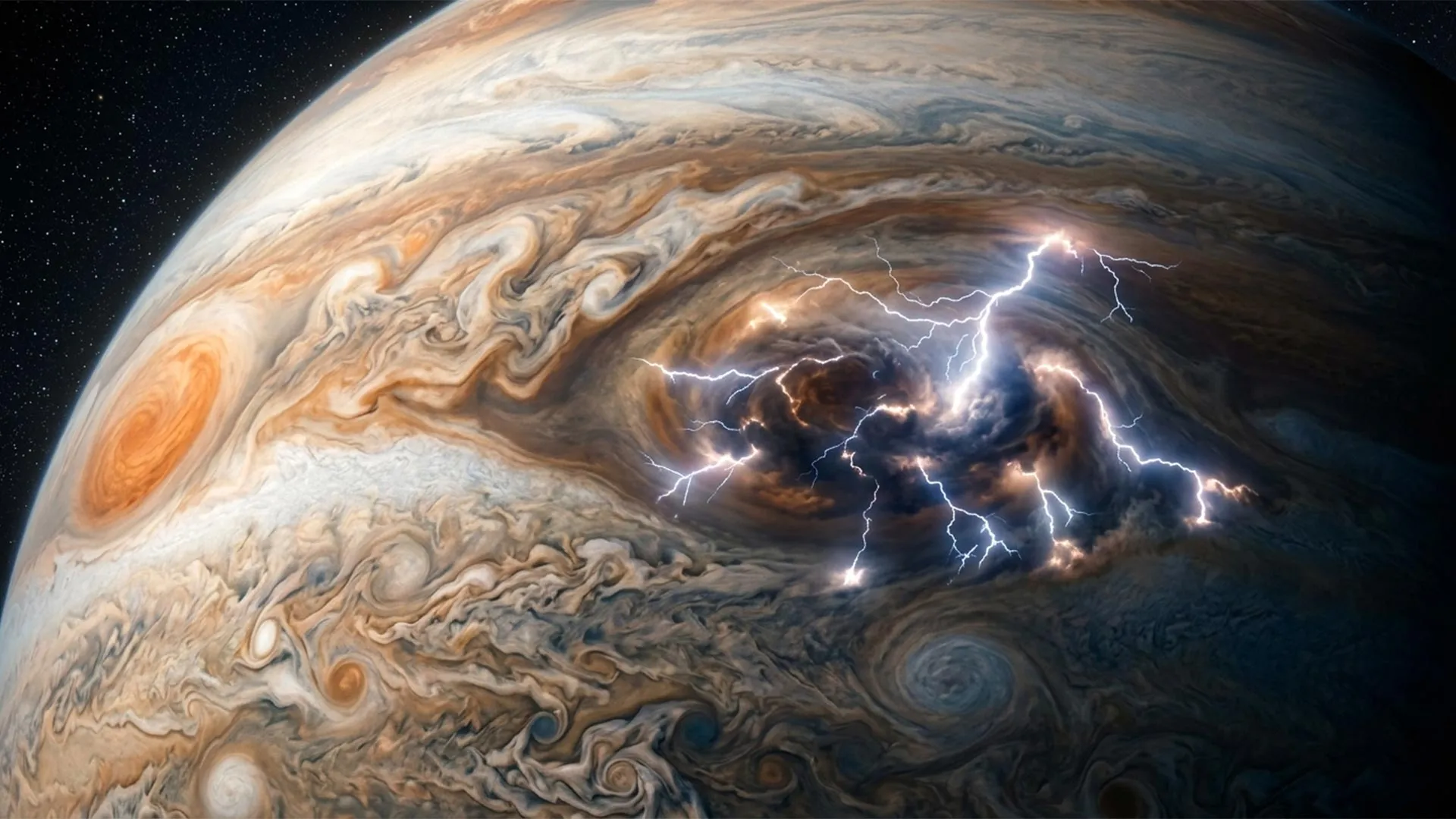
Jupiter is famous for its huge storms, some of which rage for centuries. Now, scientists have discovered that these massive storms can generate lightning that is much more powerful than what is normally seen on Earth.
Using data from NASA’s Juno spacecraft, researchers at the University of California, Berkeley, found that some lightning bolts on Jupiter can be 100 times stronger than those on Earth, and may even be more powerful.
The discovery was made by Juno’s microwave radiometer. This microwave radiometer is an instrument that has been studying Jupiter’s atmosphere since the spacecraft entered orbit around the planet in 2016. The device can detect radio emissions caused by lightning, as well as radio interference caused by storms on Earth. Microwaves occupy the high frequency end of the radio spectrum.
The study was published in the journal AGU progress.
Why are Jupiter’s storms so intense?
Studying storms on other planets could help scientists better understand climate on Earth, said lead author Michael Wong, a planetary scientist at the Space Science Institute at the University of California, Berkeley.
“There’s a lot we don’t know about lightning on Earth,” Wong said.
In recent years, researchers have identified several unusual electrical phenomena associated with thunderstorms on Earth. These “transient luminous events” (TLEs) occur above the storm and include sprites, jets, halos, and ELVEs.
On Jupiter, lightning provides insight into convection, the process that moves heat through the atmosphere.
“Convection works a little differently on Earth and Jupiter, because Jupiter’s atmosphere is mostly hydrogen, and moist air is heavier and harder to lift upward,” Wong explained.
Earth’s atmosphere consists mostly of nitrogen, which is heavier than water vapor. This means that moist air on Earth tends to rise. But on Jupiter, moist air is heavier, so storms require more energy to rise through the atmosphere. Once they occur, huge amounts of energy are released, creating intense winds and powerful cloud-to-cloud lightning.
NASA’s Juno spacecraft measures lightning on Jupiter
Almost every spacecraft that has visited Jupiter has detected lightning. The bright flash stands out clearly on the dark side of the Earth, making it relatively easy to spot.
Previous missions suggested that Jupiter’s lightning was so powerful that only the brightest flashes could be detected. But Juno later complicated the situation when its sensitive star-tracking camera revealed a number of weak flashes comparable to lightning on Earth.
Wong said one of the challenges with visible light observations is that clouds obscure some of the flashes, making it difficult to determine their actual brightness.
Because microwave signals can pass through clouds, Juno’s microwave radiometer provided a better way to estimate lightning energy. Although this instrument is not specifically designed to study lightning, it can detect microwave radiation from nearby storms.
Still, Jupiter’s atmosphere posed other challenges. Storms often occur at the same time throughout the huge belt of clouds orbiting the Earth, making it difficult to determine which storm caused each signal.
Wong likened the problem to hearing a crackling sound at a Lunar New Year parade, not knowing whether the sound was coming from nearby popcorn or distant fireworks.
Jupiter’s ‘stealth’ superstorm
Scientists finally caught a breather in 2021 and 2022, when storm activity in Jupiter’s northern equatorial belt temporarily decreased. This allowed Wong and his team to focus on one isolated storm at a time.
Using observations from the Hubble Space Telescope, Juno’s onboard camera, and images taken by amateur astronomers, the team pinpointed the locations of several unusual storms that Wong called “stealth” superstorms.
Like Jupiter’s larger superstorms, these systems lasted for months and dramatically changed the surrounding cloud patterns. However, the height of their cloud towers remained relatively modest.
“Because we had precise location information, we were able to say, ‘Okay, we know where it is. We’re directly measuring the power,'” Wong said.
During this quiet period, Juneau passed over isolated storms 12 times. During four high-altitude flights, the spacecraft got close enough to detect microwave signals from lightning.
Scientists recorded an average of three flashes of lightning per second during these passes. Juno detected 206 individual microwave pulses in just one encounter.
Of the 613 pulses measured, the researchers estimated that the lightning intensities ranged from about the same intensity as lightning on Earth to more than 100 times stronger.
Wong noted that there is still some uncertainty in the comparison because lightning on Jupiter and Earth was measured at different radio wavelengths. Previous research even suggested that Jupiter’s lightning could be a million times more powerful than lightning on Earth.
How powerful is Jupiter’s lightning?
Determining the total energy of a lightning bolt is complicated, said co-author Ivana Kolmashova, an astrophysicist at Charles University in Prague, Czech Republic, and a member of the Czech Academy of Sciences.
Lightning releases energy in many forms, including radio waves, light, heat, sound, and chemical reactions.
On Earth, a typical lightning bolt releases about 1 gigajoule, or 1 billion joules of energy. This is enough to power approximately 200 ordinary households for one hour.
Wong estimates that Jupiter’s lightning could emit 500 to perhaps 10,000 times more energy than Earth’s lightning.
The mystery behind Jupiter’s lightning
Researchers believe that Jupiter’s lightning occurs in a similar way to thunderstorms on Earth. Rising water vapor condenses into droplets or ice crystals, which become electrically charged and eventually create large voltage differences between clouds or between clouds and the ground.
On Earth, thunderstorms are commonly associated with hail. On Jupiter, scientists think storms may produce icy slush-like objects called “mash balls,” which form when water and ammonia combine.
Even with the new discovery, researchers still don’t fully understand why Jupiter’s lightning is so powerful.
“This is where the details start to get interesting. You can ask, ‘Is the important difference the hydrogen and nitrogen atmosphere, or is the higher height of Jupiter’s storms and therefore the longer distance involved?'” Wong said.
While storms on Earth are about 10 kilometers high, storms on Jupiter can be over 100 kilometers high.
“Or could more energy be available because Jupiter’s moist convection allows more heat to build up before creating storms and lightning?” he added. “It’s an active area of research.”
Wong’s co-authors include researchers from the United States, the Czech Republic, and Japan, as well as Ramanakumar Sankar, a postdoctoral researcher at Berkeley. This research was supported by NASA (80NSSC19K1265, 80NSSC25K0362).
