


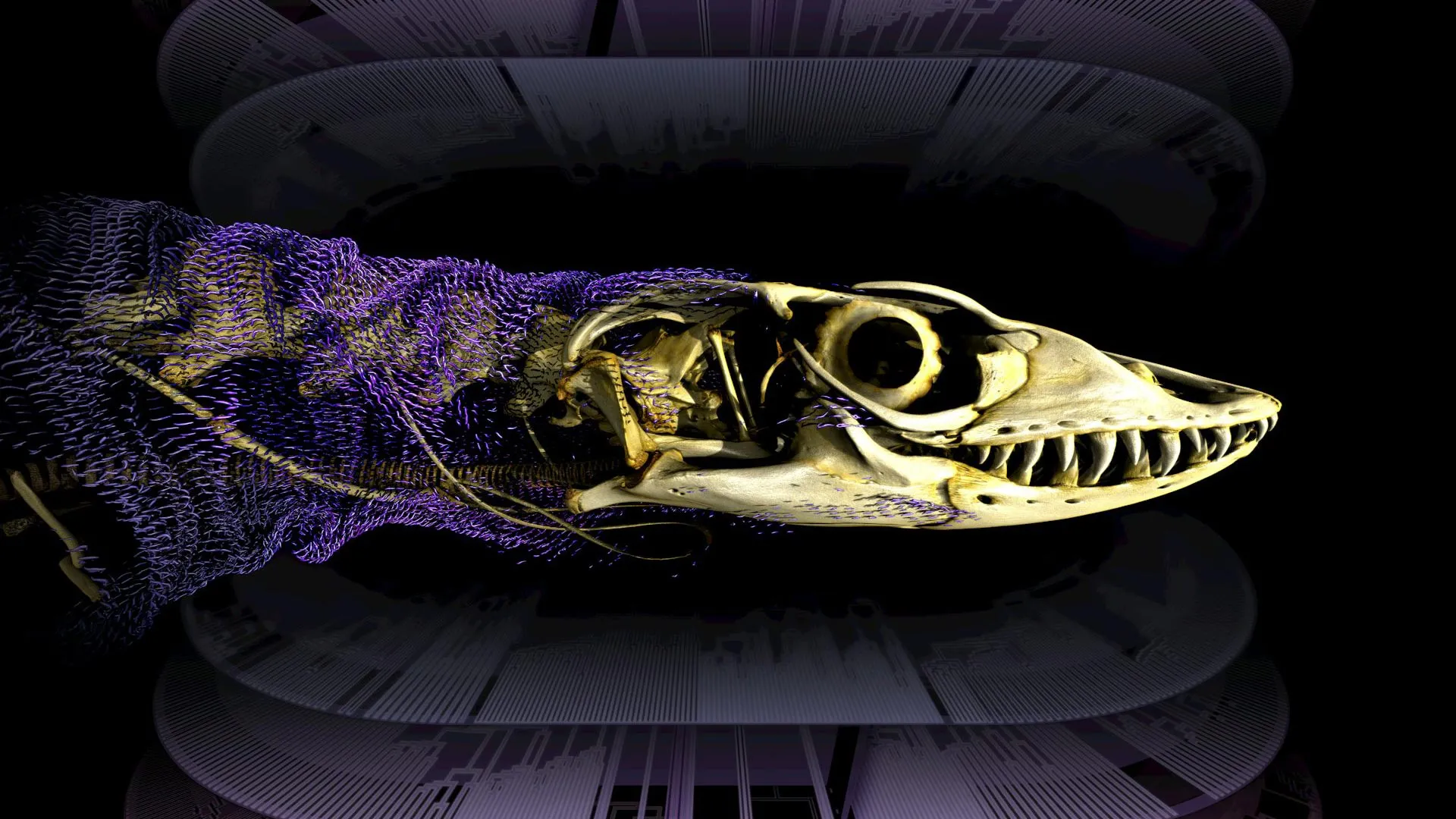
Our bones don’t begin deep within our bodies. Not long after the first complex animals took shape, they began with skin.
Skin bones have remained a recurring motif in evolution ever since. But we still know surprisingly little about them. Why do they appear repeatedly in different groups, such as turtles, crocodiles, lizards, snakes, and even dinosaurs? And was there a single ancestor with skin bones that produced them all?
In a new study published in the Biological Journal of the Linnean Society, we investigated this question. We combined fossil evidence with modern computational tools to reconstruct the evolution of reptile skin bones over 320 million years.
What we discovered concludes a centuries-old debate. Skin bones actually evolved independently across multiple lizard lineages. Along the way, we also tracked the unique evolutionary resurgence of one of the most iconic groups: monitor lizards.
When the bones were superficial
The oldest known dermal bones in the fossil record may date back 475 million years. At that time, some early vertebrates had evolved elaborate bony exoskeletons.
This may seem counterintuitive, since vertebrates are literally defined by the fact that they have a backbone. However, their bony internal skeleton did not evolve until 50 million years later.
Throughout evolutionary history, the ability of the skin to form bone tissue has resurfaced many times. Fish scales are one example.
Another example is osteogerm, which is the skin bone of a terrestrial animal. Osteoderms may have helped animals adapt to life on land after they left the ocean in the distant past.
Beyond that, the image becomes blurry. Although osteoderm disappeared in most lineages, it continued to reappear, especially in reptiles. Understanding how this happened required assembling a complex evolutionary puzzle.
A story told by bones
Imagine arriving at the scene of a bank robbery long after it has occurred. There are no perfect witnesses. You talk to dozens of people. One person saw the getaway car and another noticed the robber’s jacket. Someone else heard the alarm.
Each story is incomplete and some even contradict each other. But as you collect more accounts, certain details begin to match. Eventually, a consistent image emerges.
This is how we approached the mystery of reptile dermal bones. Our sightings were 643 extant and extinct species. Each was related to the others in some way and offered a unique perspective. We continued our investigation until their stories began to converge.
We found that most lizards first evolved osteoderms more than 100 million years ago, during the Late Jurassic and Early Cretaceous periods. At the time, some of the most iconic dinosaurs roamed the earth. Brachiosaurus,intense Allosauruswith plate back stegosaurus.
Climate and ecosystems were changing rapidly, creating new challenges and opportunities. Armor may help lizards survive predators, cope with harsh environments, and move to new habitats.
After early rapid changes in osteoblast evolution, the pace slowed, and most groups have continued to retain skin bones ever since.
With one big exception.
Goanna’s comeback
The ancestors of monitor lizards, also known as monitor lizards in Australia, completely lost their osteoderm. This is likely because their active lifestyles and efficient bodies functioned better without the additional weight.
But when their descendants arrived in Australia about 20 million years ago, something amazing happened.
This re-evolution can be traced back to the Miocene, when Australia’s climate was becoming drier. The skin bones helped reduce water loss and may have provided protection in open, dry terrain.
Remarkably, monitor lizards are the only lizard lineage known to reacquire osteoderm after losing it. This challenges Dollo’s law, which states that once a complex trait disappears, it cannot re-evolve.
settles a century of controversy
In the early 20th century, researchers thought that lizards inherited osteoderm from a common ancestor.
Later, this view was replaced by the idea that these bone plates evolved independently among selected groups. Subsequent debates about the underlying evolutionary mechanisms, even at the molecular level, rushed forward without anchoring the origin of osteoderms to a clear evolutionary timeline that led to today’s reptiles.
Our research provides this foundation, and we are proud to have it published in the same journal in which Charles Darwin first shared his groundbreaking ideas. In many ways, our work is a synthesis of past and present.
Fossil evidence helped answer long-standing questions, but only modern computing made it possible to narrow down thousands of evolutionary scenarios, each informed by trait data from hundreds of species, into a single, coherent story.
The evidence is clear. Osteoblasts evolved multiple times independently across different lizard lineages over hundreds of millions of years. Now that we know this, scientists will be able to investigate the genetic and developmental mechanisms behind them.
Among lizards, monitor lizards stand out as the only lineage known to have lost this armor, only to regain it through a surprising twist of evolution. This pattern fits neatly among other evolutionary oddities seen in Australia, where marsupials reign and mammals lay eggs.
It also shows that evolution rarely follows a straight path, but winds its way through the ever-changing conditions on Earth.
