


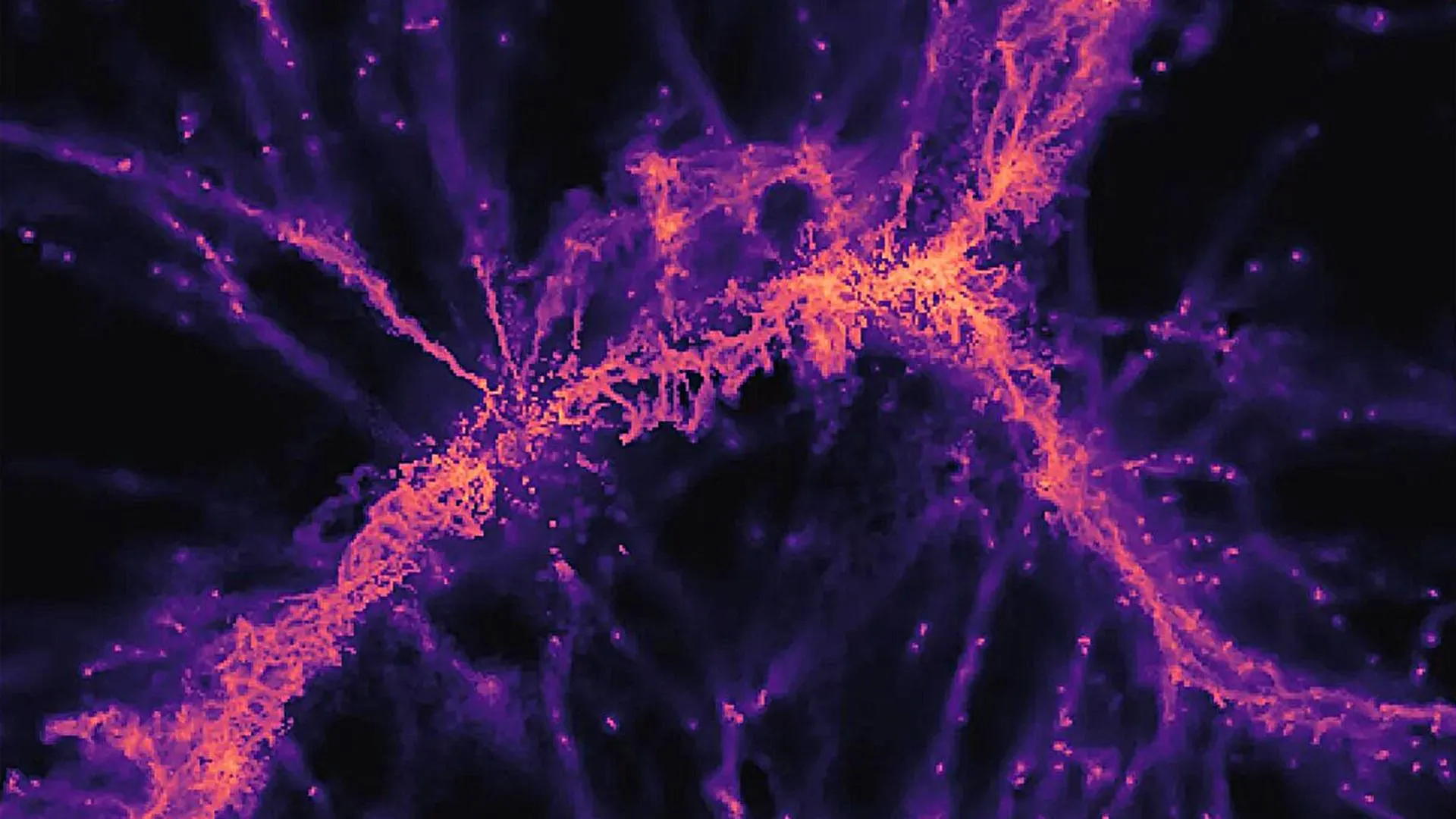
Scientists have created the clearest image yet of part of the cosmic web, a vast hidden network of matter that stretches across the universe and connects galaxies. After spending hundreds of hours collecting observations, an international team has captured detailed images of a giant cosmic filament connecting two galaxies that were actively forming when the universe was only about 2 billion years old.
The discovery provides a rare opportunity to directly observe one of the largest structures in existence, and could help researchers better understand how galaxies grow and evolve over cosmic time.
hidden structure of the universe
Modern cosmology suggests that dark matter makes up about 85% of all matter in the universe. Although dark matter is invisible to the naked eye, it is thought to form a giant web-like framework made up of long filaments. At the points where these filaments intersect, galaxies form and shine brightly.
Scientists believe that these filaments also act as intergalactic highways, funneling gas into galaxies and promoting the birth of new stars. Knowing how this gas moves through the cosmic web is thought to be essential to understanding how galaxies develop.
However, detecting the gas was extremely difficult. Most intergalactic gas has been observed only indirectly, by measuring how it absorbs light from bright objects behind it. Hydrogen, the most abundant element in the universe, emits only a very faint light, making direct observation almost impossible with older instruments.
Hundreds of hours of telescope observations
The new observations were made by researchers from the University of Milano-Bicocca and scientists from the Max Planck Institute for Astrophysics (MPA). The research team used MUSE (Multi-Unit Spectroscopic Explorer), a powerful instrument aboard the European Southern Observatory’s Very Large Telescope in Chile.
Despite using such advanced technology, the project required one of the most ambitious MUSE observing campaigns ever conducted in a single region of the sky. The researchers collected hundreds of hours of data to detect filaments distinct and faint enough for detailed analysis.
The study, led by Davide Tornotti, a doctoral student at the University of Milano-Bicocca, produced the clearest images yet of a cosmic filament that stretches approximately 3 million light-years. This structure connects two galaxies, each containing an active supermassive black hole.
The survey results are natural astronomy And it provides a new way to study the physical properties of gas within intergalactic filaments.
12 billion years of space travel
“By capturing the faint light emitted by this filament, which took just under 12 billion years to reach Earth, we were able to precisely characterize its shape,” explains Davide Tornotti. “For the first time, we have been able to trace the boundary between gas in galaxies and matter in the cosmic web using direct measurements.”
To better interpret their observations, the researchers compared their data to supercomputer simulations of the universe created by MPA. These simulations predicted what such a filamentary structure should look like under current cosmological models.
“Compared with new high-resolution images of the cosmic web, we find substantial agreement between current theory and observations,” Tornotti added.
New clues about galaxy formation
The good agreement between observations and simulations gives scientists greater confidence in their understanding of how gas is distributed around galaxies and how they receive the material they need to continue forming stars.
Researchers now hope to identify many more of these faint structures to build a broader picture of how matter flows through the cosmic web.
“We are excited about this direct and high-resolution observation of cosmic filaments,” said Fabrizio Allrigoni Bataia, an MPA staff scientist involved in the study. So we’re collecting more data to further elucidate such structures, with the ultimate goal of having a comprehensive vision of how gas is distributed and flows in the cosmic web.”
