


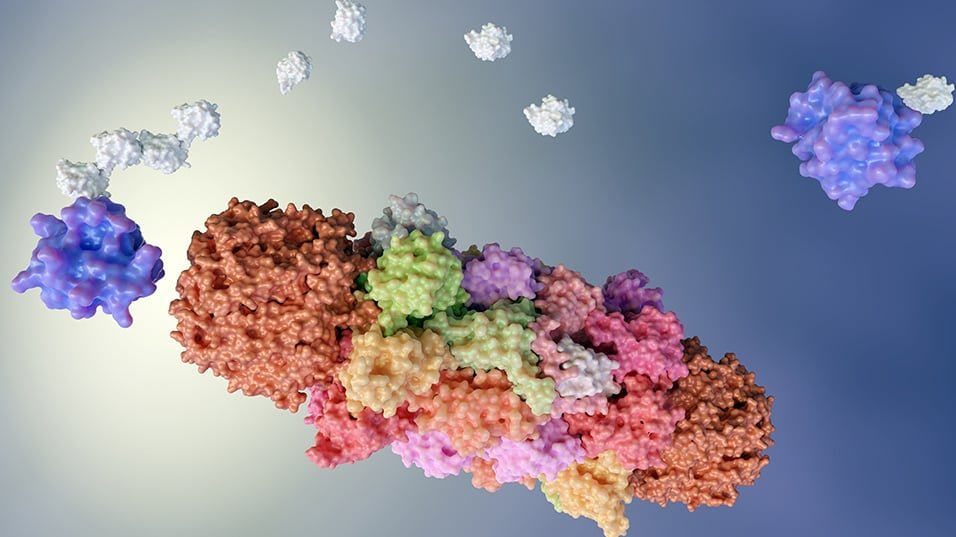
Targeted protein degradation is changing the way drug discovery teams think about disease biology. For many years, small molecule programs have been built around inhibition. The compound was expected to bind to disease-associated proteins and block their activity. This logic still works for many targets. However, this is not sufficient for proteins that lack distinct binding pockets, function primarily as scaffolds, or cause disease through non-enzymatic functions. Here, the degradation of the target protein becomes important. That asks a different question. Is it possible to not only block a protein, but also tell cells to remove it?
Why target protein degradation is important now
The interest in target protein degradation stems from practical limitations in traditional drug discovery. A large part of the proteome remains difficult to treat with conventional inhibitors. These include transcription factors, scaffold proteins, mutant proteins, and proteins involved in complex regulatory networks. Many are related to cancer, immunology, inflammation, neurodegeneration, and rare diseases.
Degraders use the cell’s protein disposal systems, primarily the ubiquitin proteasome system, to bring the protein of interest close to E3 ligases. The target protein is then marked for degradation. This event-driven mechanism may confer stronger and more durable biological effects than occupancy-driven inhibition.
This promise is significant, but it should not be oversold. Degraders are not automatically better than inhibitors. They must demonstrate selective degradation, cellular activity, useful exposure, manageable safety, and a development pathway that can withstand formulation and scale-up pressures.
Non-draggable targets and new discovery logic
Beyond just target binding
The phrase “undruggable target” is often used too loosely. In practice, it refers to targets that are difficult to modulate using traditional small molecules, either because there is no suitable binding pocket or because inhibition does not sufficiently impact their disease-causing role. Degradation of target proteins brings new logic to these targets. Binding is still necessary, but it is not the only purpose. Degraders must induce proximity, form a productive ternary complex, and cause ubiquitination to result in measurable degradation within the cell.
This changes the discovery cascade. Programs cannot rely solely on affinity or biochemical potency. It requires cytolytic data, kinetics, proteomics, pathway readouts, and early feasibility checks. Weak binders can be useful if they promote efficient degradation. Strong binders may not work unless they form a productive complex. The old rules are helpful, but they don’t dictate the program.

infographic.jpg
PROTAC Drug Discovery and Molecular Adhesives
PROTAC drug discovery has become one of the most well-known areas of targeted protein degradation. PROTACs are heterobifunctional molecules in which one ligand binds to the protein of interest, another to the E3 ligase, and a linker joins them. Their design allows medicinal chemists to manipulate several variables, including E3 ligase selection, linker length, exit vector, polarity, permeability, and metabolic stability.
Molecular adhesives are typically small molecules that stabilize or induce interactions between target proteins and E3 ligases. In some cases, they may offer better drug-like properties, but their discovery is not predictable because appropriate starting points are difficult to rationally design.
Both approaches expand the scope of TPD drug development. They also pose practical challenges. PROTACs often sit outside the traditional Rule of Five space. Molecular adhesives may look simpler on paper, but finding selectivity and appropriate degradation biology is challenging.
Proteolytic assays as decision-making tools
Assay design determines program quality
Proteolytic assays do not support experiments with TPD. These are central decision-making tools. Degradation programs require assays that can separate binding, target binding, degradation, pathway regulation, and downstream phenotypes. Western blotting, capillary Westerns, HiBiT or NanoLuc tag-based systems, immunofluorescence, flow-based readouts, and mass spectrometry-based proteomics can all contribute depending on the target and stage of the program.
The key point is the suitability of the assay. Although tag-based assays can help increase throughput, they may not fully represent the endogenous biology. Detection of endogenous proteins is close to physiological relevance, but can be time-consuming and difficult to scale up. Cell viability readouts alone provide weak evidence unless related to target degradation or mechanism.
From deterioration to development potential
A good proteolytic assay should also support chemical determinations. Data should explain whether changes in linker length, E3 ligand, stereochemistry, or physicochemical properties improve degradation, potency, selectivity, and exposure. The best cascades connect biology with DMPK, safety, and formulation thinking early. Waiting until discovery is delayed due to permeability, solubility, metabolic stability, or bioavailability issues is costly, especially in PROTAC programs.
This is why you need integrated review points in your TPD program. Molecules that appear potent in one cell line may not work in disease-relevant models. Even a decomposer with a good DC50 may have an insufficient Dmax, a slow reaction rate, or insufficient selectivity. Compounds may degrade the target but still do not translate into sustained pharmacodynamic effects.
TPD drug development requires integrated capabilities
Chemistry, biology, DMPK, and analysis need to work together
TPD drug development is not a linear handoff from chemistry to biology to DMPK. These features work better when they work in parallel. Medicinal chemistry needs to understand the degradation hypothesis. Biology must interpret whether the observed effects are relevant to the target. DMPK requires early reporting of exposure and metabolic risks. Analytical and bioanalysis teams need to support reliable quantification, metabolite understanding, and translational readouts.
This discipline is important for new modalities where standard playbooks may not be sufficient. The challenge is not just in creating degraders. The challenge is to create degraders that behave like new drug candidates.
be at the forefront
Being at the forefront of targeted protein degradation means getting into the program before cheap claims are made. This means testing whether the target is suitable for degradation, whether the disease context justifies the approach, whether the assay system is reliable, and whether the chemistry can be optimized without losing developability.
For sponsors, there is value in making early decisions about which targets to pursue, which E3 ligases to explore, which assay cascades to trust, which chemistry series to stop, and when to move from hit discovery to candidate quality optimization. Continuity is important in CRDMO-led programs. Fragmented runs can create attractive data packages that are not combined as the molecule enters deeper development.
summary
Targeted protein degradation has reached a stage in the field where fewer broad promises and more disciplined execution are needed. Opportunity is real. It can address difficult biology, including some undruggable targets, and reshape the way drug discovery approaches new techniques. However, progress will depend on clear targeting logic, robust proteolytic assays, integrated PROTAC drug discovery, and early development thinking. That’s the real front line.
As targeted protein degradation moves toward broader therapeutic effects, integrated discovery capabilities will be critical to turning promise into progress. Syngene is supporting this effort by integrating biological, chemical, and developmental insights across new modality programs.
Learn more about our detection capabilities.
