


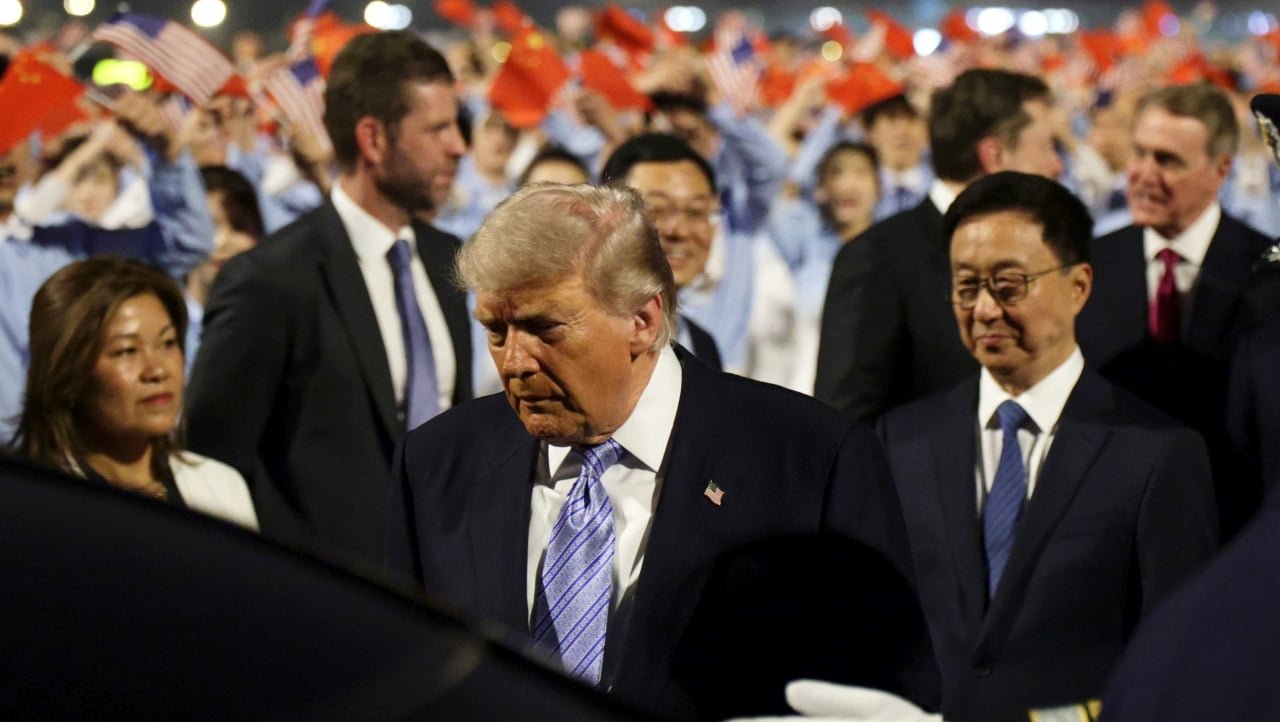
As President Donald Trump arrives in Beijing, one key industry is missing from his business delegation: pharmaceuticals.
Jacob Theisen, CEO of a medtech company, is the only representative of the life sciences industry.
The 17-person delegation is dominated by Wall Street and tech giants, including Apple’s Tim Cook, Nvidia’s Jensen Huang and Tesla’s Elon Musk, as well as the CEOs of Goldman Sachs, BlackRock and Blackstone, according to the report. When it comes to agriculture and food, there’s only one person out there: Brian Sykes of Cargill.
But it’s not just the pharmaceutical industry that’s absent from President Trump’s side. Wholesale, retail, and cultural entities are not included.
During his two-day summit with Chinese President Xi Jinping in Beijing, Trump told reporters before leaving Washington on Tuesday that he was expected to focus on trade “first and foremost.” According to Reuters, President Trump also wants to discuss the creation of an “investment committee” and a “trade committee” with China.
Still, this lack of drug company representation stands in contrast to a similar recent trip to Beijing led by President Trump’s British and German counterparts.
In February, Bayer CEO Bill Anderson was reported to be part of the economic delegation accompanying German Chancellor Friedrich Merz on his state visit to China.
AstraZeneca and GSK leaders joined British Prime Minister Keir Starmer and a delegation of around 50 others on a visit to China in January. During the visit, AZ unveiled $15 billion in investments in the country, including plans spanning pharmaceutical research, development and manufacturing.
US drug companies are clearly interested in China. Pfizer CEO Albert Bourla and Eli Lilly CEO David Rix attended the annual China Development Forum in Beijing in March. The two executives were also among a group of more than 40 international business leaders who met with President Xi in Beijing in March 2025, shortly after President Trump imposed a series of additional tariffs on imports from China.
Agreements and cooperation do not require high-profile state visits. As President Trump heads to China, Bristol-Myers Squibb on Tuesday announced a wide-ranging partnership with China’s Hengrui Pharmaceuticals in a potential $15.2 billion deal that includes 13 drug programs for both companies.
The lack of a pharmaceutical industry voice in President Trump’s delegation may reflect the topic’s relative low priority on the president’s agenda compared to semiconductors and artificial intelligence, or it may simply reflect the direction of investment flows. After all, President Trump is clearly intent on squeezing further investment from China into the United States, not the other way around, as many pharmaceutical companies are doing.
President Trump’s visit comes as regions and industries in Washington are growing wary of China’s rapid rise in the global biotech space, as major pharmaceutical companies and venture capitalists race to capitalize on China’s innovation and rapid R&D speed for the U.S. market.
Just a few days ago, the House Appropriations Committee released a draft spending bill report that would prohibit the FDA from accepting clinical data generated in China, Russia, Iran, and North Korea in new drug applications submitted by sponsors to the FDA to begin clinical trials in the United States.
“The committee is deeply concerned about the increasing influence of the People’s Republic of China (China) on the U.S. pharmaceutical supply chain and drug development ecosystem,” the report said, while comparing the conduct of early-stage clinical trials in China to “the transfer of know-how to an adversary country.”
The report is non-binding and unlikely to be adopted as is, but it would send a strong signal to officials about how Congress thinks federal funds should be spent.
Related: “A collaborative effort between industry and government”: Strand Therapeutics CEO Jake Beecraft talks about FDA IND reform and China
In a separate opinion piece published in Statistics on Tuesday, Olivia Kosloff, co-chair of the Council on Foreign Relations’ China Strategic Initiative Working Group, argued that by licensing from Chinese biotech, U.S. biopharmaceutical companies are abandoning the “long-term viability of American biotech” in pursuit of “short-term economic gain.”
He called on U.S. pharmaceutical leaders to advocate for policies that could deter U.S. investment in Chinese biotech assets.
