



“Lulu” may sound like a funny word, but the health burden that comes with it is no laughing matter. Locally undesirable land uses (LULUs) – industrial sites, highways, power plants, waste facilities – are essential to the functioning of cities. But living near them can also mean greater exposure to pollution, excessive noise, and other environmental stressors.
Many studies link this type of exposure to a wide range of health concerns. Air pollution is linked to millions of premature deaths around the world each year alone and that is Associated with heart and lung diseaseEspecially in communities located near industrial activities or areas with heavy traffic. Researchers are also increasingly documenting the link between environmental conditions and mental health.
exposed to air pollution over long periods of time Associated with depression and anxietyOn the other hand, environmental noise from traffic and industrial infrastructure associated with symptoms of stress and anxiety. More broadly, environmental pollution is now understood to affect people’s physical and mental health. Evidence linking cognitive decline, psychological distress, and worsening of mental health over time.
The health burden of LULU is not evenly distributed. decades environmental justice research We show that these patterns reflect long-standing inequalities in political power, land-use decisions, and access to resources.
One of the clearest historical frameworks for understanding these patterns is residential segregation and its relationship to redlining. From the 1930s to the 1960s, the federal government graded neighborhoods based in part on race and ethnicity, and many black and immigrant communities were redlined or labeled as high-risk for investment. Redlining did not create racial discrimination per se, but it formalized and reinforced patterns of disinvestment that shaped neighborhoods.
a Ever-increasing research content also found that neighborhoods with a history of redlining tend to have higher concentrations of environmental burdens, such as industrial land uses, busy transit arteries, and other LULUs. These same regions often continue to face increased socio-economic disadvantage and exposure to environmental stressors. a recent research The study, conducted by researchers at the University of Michigan, The Ohio State University, and the National Community Reinvestment Coalition (NCRC), reflects this broader pattern in Chicago.
 Chicago is the largest hub for the railroad industry. Six of the seven Class I railroad lines, excluding the Kansas City Southern Railroad, converge in Chicago. As of 2002, severe congestion on freight trains meant that it took as long for a train to pass through the Chicago area as it did to arrive there from the West Coast of the United States (approximately two days). About a third of the country’s freight trains pass through the city, making it a major bottleneck for the country. (Photo credit: Wikipedia Commons)
“We found that areas with high levels of historical redlining tend to have higher concentrations of certain LULUs, particularly industrial land uses, vacant land, and construction sites,” said lead researcher Liang Chen, Ph.D., from the University of Michigan.
These regions also tended to report higher levels of poor self-rated mental health. In our analysis, industrial sites, construction sites, and vacant lots were particularly important to understanding how red light zones, neighborhood conditions, and mental health are patterned across cities.
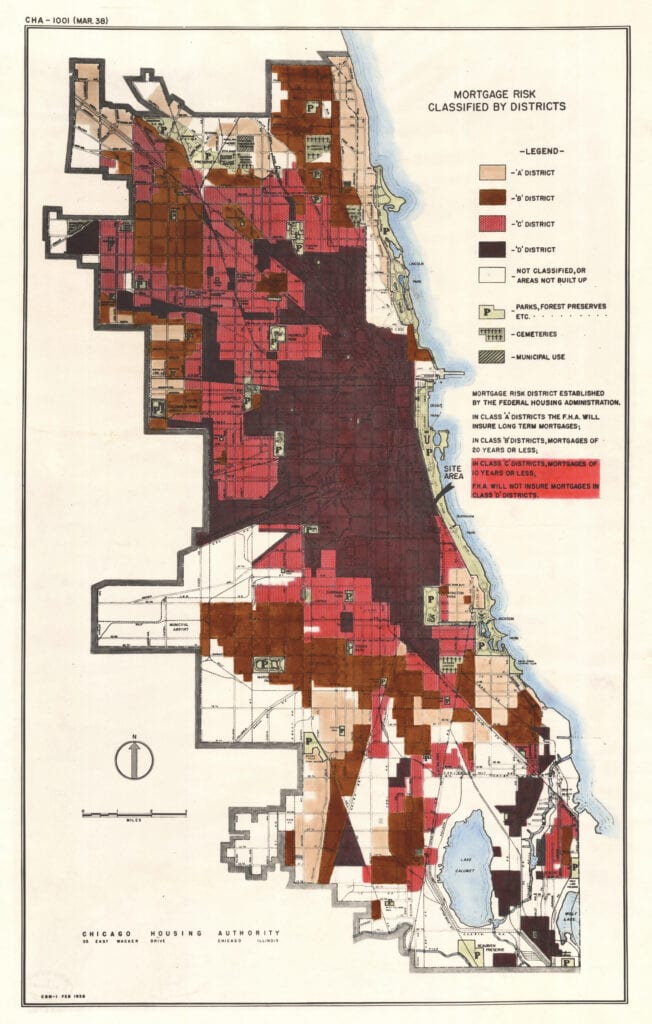 A 1938 copy of the Federal Housing Authority Neighborhood Assessment for Chicago, Illinois, by the Chicago Housing Authority. (Image from the University of Chicago Map Collection; https://www.federalreservehistory.org/essays/redlining.)
These findings suggest that today’s geography of LULU closely overlaps with the historical geography of housing discrimination defined by redlining. In Chicago, like in many U.S. cities, neighborhoods that suffered from decades of disinvestment continue to experience greater environmental burdens and worsening health outcomes. This shows how the legacy of racism and land use continues to shape mental health outcomes today.
Deliberate policy actions are needed to address these patterns. Tools like the Community Reinvestment Act (CRA) can help by encouraging investment in historically underserved areas and supporting redevelopment efforts that expand access to affordable housing, community facilities, and resources that improve neighborhood conditions and promote community health.
Dr. Bruce C. Mitchell. I am a principal investigator on the NCRC research team.
Photo credit: Chait Goli (via Pexels)

