


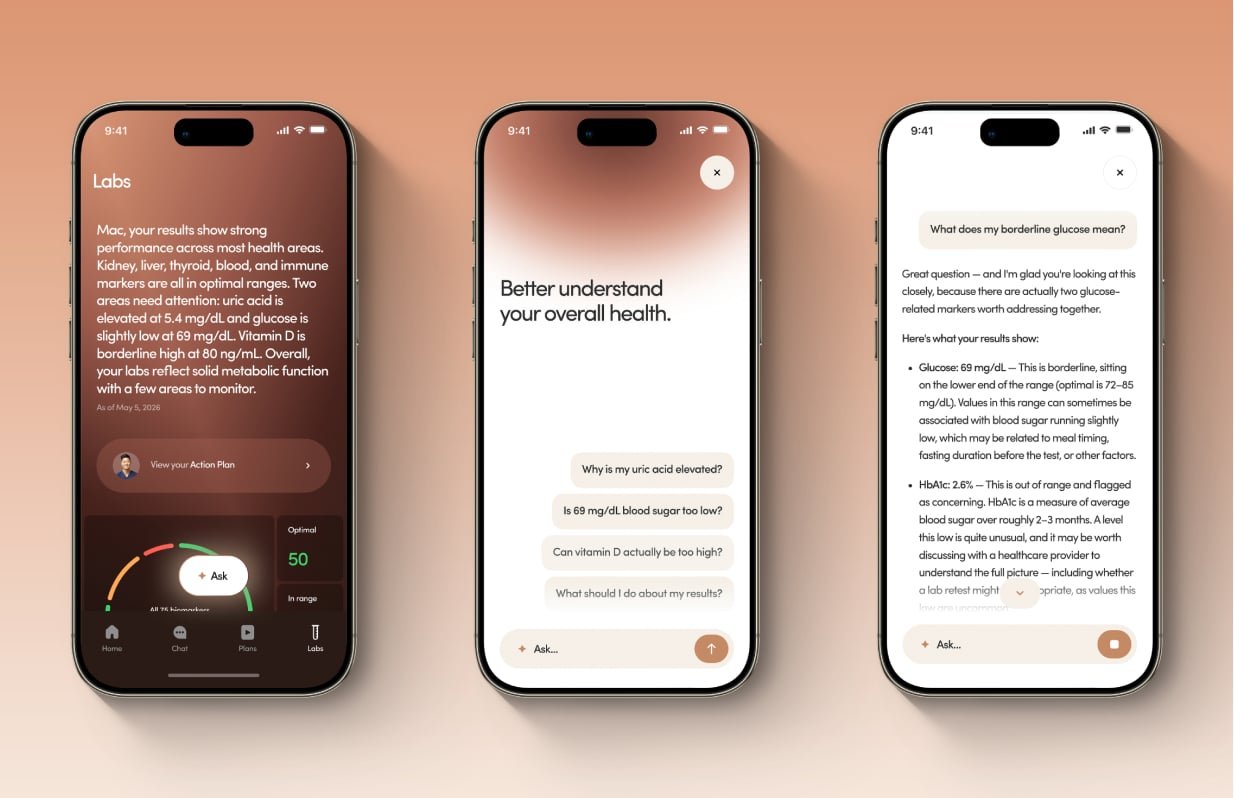
Hims & Hers has launched an artificial intelligence agent embedded in its platform to help interpret biomarker test results and provide users with personalized insights about their health.
The company launched a direct-to-consumer clinical testing program for health biomarker testing in November. The new agent AI, Labs AI, is available to some customers in beta testing and will be rolled out to all Labs customers over time, the company announced Thursday.
As part of its strategy to expand into prevention and health screening, Hims & Hers’ Labs is offering access to 130 biomarker tests across 10 health areas including heart health, metabolism, hormones, inflammation and stress. According to Dr. Patrick Carroll, chief medical officer at Hims & Hers, the new AI care agent will make test results clearer, more convenient, and easier to work with for customers.
“AI Companion educates the customer about every lab test that is returned; it is not set up to diagnose,” Carroll said in an exclusive interview about Labs AI. “This is set up to format information and educate customers, and the same information coming from the AI application is sent to providers so they can match messaging and use AI to deliver cleaner, more easily interpretable results to customers.”
The AI agent can identify patterns across 130 biomarker tests and explain to users why they are important and how they fit into a broader picture of health, executives said.
Labs AI is a custom-built AI system that infers a customer’s biomarker history and personal health profile to generate specific, safe, and actionable insights, the company said. It combines Frontier Language Models with anonymized learning from Hims & Hers’ in-house clinical knowledge base and thousands of patients.
Labs AI does not pull answers from the open internet and consumer data is kept secure, Mo El-Shenawy, chief technology officer at Hims & Hers, told Fierce Healthcare in an email interview.
The AI agent is not intended to diagnose or replace clinical judgment, he said.
“Labs AI uses Frontier Foundation Models to ground its responses in customer biomarker data and our curated medical knowledge base, which is unique and developed in collaboration with healthcare professionals specifically for this purpose,” said El-Shenawy.
He claims that Labs AI is “built with clinician-approved guardrails, continuously monitored for accuracy and safety, and evaluated against rubrics set by medical experts.”
“This includes mandatory cross-category safety checks, tool-based searches for patient biomarker values, and a multi-tiered evaluation system to gate any code changes,” he said.
El-Shennawy joined the company a year ago, bringing his expertise in technology and AI, most recently as president and chief technology officer of Cruise, a self-driving car company owned by General Motors.
“What attracted me to Hims & Hers was a specific combination that I hadn’t seen before: a trusted platform that millions of people already use to access care, a seamless model that gives customers real control over their experience from end to end, and a real need for a modern technology foundation. Most companies have one of these. Few have all three,” he told Fierce Healthcare.
El-Shennawy said he sees the potential to use technology to improve the health system, which remains “too fragmented, too unresponsive, too difficult to respond to.”
“I joined because I believe we can build something fundamentally better here: an AI-native platform, rather than layered on top of broken workflows, with intelligence embedded throughout the care journey, with clinical guardrails, trust at the center, and real outcomes as a measure of success. The combination of its mission, foundation, and technical ambition made this an easy yes for me,” he said.
Hims & Hers executives said the company plans to deploy additional AI care agents.
“The same tool-based inference, layered assessment, and tracing infrastructure that powers Labs AI is the foundation for everything that comes next. This is not a one-time feature, but a platform for embedding intelligence throughout the care experience,” said Elshenawy.
“Some of what’s coming next will be subtle: faster, more seamless experiences that make it easier to take care of yourself without drawing attention to yourself. Other features will also become more visible, such as smarter dosing that adapts to what customers share and care companions that help them build and maintain long-term health habits.”
Learn more about Labs AI
For each customer, Labs AI assembles a structured profile that includes current and past biomarker values, trends over time, demographic and lifestyle background, and previous care records if the customer chooses to share. AI agents can surface patterns that are not obvious from a single biomarker, such as reading different testosterone levels depending on sleep or stress outcomes, or a range of results that suggest broader metabolic trends that a single biomarker cannot show, El-Shenawy said in a blog post.
Customers can directly ask AI agents questions about biomarkers, health categories, and analytics. For customers asking about heart health, Labs AI can explain how patterns in LDL cholesterol, ApoB, and lipoprotein (a) biomarkers indicate additional cardiovascular risk. Labs AI can also generate personalized guidance on how aerobic exercise, soluble fiber, and healthier fats can reduce that risk, and when to involve a qualified clinician, according to the blog post.
If a customer needs more than education, the AI agent will proactively recommend connecting with a licensed provider. The company says that when a handover occurs, the provider already has Labs AI summary analytics in place, so no context is lost.
“What makes Labs AI different is that it involves clinicians from the beginning, rather than bringing them in at the end to review the finished product,” El-Shenawy said.
He noted that the protocols and guardrails operated by Labs AI were built in conjunction with healthcare workers. “Clinicians also created rubrics that are used to assess accuracy, consistency, safety, and evidence. These rubrics are encoded as automated tests in the development pipeline, so all code changes are checked against them before shipping,” he added.
Elshenawy’s technical team also regression tests model and protocol changes against benchmarks set by medical experts. “We perform dedicated adversarial testing, including instant injection sweeps, to ensure the system remains within its intended range and safety boundaries. The reason is simple: If clinicians don’t trust the system, it shouldn’t be in the hands of customers. Labs AI is designed for education, not diagnostics, and it remains accessible to licensed providers even when customers require clinical care,” he said.
Many AI tools in healthcare are built for general purposes and applied in clinical settings. Elshenawy claims that Labs AI is designed to “use diverse data to uncover complex and nuanced patterns related to our customers’ biomarkers.”
“I describe this technical approach as search-enhanced inference, tool-based access to customers’ structured health profiles, and a multi-layered evaluation framework that tests every release against accuracy, safety, and evidence-based rubrics,” El-Shenawy told Fierce Healthcare.
“When a customer receives new test results, Labs AI does not evaluate them individually. If the customer chooses to share, it compiles current results, past values, trends over time, demographics, lifestyle factors, and previous care records. From there, it helps explain what has changed, what may be involved, and which combination of results is worth discussing with a licensed provider.”
He added that the clinical context is important because two people can have similar biomarker results but have very different histories, risk factors, goals, and patterns over time.
“One specific example is the ability to look at entire categories of biomarkers, rather than treating each result as an independent number. While a single value may not tell the whole story, patterns across metabolic health, hormones, inflammation, nutrition, and organ function can help customers better understand their overall health and where follow-up may be helpful,” he said.
