


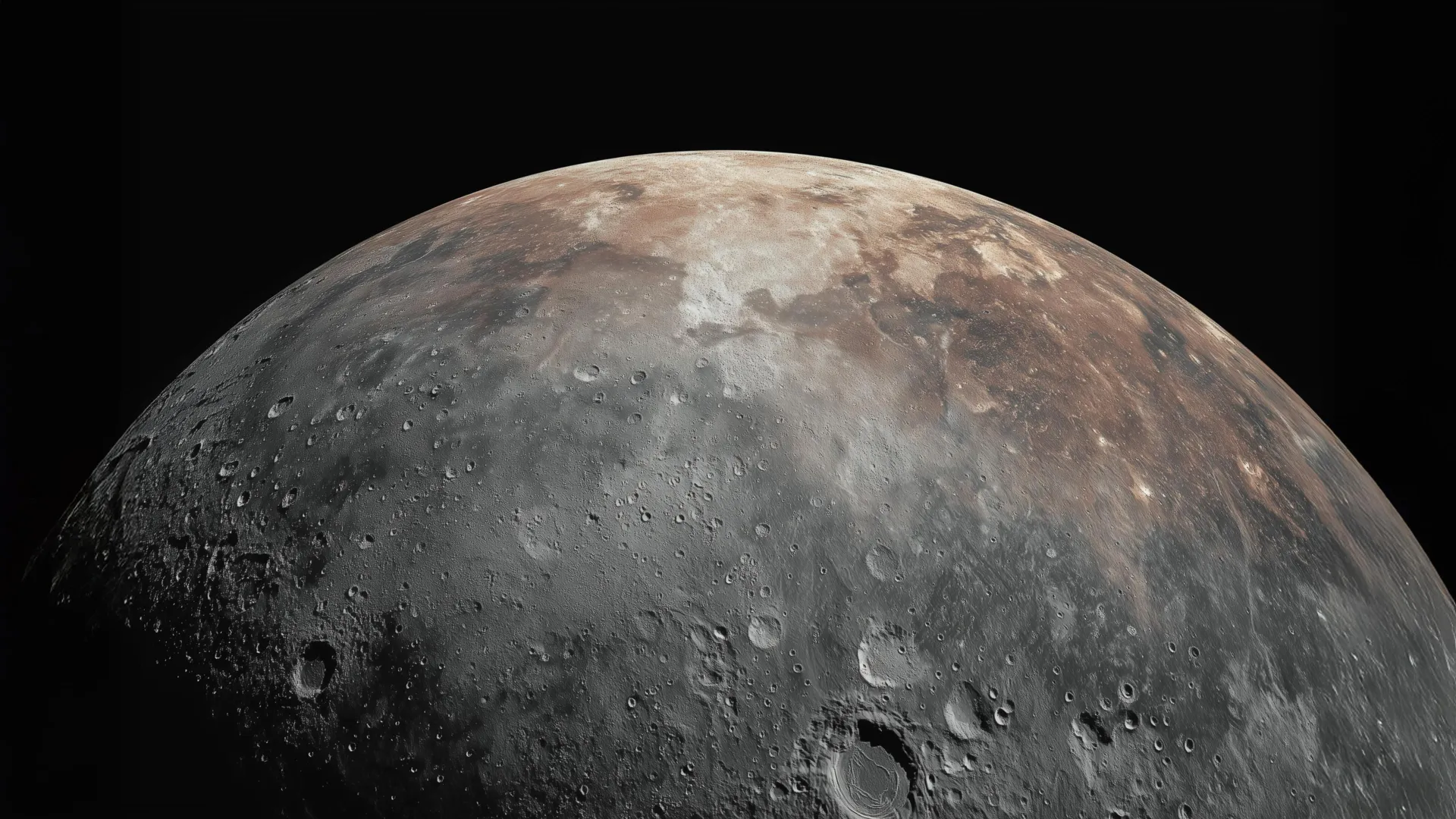
An international team led by former MPIA (Max Planck Institute for Astronomy, Heidelberg, Germany) PhD student Sebastian Zieba (Center for Astrophysics | Harvard & Smithsonian, Cambridge, USA) and MPIA Director and Principal Investigator Laura Kreidberg investigated the surface composition of rocks using MIRI (Mid-Infrared Imaging Instrument) aboard the James Webb Space Telescope (JWST). Exoplanet LHS 3844 b. This research goes beyond studying the atmosphere and focuses on the geology of planets orbiting other stars, providing deeper insight into their properties. The research results were published in a magazine natural astronomy.
LHS 3844 b is a rocky world about 30% larger than Earth that orbits a cold red dwarf star in just under 11 hours. It is very close to its star, orbiting only about 3 star diameters above its surface. The planet is tidally locked, meaning one side permanently faces the star and the other side is in darkness. Average daytime temperatures reach around 1000 Kelvin (about 725 degrees Celsius or 1340 degrees Fahrenheit). This system is relatively close to Earth, at a distance of 48.5 light years (14.9 parsecs).
“Thanks to JWST’s incredible sensitivity, we can detect light coming directly from the surface of this distant rocky planet. We see a dark, hot, barren rock with no atmosphere,” said MPIA’s Laura Kreidberg.
Its dark appearance suggests it may resemble a magnified version of the Moon or Mercury. This conclusion is reached by analyzing the infrared radiation emitted by Earth’s hot daytime. Scientists cannot directly image planets. Instead, it measures subtle changes in brightness from a combination of light as the star and orbiting planet move.
MIRI investigated infrared radiation in the 5-12 micrometer range by splitting the light into smaller wavelength intervals and measuring the intensity of each. This process creates a rainbow-like spectrum that reveals how light is distributed into different wavelengths. Previous observations with the Spitzer Space Telescope provided additional data that strengthened the analysis.
Elimination of Earth-like crust
The study of the geology of exoplanets is based on knowledge gained from the study of Earth and other rocky bodies in the solar system. The researchers compared their observations to computer models and a library of known rocks and minerals from Earth, the Moon, and Mars. These comparisons showed that LHS 3844 b does not have an Earth-like crust that is typically rich in silicate minerals like granite.
This discovery is not unexpected, as Earth is unique in the solar system in having such a crust. Still, it provides clues about Earth’s past. On Earth, a silicate-rich crust is formed through long-term processes associated with tectonic activity, often requiring water. Rocks melt and recycle, and lighter materials rise to form the Earth’s crust.
“The absence of such a silicate crust on LHS 3844 b may lead some to conclude that Earth-like plate tectonics is not applicable or effective for this planet,” says Sebastian Ziva. “This planet probably contains almost nothing but water.”
basalt-rich surface
The data shows a surface made of basalt- and mantle-like rocks, similar to the volcanic materials found on Earth and the Moon, instead of granite-like materials. The researchers performed detailed statistical comparisons between the observed spectra and various possible mixtures of minerals.
They found that large areas of solid basalt or magmatic rock best matched the data. These rocks are rich in magnesium and iron, and may also contain minerals such as olivine. Broken rock fragments such as gravel are also reasonably compatible, but fine powder and dust alone do not match observations due to their bright appearance.
Without a protective atmosphere, the planet is constantly exposed to strong radiation from stars and meteorite impacts. These processes gradually destroy the rock and change its surface.
“It turns out that these processes don’t just slowly dissolve hard rocks to produce regolith, a layer of fine particles and powder that we see on the Moon,” Ziva explains. “They also add iron and carbon to darken the layer, making the properties of the regolith more consistent with observations.”
fresh lava or ancient dust
The data support two possible explanations for the planet’s surface. One scenario suggests a landscape dominated by relatively young, hard basaltic rocks. In this case, recent geological activity, such as widespread volcanism, may have brought the planet back to the surface.
The second scenario also involves a dark surface, but this one was formed by long-term exposure to space. Over time, weathering will form extensive layers of dark regolith, similar to the dusty surfaces seen on the Moon and Mercury. This interpretation means that the planet has been geologically inactive for a long period of time.
Look for signs of activity
The difference between these two possibilities is primarily whether the planet is still geologically active. On Earth and other active worlds, volcanic activity releases gases into the surrounding environment. One such gas is sulfur dioxide (SO2), which is commonly associated with volcanic activity.
If LHS 3844 b were currently active, MIRI could have detected this gas. However, no such signal was found. This absence suggests that recent volcanic activity is unlikely, making the scenario of a weathered, inactive surface more likely. If correct, this planet could be very similar to Mercury.
To answer this question, the team is conducting further observations with JWST. These new measurements aim to detect subtle differences in the way solid rocks and loose materials emit and reflect light. The way light is emitted at different angles depends on the texture of the surface, whether it’s a smooth rock or a rough, powdery material. This method has already been used successfully to study asteroids in the solar system.
“We are confident that the same technique will allow us to reveal the properties of LHS 3844 b’s crust, and in the future, the properties of other rocky exoplanets,” Kreidberg concludes.
Additional Information
Laura Kreidberg was the only MPIA astronomer involved in this study.
Other researchers are: Sebastian Zieba (Center for Astrophysics | Harvard University & Smithsonian University, Cambridge, USA), Brandon P. Coy (Department of Geophysical Sciences, University of Chicago, USA), Aaron Bello-Arufe (Jet Propulsion Laboratory (JPL), California Institute of Technology, Pasadena, USA), Kimberly Paragas (Department of Geology and Planetary Sciences, California Institute of Technology, Pasadena, USA), Xintong Lyu (Peking University, Beijing, China, USA), Renyu Hu (Pennsylvania State University, University Park, USA and JPL), Aishwarya Iyer (NASA Goddard Space Flight Center, Greenbelt, USA), Kay Wohlfarth (Dortmund University of Technology, Germany)
The JWST observations used in this study were carried out as part of GO program #1846 (Principal Investigator: Laura Kreidberg, Co-Principal Investigator: Renyu Hu) entitled “Exploring volcanic activity and geodynamic features on the hot rocky exoplanet LHS 3844 b”.
The MIRI consortium is made up of the ESA (European Space Agency) member states: Belgium, Denmark, France, Germany, Ireland, the Netherlands, Spain, Sweden, Switzerland, and the United Kingdom. National scientific organizations are funding the consortium’s activities. In Germany, it is funded by the Max Planck Society (MPG) and the German Aerospace Center (DLR). Participating German institutions include the Max Planck Institute for Astronomy in Heidelberg, the University of Cologne, and Hensoldt AG (formerly Carl Zeiss Optronics) in Oberkochen.
The James Webb Space Telescope is the world’s premier observatory for space research. This is an international program led by NASA and its partners ESA and CSA (Canadian Space Agency).
The Spitzer Space Telescope was operated by the Jet Propulsion Laboratory at the California Institute of Technology under contract with NASA.
