

Close Menu

    Subscribe to Updates

    Get the latest creative news from FooBar about art, design and business.

    What's Hot

    Scientists may have finally discovered how Alzheimer’s disease spreads to the brain

    June 30, 2026

    Delhi plans to ban petrol rickshaws and scooters to cut toxic fumes | India

    June 30, 2026

    Researchers discover new species of beetle hiding right next to their lab

    June 30, 2026
    Facebook X (Twitter) Instagram
    Facebook X (Twitter) Instagram
    Health Magazine
    • Home
    • Environmental Health
    • Health Technology
    • Medical Research
    • Mental Health
    • Nutrition Science
    • Pharma
    • Public Health
    • Discover
      • Daily Health Tips
      • Financial Health & Stability
      • Holistic Health & Wellness
      • Mental Health
      • Nutrition & Dietary Trends
      • Professional & Personal Growth
    • Our Mission
    Health Magazine
    Home » News » This exotic particle may finally explain why matter has mass
    Nutrition Science

    This exotic particle may finally explain why matter has mass

    healthadminBy healthadminApril 25, 2026No Comments4 Mins Read
    This exotic particle may finally explain why matter has mass
    Share
    Facebook Twitter Reddit Telegram Pinterest Email


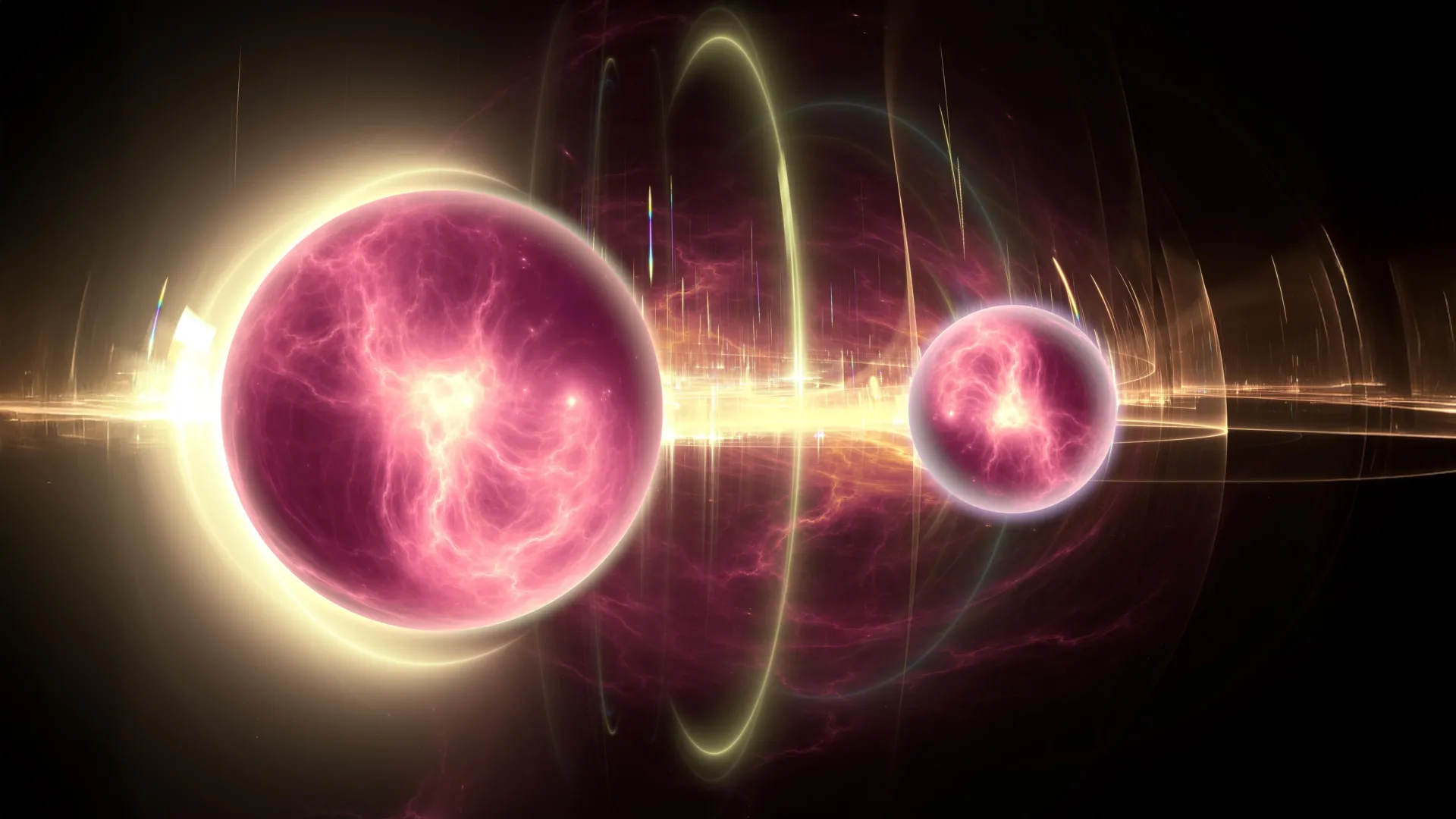
    Everything around us has mass, but its origin remains one of physics’ biggest unsolved questions. According to modern theory, mass does not simply arise from matter itself. Instead, it is connected to the nature of a vacuum, not an empty space but a dynamic environment with a complex structure. Studying special particle systems can help scientists better understand this hidden framework and how mass is generated.

    One promising approach involves mesons, particles consisting of quarks and antiquarks bound to an atomic nucleus. This combination is known as a mesic nucleus. By studying these systems, researchers can study the structure of the vacuum and the mechanisms that give mass to particles. Now, new experimental results have uncovered evidence for an entirely new type of mesic nucleus, bringing scientists closer to that goal.

    Evidence of rare and exotic particle states

    An international research team has reported the signature of a never-before-seen, theoretically predicted state called an η’mesic nucleus. Their findings, to be published in Physical Review Letters, indicate that this unusual binding system may exist.

    Under certain conditions, short-lived particles known as mesons (which exist for less than 1/10 millionth of a second) can become temporarily trapped within an atomic nucleus. When this happens, a rare and exotic condition is formed. Studying these mesic nuclei helps scientists understand how the strong nuclear force behaves and how the vacuum changes in extremely dense environments.

    “One particularly interesting particle is the η’ meson,” says senior author Kenta Itabashi. “Because it is unusually heavy compared to related particles, physicists expect its mass to change when it resides in nuclear material. Observation of this phenomenon could provide valuable information about how particle mass is generated in the universe.”

    High-precision experiments inside particle accelerators

    To search for η’-mesic nuclei, the research team conducted high-precision experiments at the GSI Helmholtzzentrum für Schwerionenforschung in Germany.

    The researchers aimed a beam of high-energy protons at a carbon target. This process excited the carbon nucleus and produced η’ mesons, which in some cases became attached to the nucleus. To study these interactions, the researchers measured the excitation energy of carbon nuclei by analyzing deuterons, the simplest atomic nuclei consisting of one proton and one neutron, released during the reaction. These measurements were made using a high-resolution spectrometer called a fragment separator (FRS).

    The experiment also relied on a special detector known as WASA, originally developed in Uppsala, Sweden. The device allowed scientists to detect high-energy protons leaving their target and identify a signal indicating that η’ mesons were produced and trapped within the nucleus. These signals, known as decay signatures, were important for identifying exotic conditions.

    “Using a new experimental setup that combines FRS and WASA, we are able to identify structures in our data that are consistent with the theoretical features of η’-mesic nuclei,” explains lead author Ryohei Sekiya. “Our analysis suggests that these bound states did indeed form.”

    What the results reveal about mass

    The experimentally measured excitation spectra of carbon nuclei show a pattern consistent with the formation of η’-mesic nuclei. This result also suggests that if the η’ meson is inside the nuclear material, its mass may decrease. This finding supports theoretical predictions and provides valuable experimental insight into how particle properties change under extreme conditions.

    “Our measurements provide important new clues about how mesons behave in nuclear material,” Itabashi says. “This brings us closer to answering deep, fundamental questions about how matter acquires mass and how the vacuum structure inside the nucleus changes.”

    what happens next

    The research team plans to perform further experiments to improve the accuracy of their measurements and look for additional decay signals that could confirm the presence of η’mesic nuclei. Each new result helps further our understanding of the fundamental laws governing matter and the universe.

    The paper “Excitation spectrum of 12C(p,d) reaction near the η’ meson emission threshold measured simultaneously with high-momentum protons” is physical review letter.


    Source link

    Visited 5 times, 1 visit(s) today
    Share. Facebook Twitter Pinterest LinkedIn Telegram Reddit Email
    Previous ArticleThe constant beating of the heart inhibits the growth of tumors within heart tissue
    Next Article Ultra-processed foods are associated with measurable reductions in human attention span
    healthadmin

    Related Posts

    Scientists may have finally discovered how Alzheimer’s disease spreads to the brain

    June 30, 2026

    Researchers discover new species of beetle hiding right next to their lab

    June 30, 2026

    Scientists say creatine may help fight depression

    June 30, 2026

    Giant asteroid hits North Sea, causing 330-foot-high tsunami

    June 30, 2026

    Why are scientists worried they’re missing evidence of extraterrestrial life?

    June 30, 2026

    Millions of stars exploding may soon reveal the secrets of dark energy

    June 29, 2026
    Add A Comment

    Comments are closed.

    Categories

    • Daily Health Tips
    • Discover
    • Environmental Health
    • Exercise & Fitness
    • Featured
    • Featured Videos
    • Financial Health & Stability
    • Fitness
    • Fitness Updates
    • Health
    • Health Technology
    • Healthy Aging
    • Healthy Living
    • Holistic Healing
    • Holistic Health & Wellness
    • Medical Research
    • Medical Research & Insights
    • Mental Health
    • Mental Wellness
    • Natural Remedies
    • New Workouts
    • Nutrition
    • Nutrition & Dietary Trends
    • Nutrition & Superfoods
    • Nutrition Science
    • Pharma
    • Preventive Healthcare
    • Professional & Personal Growth
    • Public Health
    • Public Health & Awareness
    • Selected
    • Sleep & Recovery
    • Top Programs
    • Weight Management
    • Workouts
    Popular Posts
    • 1773313737_bacteria_-_Sebastian_Kaulitzki_46826fb7971649bfaca04a9b4cef3309-620x480.jpgHow Sino Biological ProPure™ redefines ultra-low… March 12, 2026
    • pexels-david-bartus-442116The food industry needs to act now to cut greenhouse… January 2, 2022
    • 1773729862_TagImage-3347-458389964760995353448-620x480.jpgDespite safety concerns, parents underestimate the… March 17, 2026
    • 1773209206_futuristic_techno_design_on_background_of_supercomputer_data_center_-_Image_-_Timofeev_Vladimir_M1_4.jpegMulti-agent AI systems outperform single models… March 11, 2026
    • 1774403998_image_28620e4b6b0047f7ab9154b41d739db1-620x480.jpgGait pattern helps distinguish between Lewy body… March 24, 2026
    • Leukemia-620x480.jpgBiomimetic platform powers CAR T therapy for… March 9, 2026

    Demo
    Stay In Touch
    • Facebook
    • Twitter
    • Pinterest
    • Instagram
    • YouTube
    • Vimeo
    Don't Miss

    Scientists may have finally discovered how Alzheimer’s disease spreads to the brain

    By healthadminJune 30, 2026

    Alzheimer’s disease is characterized by the buildup of a toxic protein called tau that damages…

    Delhi plans to ban petrol rickshaws and scooters to cut toxic fumes | India

    June 30, 2026

    Researchers discover new species of beetle hiding right next to their lab

    June 30, 2026

    Scientists say creatine may help fight depression

    June 30, 2026

    Subscribe to Updates

    Get the latest creative news from SmartMag about art & design.

    HealthxMagazine
    HealthxMagazine

    At HealthX Magazine, we are dedicated to empowering entrepreneurs, doctors, chiropractors, healthcare professionals, personal trainers, executives, thought leaders, and anyone striving for optimal health.

    Our Picks

    Scientists say creatine may help fight depression

    June 30, 2026

    Review assesses effectiveness of creatine as add-on therapy for depression

    June 30, 2026

    New diagnostic tool bypasses blood-brain barrier to detect autism early

    June 30, 2026
    New Comments
      Facebook X (Twitter) Instagram Pinterest
      • Home
      • Privacy Policy
      • Our Mission
      © 2026 ThemeSphere. Designed by ThemeSphere.

      Type above and press Enter to search. Press Esc to cancel.