


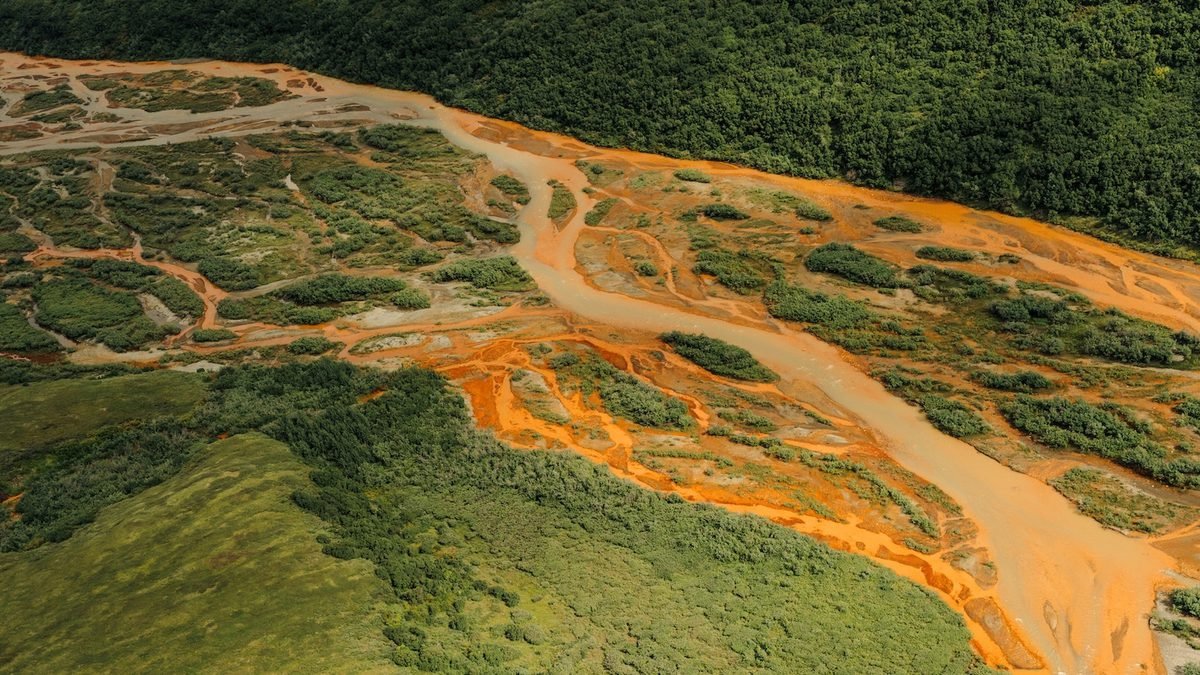
When ecologist Patrick Sullivan flew to Alaska’s Salmon River to conduct a vegetation survey in the summer of 2019, he was excited to paddle a pristine arctic river. But before he and his colleagues got there, the pilot warned them that they might not see what John McPhee described in his best-selling book, Coming Into the Country, as “the purest water I’ve ever seen.”
Even then, Sullivan was unprepared for the river that would eventually come into view. As far as the eye could see, the water was a bright orange color. Later research revealed that it was too toxic for fish and most other aquatic life and coastal plants to survive.
“I was in shock,” Sullivan recalled. “Pilots told us that (the river) was clear the previous year, and we have photographic evidence that it was clear in 2017.”
Until relatively recently, rivers polluted by the oxidation of iron and other heavy metals were found scattered on a small scale throughout the Circumpolar world. But over the past decade, the number of rusted and yellowed rivers has increased dramatically, and researchers are racing to understand where, when and how the phenomenon is affecting fish, other wildlife and the drinking water that indigenous peoples depend on, and whether its spread across the Arctic will ever come to an end.
pH levels in some rivers in Alaska and northern Canada have fallen to 2.3, comparable to the acidity of vinegar.
What scientists do know is that the chemistry behind this rust is closely related to climate-induced permafrost thaw, increased precipitation, also caused by global warming, and the landslides and subsidence caused by these effects.
Subscribe to the E360 Newsletter to receive weekly updates delivered to your inbox. sign up.
Since at least 2019, rust and other similar river discolorations have spread to more than 200 rivers in Alaska, a growing number of rivers in the Yukon and Northwest Territories, and as far north as the Arctic Islands. pH levels in some rivers have fallen to 2.3, comparable to the acidity of vinegar.
No one realized what was happening until 2018, when national park ecologist Jonathan O’Donnell arrived to collect fish and biological samples from the Akilik River in Alaska’s Kobuk Valley National Park. That’s when he and his colleagues noticed that the river had turned orange compared to the clear water they had seen the previous year. He and Brett Poulin, an assistant professor in the Department of Environmental Toxicology at the University of California, Davis, began sampling streams in Alaska’s Brooks Range in 2022 and found that stream discoloration at 75 locations was associated with dramatic declines in aquatic invertebrate diversity and fish populations. For example, in the tributaries of the Akiliku River, juvenile fish such as dolly varden char and slimy sculpin have disappeared.
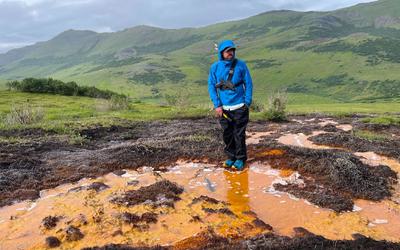
Ecologist Patrick Sullivan studies acid leaching in Alaska’s Kobuk Valley National Park in 2023.
Roman Dial / Alaska Pacific University
They suggest in their research report that these findings have significant implications for drinking water supplies and subsistence fishing in rural Alaska. Although not yet documented, there are concerns that this rusting, combined with rising water temperatures that would be deadly to the cold-water species, may have contributed to the collapse of the region’s Chinook salmon fishery. The situation was so dire that in 2024 Alaska fisheries managers and Canadian First Nations signed an agreement closing all salmon fishing in the Yukon River for seven years.
It didn’t take much research to figure out what was going on.
Rust comes from iron sulfide minerals buried in the shale bedrock of permafrost. These minerals were formed in ancient times in the Arctic when molten iron reacted with hydrogen sulfide gas released from volcanoes. Like the carbon trapped in permafrost, minerals and metals within permafrost remain inert unless exposed to weathering by water, oxygen, and bacterial activity.
But when the permafrost thaws, oxygen seeps in and groundwater begins to flow in a different direction. When the dormant bacteria awaken, they begin to oxidize the sulfide minerals, converting them to dissolved iron and sulfate, producing sulfuric acid. Acidified water often has an orange color due to iron leaching.
In Alaska, the latest satellite images show affected rivers extending over 600 miles wide.
As the climate warms, many parts of the Arctic are getting more rain and snow. And as more rain falls and more snow melts, the permafrost underlying much of the Arctic and sub-Arctic regions is thawing faster. The melting is buckling roads and buildings, causing landslides, draining lakes and clogging rivers with mineral and wood debris.
Rain falls on the North Pole, setting off a chain of alarming changes. read more.
In Alaska, the latest satellite images show that affected rivers are now more than 600 miles wide, said Abagael Pruitt, a researcher in the Department of Environmental Toxicology at the University of California, Davis, who works with O’Donnell and the National Park Service to study the effects of permafrost thaw.
Canadian scientists have discovered rusting in the Peel and Mackenzie River basins of the Yukon Territory and the Northwest Territories. Benoît Turcotte, a hydrologist with the Yukon Geological Survey, stumbled upon this phenomenon in recent years while conducting erosion studies along the Ogilvie and East Blackstone rivers in the Peel River basin. Peel flows into the Mackenzie River, Canada’s longest river.
“Several other streams in the area have recently turned milky and have orange sediments on the channel bed, which appears to have significantly altered aquatic habitat,” he said. “This slime contained bubbles that resembled hundreds of aquatic eyes that stared at us as we walked. I’m no biologist, but it was hard to imagine anything living in that water.”

Chu Tsuen Dek, a rust-colored river in Canada’s Yukon Territory.
Benoit Turcotte / Yukon Geological Survey
The changes are an unwelcome development for Indigenous leaders and conservationists who have spent two decades successfully blocking mining in the Peel River Basin. Many of the rivers in the Peel River Basin are among the most pristine rivers in the world.
Rust in northern Canada is spreading so rapidly that scientists at the University of Alberta and Carleton University in Ontario are scrambling to publish research papers and consult First Nations communities before speaking publicly about their findings.
Geological Survey of Canada scientists Stephen Grasby, Rod Smith and colleagues recently published a paper describing observations in groundwater and surface water draining from the Smoking Hills east of the Mackenzie River. There, organic-rich shale has been spontaneously combusting for thousands of years. Heat from smoldering rocks has long contributed to the natural processes of local subsidence and permafrost thaw, but warming-related wildfires and heavy rains in the region now appear to have thrown this process into overdrive.
“It’s humbling to learn how nature produces some of the most toxic acidic water you can find anywhere,” says the scientist.
Six years after visiting in 2017, Grasby said he was shocked at how quickly the landscape had changed. He and his colleagues noticed that the water draining from some locations was too acidic to be measured with a pH meter. The optimal pH range for drinking water is 6.5 to 8.5. His samples registered in the negative range. “It’s humbling to see how nature produces the most toxic acidic water you can find anywhere, which is far worse than anything humans can create at a mine site,” he says.
Grasby said water acidification, whether related to combustion or climate warming, is also releasing toxic heavy metals such as cadmium. In one case, his team found cadmium levels in water around the Smoking Hills to be 7,000 times higher than safe drinking water standards.
This is a serious concern, as numerous studies have already detected spikes in heavy metals, including cadmium, mercury, and selenium, in salmon, seabirds, caribou, beluga whales, polar bears, and other animals. Many scientists had assumed that much of it was coming from receding glaciers and ice sheets in areas such as the southwest coast of Greenland and Svalbard. Only recently has it been discovered that heavy metals are being transported to rivers and lakes by thawing permafrost. In a recent study, Canadian scientist Elliot Skiyashkan and his colleagues suggested that this kind of thaw “underscores the urgent need” for interdisciplinary research to better understand this emerging problem.
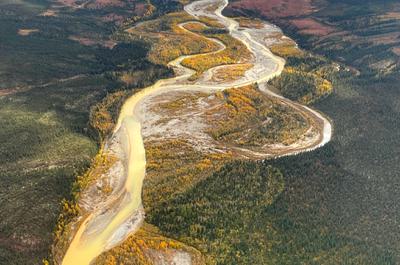
Alaska’s Salmon River turns orange in 2020.
Roman Dial / Alaska Pacific University
As water moves downstream and is diluted by other, cleaner sources, the river’s acidity and toxicity levels decrease, Grasby said. But researchers still found that drinking water drawn from the nearby Houghton River, which receives drainage from the Smoking Hills, exceeded levels considered safe. Fortunately, there are no communities along the Houghton River. However, this river is a popular route for canoeists in its natural setting.
Experts say the type of sinkholes Grasby and Smith are observing are increasing exponentially across the Arctic, and rivers with similar geological features are bound to become even more rusty.
Queen’s University scientists Melissa Lafniere and Scott Lamoureux have documented a similar scenario in two lakes at the Cape Bounty Arctic Divide Observatory research facility on Melville Island, Nunavut, in the highest reaches of the Arctic.
“What we saw was a significant change in sulfate in both East and West Lakes,” says Lafniere, who is working with graduate students to identify the source of the sulfate. “My hypothesis is that the oxidation of sulfide minerals and the oxidation of sulfide minerals that are made available by subsurface flow of groundwater associated with deep snowmelt in very warm years is similar to what causes river rust in the Yukon and Alaska.”
“This will have a major impact on fish and aquatic life, as well as the bears and raptors that feed on those fish.”
Twenty years ago, annual precipitation in the Arctic ranged from about 10 inches in the southern regions to just under 2 inches in the far north. But temperatures in the Arctic continue to rise up to four times faster than on the entire planet, and recent research suggests that melting sea ice and increasing open ocean will increase precipitation by up to 60 percent in the coming decades, with many places receiving more rain than snow. Most measurements come from a small number of boreholes, making it difficult to map and identify where permafrost is most susceptible to thaw. But University of Alberta geophysicist Keetash Moshtagian and his colleagues used airborne electromagnetic surveys across 56 sites in the central Mackenzie Valley. As described in their recent paper, they found that the depth and thickness of permafrost can vary even over short distances, depending on soil type, vegetation, surface water, and disturbances such as wildfires. They found that rivers, lakes, and even small ponds often form frozen corridors that disrupt the continuity of permafrost beneath the surface.
The United States, which seeks Greenland’s mineral resources, is faced with the harsh realities of the Arctic. read more.
Scientists say there isn’t much that can be done about rust other than protecting the areas most vulnerable to permafrost thaw from mining and other resource developments that disturb the land.
“If the sulfide minerals that aren’t weathered become oxidized, they may eventually disappear,” Sullivan said. “We don’t know. But until then, this could have a major impact on the safety of the fish and aquatic life, the bears and raptors that eat those fish, the plants that grow along these rivers, and even the water that people who live downstream drink.”
