


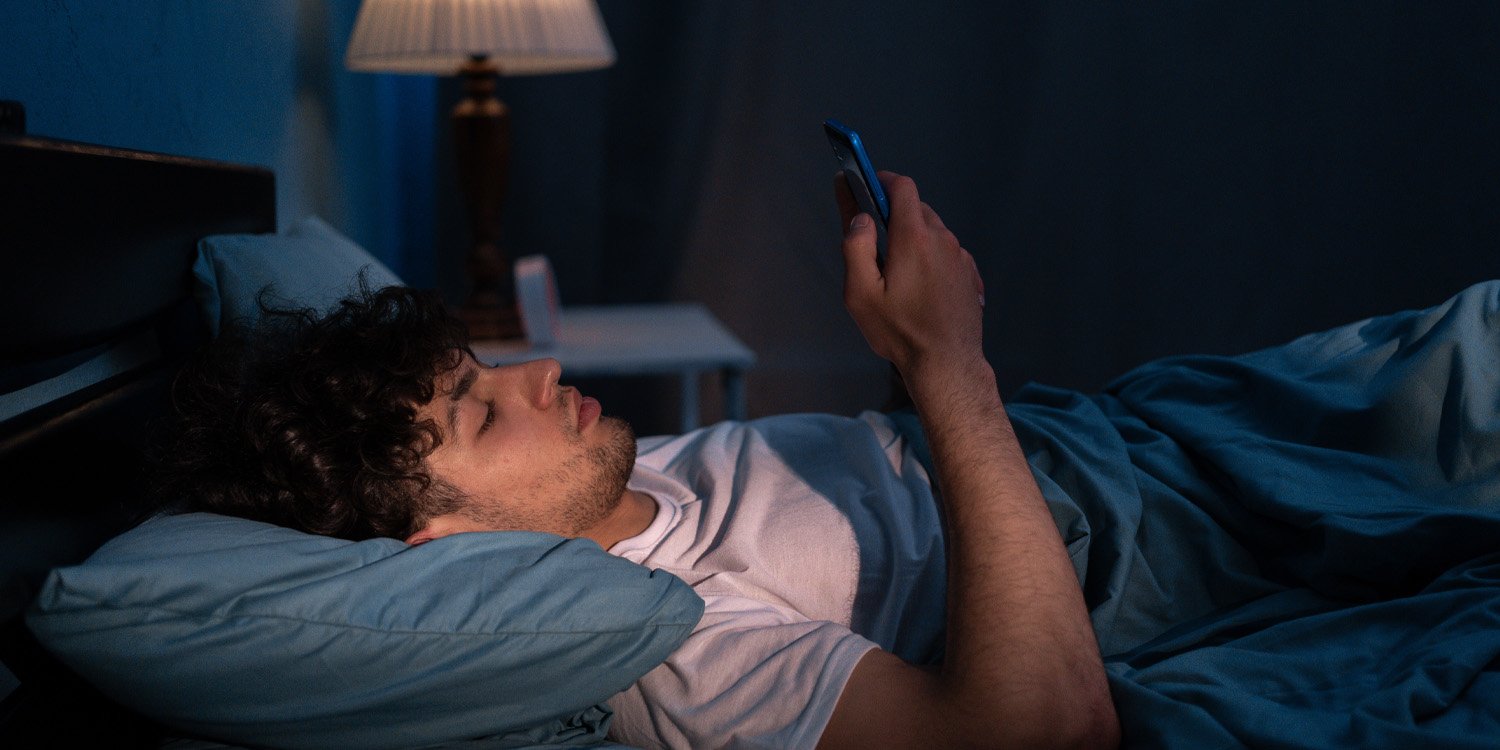
New research published in addictive behavior Studies suggest that struggling to control your social media habits can impair your sleep quality and negatively impact your mental health. This study provides evidence that screen time, which interferes with the night, tends to be a major pathway leading to symptoms of depression and anxiety. Protecting your sleep habits may be one of the most practical steps we can take to protect our mental health.
Previous studies examining the relationship between frequent social media use and mental health have yielded mixed results. Some studies suggest a clear association with later depression and anxiety, while others show that the association is weak or not significant at all.
Scientists have found that there is a gap in understanding exactly how these factors combine over time. When you endlessly scroll through apps late at night, the first thing you sacrifice is your sleep. However, the specific role of sleep in bridging the gap between digital habits and psychological distress remained untested over time.
“This study is part of a larger project entitled ‘Social media use, sleep and mental health: the eMediate study,'” said study author Oli Ahmed from the Department of Psychology at the University of Chittagong.
“This study was designed to address two issues: inconsistencies in existing evidence and real-world concerns about addictive social media use, referred to in this study as ‘problematic social media use’ (PSMU). Some longitudinal studies have found evidence for a relationship between PSMU and subsequent depression and anxiety symptoms, but no evidence as to how they are related. However, other studies have found no association between these factors.”
“Furthermore, there is no evidence of a relationship between PSMU and subsequent health outcomes. In this study, we wanted to understand whether there really is a link between these factors, and if so, how. Sleep is something people often sacrifice when using social media, but its role in the association between PSMU and mental health has not been tested over time.”
The sample included 437 young Bangladeshi social media users. The mean age of this group was 22.62 years, and 49.7 percent of participants were female. Participants completed four in-depth surveys over a nine-month period, three months apart. To keep the data accurate, the researchers excluded people who failed basic attention filter questions. The study used standardized psychological questionnaires to measure several specific aspects of participants’ lives.
First, the researchers assessed problematic social media use. This concept is defined as a compulsive urge to spend excessive time on social platforms in a way that disrupts daily life. The researchers also measured symptoms of depression and generalized anxiety.
To assess sleep, scientists looked at two different concepts: insomnia symptoms and overall sleep quality. Insomnia refers to a specific clinical difficulty falling asleep or staying asleep. Sleep quality is a broader measure of how rested a person feels, how long they sleep, and how often they wake up during the night.
Finally, the researchers measured overall psychological well-being. This concept reflects a person’s general sense of daily functioning, equanimity, and life satisfaction. The researchers then used a complex statistical model to examine how changes in one area predicted changes in another area over a nine-month period.
Researchers found that problematic social media use consistently predicted increased subsequent symptoms of depression and anxiety. Specifically, if individuals reported social media habits that were more difficult to control than their usual baseline, they were more likely to later develop symptoms of greater psychological distress. When comparing different populations, those with higher average usage also had higher average distress.
Researchers found that sleep deprivation acted as a mediator of this relationship. In scientific terminology, a mediator is an intermediate step or pathway that explains how one event causes another. The findings suggest that compulsive social media use leads to sleep deprivation, which in turn causes increased depression and anxiety.
Insomnia symptoms were found to be a stronger mediator than general sleep quality. This suggests that certain severe sleep disorders have a greater impact on poor mental health than simply having occasional sleepless nights. The researchers noted that delaying bedtime due to fear of missing out is likely to trigger a series of neurobiological changes associated with negative mood.
The study also revealed unique relationships regarding general psychological well-being. Problematic social media use, by itself, does not directly reduce a person’s overall well-being. Rather, it was associated with decreased well-being indirectly, entirely through the insomnia pathway. This indicates that sleep disruption is the main mechanism that deprives a person of a sense of general well-being.
“When you become psychologically involved in compulsive or hard-to-control social media use, sleep is probably one of the first things you suffer from,” Ahmed told Cypost. “This sleep disruption can contribute to depression, anxiety, and poor health. It’s not just screen time, but how that screen time impacts our nights. Protecting our sleep may be one of the most practical things we can do to protect our mental health.”
The scientists noted that the observed effects were small to moderate. This means that while a few late nights on your smartphone won’t immediately cause a mental health crisis, the cumulative effects over several months tend to be very significant. They were also surprised to find that digital habits differentially impact different areas of mental health.
“The relationship between PSMU and subsequent mental health is not the same for depression, anxiety, and well-being,” Ahmed explained. “PSMU was not directly associated with subsequent health outcomes; instead, this association was associated with increased symptoms of insomnia. This suggests that insomnia is a major pathway rather than just a contributing factor, particularly for health outcomes. In contrast, the associations with depression and anxiety were only partially contributed by insomnia and poor sleep quality, suggesting that other mechanisms are also at play.”
The data also revealed certain gender differences. Female social media users who exhibited high levels of compulsive use were found to be more vulnerable to declines in general well-being than male users. Researchers suggest this may occur because women typically spend more time on social media for interpersonal interactions, which may increase their exposure to negative comparisons and cyberbullying.
As with all research, there are some limitations. Because this study relies on observational data, it cannot conclusively prove absolute causality like a controlled laboratory experiment can. People who are already experiencing poor mental health may turn to their phones more often, creating a cycle that is further reinforced.
This study also has some specific limitations. The sample also consisted mainly of young people and students. This focus on demographics means that the findings may not fully apply to older adults or different occupational groups. Scientists looked at overall social media engagement without isolating data by specific apps. Scrolling through a short video on one platform can have different effects on your brain and sleep than texting a friend on another app.
“We would like to find out whether specific platforms differ in relation to sleep and mental health. Scrolling through TikTok before bed may not be the same as messaging on WhatsApp,” Ahmed said. “We are also interested in testing whether interventions targeting sleep (such as cognitive behavioral therapy for insomnia) can break the link between PSMU and poor mental health.”
“Although this did not result directly from this study, we would like to share the key findings from the large-scale eMediate research project. The associations between PSMU, sleep, and symptoms of anxiety and depression are mutually reinforcing. However, the associations between PSMU and well-being are not the same. Findings The results show that for some users who use social media to enhance positive emotions, increased happiness can lead to PSMU, which in turn leads to decreased happiness. More information on this can be found in the General Discussion section at the following link: https://hdl.handle.net/1885/733794665. ”
The study, “Longitudinal associations between problematic social media use and mental health: The mediating role of sleep,” was authored by Oli Ahmed, Amy Dowell, Erin I. Walsh, and Nicholas Sherbuin.
