


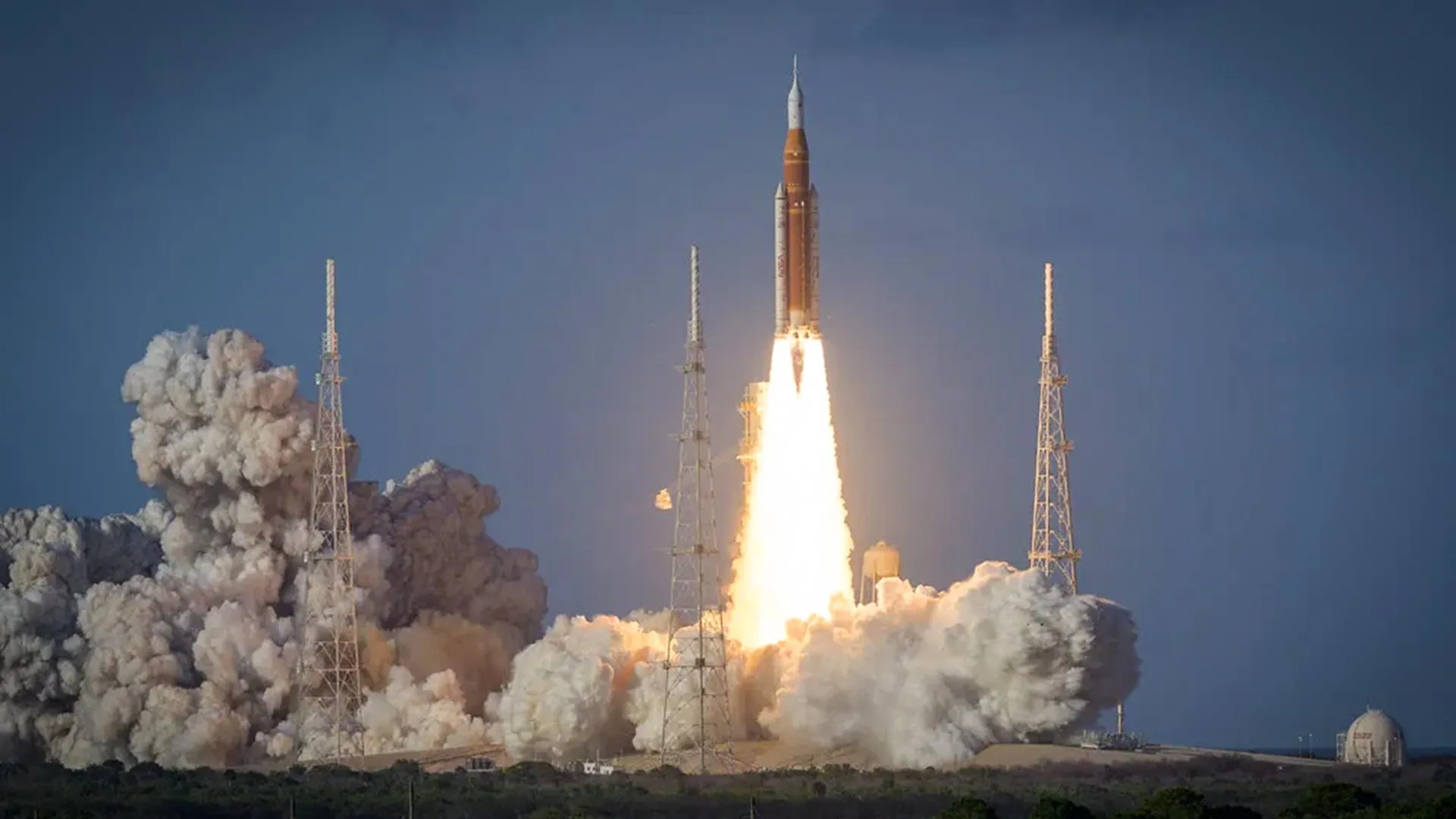
NASA launched the Artemis II mission, sending four astronauts into space for the first manned lunar orbit in more than 50 years. This mission marks a major step forward in human space exploration and signals a return to deep space beyond Earth’s orbit.
The agency’s Space Launch System (SLS) rocket lifted off from Launch Pad 39B at Kennedy Space Center in Florida on Wednesday, April 1, 2026 at 6:35 p.m. EDT. The crew embarked on a carefully planned test flight aboard the Orion spacecraft, orbiting the moon and returning to Earth.
“Today’s launch represents a defining moment for our country and everyone who believes in exploration. Artemis II builds on the vision set by President Donald J. Trump, returning humans to the Moon for the first time in more than 50 years, and opening the next chapter in lunar exploration beyond Apollo. Orion has four “Humanity’s greatest explorers are preparing for the first manned flight of this rocket and spacecraft. This is a true test mission that will take them farther and faster than any rocket will take humanity in a generation,” said NASA Administrator Jared Isaacman. “Artemis II is the beginning of something bigger than any mission. It marks our return to the Moon, not just to visit, but ultimately to stay at a lunar base, and lays the foundation for our next great leap forward.”
Artemis II crew and mission goals
The mission is scheduled to last approximately 10 days and will include NASA astronauts Reed Wiseman, Victor Glover, and Christina Koch, as well as CSA astronaut Jeremy Hansen. Artemis II, the first crewed mission in NASA’s Artemis program, is designed to carry astronauts and test key systems, establish a long-term human presence on the moon, and prepare for future missions aimed at ultimately traveling to Mars.
Shortly after reaching space, Orion deployed its solar array wings and began generating electricity from the sun. At the same time, the crew and ground teams began transitioning the spacecraft to normal flight operations while checking critical onboard systems.
“Artemis II is a test flight, and the testing has just begun,” said NASA Deputy Administrator Amit Kshatriya. “The team that built, repaired, and prepared this vehicle for flight gave our crew the machinery they needed to prove what it can do.” “For the next 10 days, Reed, Victor, Christina, and Jeremy will put Orion through its paces so that the following crew can confidently reach the moon’s surface. We are one mission in a long campaign, and the work ahead of us is more important than the work behind us.”
Orion’s journey from Earth orbit to the moon
About 49 minutes after liftoff, the rocket’s upper stage ignited, placing Orion in an elliptical orbit around Earth. The second burn will propel the spacecraft, named Integrity by its crew, into a high orbit some 46,000 miles above Earth. Once this maneuver is complete, Orion will separate from the rocket stage and continue its mission alone.
A few hours later, four CubeSats will be released from the upper stage. These small satellites were built by international partners including Argentina’s National Activities Commission, the German Aerospace Center, the Korean Aerospace Agency, and the Saudi Space Agency. These satellites will conduct scientific research and technology demonstrations.
The spacecraft will remain in high Earth orbit for about a day. During this time, astronauts will take manual control of Orion and test its maneuverability and performance. A team at NASA’s Johnson Space Center in Houston will continue to work closely with the crew to evaluate the onboard systems.
Lunar flight and return to Earth
If all systems work as expected, air traffic controllers will order Orion’s European service module to perform a menstrual ejection burn on Thursday, April 2nd. The burn lasts about six minutes and places the spacecraft on a path toward the moon. This orbit is designed to carry the crew around the moon and use its gravity to return the spacecraft to Earth.
During the lunar flight, scheduled for Monday, April 6, astronauts will spend several hours observing and photographing the moon. They would also be the first humans to see specific areas of the far side directly. Because the surface is only partially illuminated, long shadows are expected to highlight features that are difficult to see in full sunlight, such as ridges, slopes, and crater edges. The crew will also participate in scientific research, including human health research like AVATAR, to support future missions.
After completing the flyby, Orion will return to Earth and the crew will splash down in the Pacific Ocean.
Building for a long-term lunar existence
Artemis II is part of a broader effort to expand human exploration to the moon and beyond. NASA plans to carry out this mission with increasingly complex flights that will support scientific discovery, economic development and preparations to send astronauts to Mars.
The mission is the early stages of what NASA describes as a new era of innovation and exploration, aimed at establishing a permanent human presence on the moon and opening the door to deeper space travel.
