


Astrophysicists at Rutgers University are helping investigate a strange cosmic phenomenon that astronomers continue to search for answers to. At the heart of the mystery is an unusually powerful explosion in the universe that lasted much longer than anything previously observed.
NASA announced that researchers used the James Webb Space Telescope to study GRB 250702B, a long gamma-ray burst and one of the most energetic types of phenomena in the universe. These bursts typically occur when a massive star collapses into a black hole, producing a short, intense flash of high-energy gamma rays. This event behaved completely differently.
“This object exhibits extreme properties that are difficult to explain,” said Huey Sears, a postdoctoral fellow in the Department of Physics and Astronomy at Rutgers School of Arts and Sciences who studies explosions. “Usually such bursts last less than a minute, but GRB 250702B lasted for several hours and even showed signs of X-ray activity the previous day.”
Global observations reveal abnormal behavior
Sears explained that observatories around the world are analyzing data from this event. This includes teams working with China’s Einstein spacecraft and the National Science Foundation’s Super Large Array, widely known for its appearance in the science fiction film “Contact.”
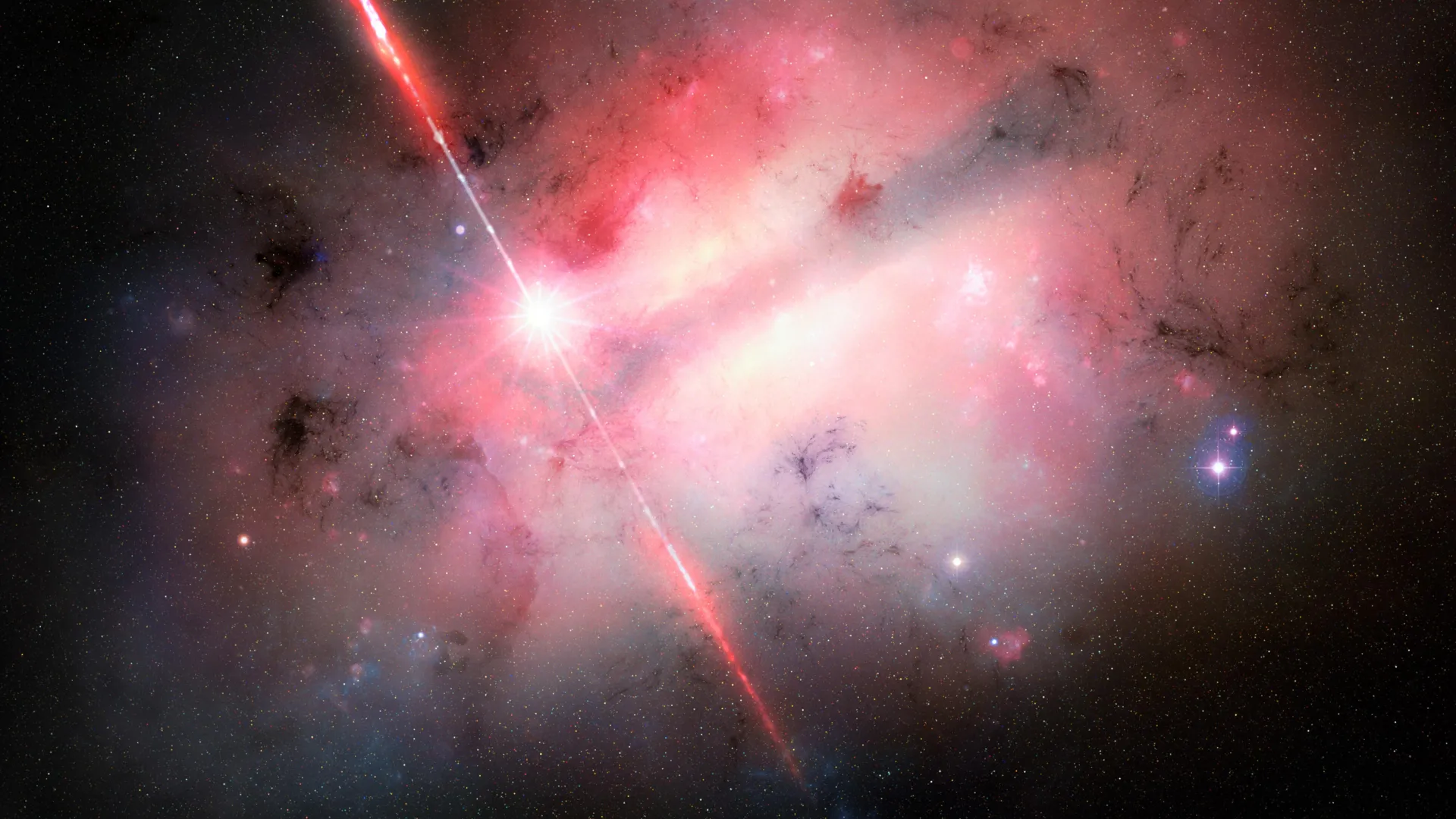
The gamma ray emission lasted for at least seven hours, almost twice as long as the previous record holder. NASA also released an animation showing one possible scenario for this event. In this model, a black hole with about three times the mass of the Sun and an event horizon just 11 miles (18 kilometers) wide orbits and merges with a companion star.
“This is certainly an explosion unlike anything we’ve seen in the last 50 years,” said Eliza Knights, an astronomer at NASA’s Goddard Space Flight Center in Maryland.
Possible explanations for black holes
Scientists are considering several explanations. One possibility is that this was an unusually extreme gamma-ray burst. Another possibility is that it was a tidal disruption phenomenon, in which a black hole thousands of times more massive than the Sun tore apart a star that got too close. A more unusual idea suggests that a smaller black hole merged with the stripped helium star and consumed it from within.
Regardless of the exact cause, the black hole did more than bite. It unleashed a powerful jet of energy across the universe.
Capturing events using multiple telescopes
NASA’s Fermi Gamma-ray Space Telescope first detected the burst on July 2, and other instruments quickly made follow-up observations. The event was so intense that no single telescope could capture the entire image. Scientists collected gamma-ray, X-ray, infrared, and radio signals and combined data from space and ground-based observatories. The explosion was not visible in normal light.
“Only through the combined power of instruments on board multiple spacecraft could we understand this event,” said Eric Burns, an astrophysicist at Louisiana State University.
Distant galaxies add mystery
Images from the Hubble Space Telescope reveal an unusual galaxy at the location of the outburst. Initially, it appeared as if two galaxies were merging, or as if one galaxy was being split by a dark dust band. Webb’s observations subsequently showed that the galaxy was about 8 billion light years away. This means that the explosion occurred long before the Earth was formed.
To better understand the central galaxy, Sears led follow-up observations using Webb’s NIRCam, the primary near-infrared imager, several months after the event.
“We see just one very large galaxy with a dust lane in such vibrant and unprecedented detail,” Sears said. “Galaxies have very complex structures, so it’s not 100% clear whether there are any traces of the explosion left behind, but if there are, they are very faint.”
the mystery remains unsolved
This discovery supports the idea that GRB 250702B was a gamma-ray burst rather than a tidal disruption event. Still, researchers have not reached a final conclusion.
“We’ve only seen a few tidal disruption events of this type, so we don’t know exactly how it will evolve,” Sears said. “Many studies of this explosion offer different and sometimes contradictory explanations. We are still in the early stages of understanding what actually happened.”
Whatever the final explanation, scientists agree that the event is rare and significant.
“This gives us a unique opportunity to study the extreme conditions of how stars and black holes evolve,” Sears said. “GRB 250702B may even be an unexpected new discovery.”
The Webb Telescope is also supported by the European Space Agency (ESA) and the Canadian Space Agency (CSA).
